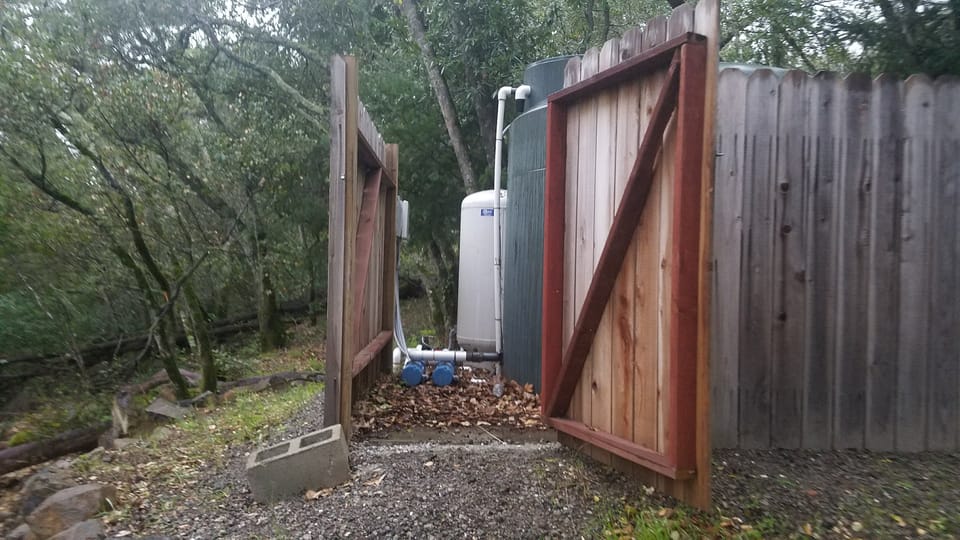
What size generator runs a well pump? Find yours in two steps
Size the generator for the start, not the run. Read the amps on your pump's breaker: 20 amps needs about a 2 kW generator, 30 amps about 4 kW, 40 amps about 5 kW. It must make 230 volts. Our view: have a pro wire it in. A transfer switch is a common way to do it.
Listen to this article
Read aloud by an AI voice.
Yes, a generator can run a home well pump. The catch is the start. A pump needs a burst of power to get spinning, far more than it uses once it is running. A generator sized only for the run may not start the pump.[1]
So size the generator for the start. The size of the pump's circuit breaker, the switch in your electrical panel that protects it, tells you how.
Some words first. Amps measure how much current a circuit carries. Volts measure its push. Watts (W) measure power, and a kilowatt (kW) is 1,000 watts. Generators are sized in kW. Hp is horsepower, the motor rating, and your pump's nameplate lists it.
Step 1: find your pump's breaker
- Open your electrical panel door, the gray box with the switches. It is often in the garage or a utility room. Open the door only. Do not take off any metal cover, touch wires or flip other breakers. If the panel is wet, rusty or buzzing, stop and call an electrician.
- Look for the switch labeled well, pump or water. A pump on 230 volts uses a double switch, two breakers joined together.
- Read the number printed on the handle. It is in amps, such as 20 or 30.
- No label? Do not guess. Ask your pump installer or an electrician which breaker feeds the pump.
The pump's own nameplate, the label on the pump or its control box, beats the breaker. A past owner may have changed the breaker.
Step 2: read across to the generator size
The chart pairs each breaker size with how much the pump uses while running and how big a generator it needs to start.
Our chart from Oakville Pump Service's figures for 230 volt home pumps.[1] Exceptions are in the table below. At 15 amps, buy 1,200 watts or more.
| Breaker | Pump size | Running | Generator |
|---|---|---|---|
| 15 amp | under ½ hp | about 700 W | 1.2 kW or more |
| 20 amp | under ¾ hp | about 1,100 W | 2 kW |
| 25 amp | 1 hp or smaller | about 1,400 W | 2.5 kW |
| 30 amp | under 2 hp | about 2,300 W | 4 kW (3 kW for a 1.5 hp pump) |
| 40 amp | under 3 hp | about 3,200 W | 5 kW |
| 50 amp | under 5 hp | about 5,300 W | 7.5 kW |
These figures assume a standard setup: a control box (the small box near the well), a pressure switch (it turns the pump on and off as pressure drops and rises) and a large pressure tank, the tank that keeps water pressure up in the house.[1] If your pump keeps constant pressure, or you are not sure what you have, ask your installer before you use this table.
- A 20 amp breaker can also feed a 1 horsepower pump. That pump needs 2.5 kW, not 2.[1] If you are unsure, use the nameplate or ask your installer.
- Size for the breaker, not the running number. Oakville Pump Service says to size the generator for the starting current, which the breaker reflects, and not the running current.[1] Our view: match the table to the generator's continuous (rated) kW. That is the power it can hold for hours. Brochures also list a higher surge or peak number that it can only hold for a moment. Do not use that one.
- A one horsepower pump uses about 1,400 watts, not 746. Pumps are rated by the work they do, and the electricity behind that work is more.[1]
- The pump company wants an internally regulated generator. That means built-in voltage regulation.[1] Our view: inverter generators, the quieter models that make steady power, usually have it. Ask the seller.
- The generator must make 230 volts. Many stores list this as 240 volts. The table above assumes a 230 volt pump, so a small generator with only ordinary 120 volt outlets will not do. Home Ready Sonoma, a local preparedness site, lists models in its backup power guide, with what each one can run.
How the generator connects
Our view: this is the part to leave to a pro. A pump is wired into the house, so a plug and an extension cord will not do.
- Use a professional installer. PG&E suggests a professional installer for a permanent generator connected to your house.[2] Our view: ask about a transfer switch, a device that moves your house from the power company to the generator and cannot do both at once. Your installer will tell you when to switch the main breaker off before the generator starts.
- Never backfeed. Backfeeding means sending generator power back into the power company's lines. PG&E says to make sure it does not happen.[2] Our view: never plug a generator into a wall outlet with a homemade cord, and never connect one to a house circuit without a transfer switch or similar device a pro installs. It can send power out to the street.
- Get the wiring inspected. PG&E says to have changes to your house wiring inspected by your city or county building department. Afterwards, tell PG&E about your backup system.[2]
Where to put it, and the fuel
- Outdoors, 20 feet from the house. Generator exhaust has carbon monoxide, a gas with no smell that can kill. Ready.gov says to keep generators and fuel outdoors, at least 20 feet from windows, doors and attached garages.[3] PG&E says a portable generator goes where its exhaust can vent, never indoors or in a garage.[2] Keep it dry, and let it cool before you refuel. Our view: also run working carbon monoxide alarms on every floor of the house.
- Keep fuel at least 50 feet from the well. The State Water Board says not to mix or store gasoline within 50 feet of a private domestic well. The well is the spot where the pipe comes out of the ground, the wellhead.[4] Our take: keep the generator and its gas tank well away from the well, and refuel only after it is off and cool, so a spill has no path to your groundwater or the creek.
- Two distances. Keep the generator 20 feet from the house. Keep fuel 50 feet from the well. Our view: if your well is within 50 feet of the house, keep spare fuel in a spot 50 feet from the well, and carry it to the generator only after the generator is off and cool.
What about a big battery?
A large battery pack with 230 volt output can run a pump too. Home Ready Sonoma's guide lists one with 4,096 watt-hours that makes 240 volts. Our view: with no fuel and no fumes, a battery is the gentler choice near a well.
- The hours matter. A watt-hour is one watt used for one hour. One hour of a 1,400 watt pump is 1,400 watt-hours. Our rule of thumb is that a battery gives about 85% of its label.
- Worked example. A 4,096 watt-hour battery gives about 3,480 watt-hours. A 1,400 watt pump could run about 2.5 hours on that. The pump usually runs only while water is in use or a tank is refilling.
- Ask the maker: can this battery start a pump of my size? The start needs more power than the run.
What it means for you
Our view. Run the pump in short bursts, not all day. Fill your storage tank or pressure tank, then shut the generator off.
- Find your pump's breaker this weekend and write the amps on the panel door.
- Use the table to find the generator size. A battery must also be able to start the pump.
- Ask an electrician about a transfer switch before the storms, not in them.
- Store fuel at least 50 feet from the wellhead.
- Set water aside too. See how a well owner gets ready for an outage.
Photos by Devan Hemmings unless noted.
Sources
- 1. Oakville Pump Service, How much power does my submersible well pump use? (March 2021)
- 2. PG&E, Backup Power Safety
- 3. Ready.gov, Power Outages
- 4. State Water Resources Control Board, GAMA Program, A Guide for Private Domestic Well Owners (June 2025)
Checked 2026-10-20. Rules and programs change. If something here is out of date, the source above wins. Spot an error? See our corrections policy.
Related reads
 Wells and groundwaterWell water testing in Sonoma County: what to test and how oftenIf you are on a private well, nobody tests your water but you. Test for bacteria twice a year and after any flood, and for nitrate and minerals like arsenic and manganese every five years. About 1 in 3 Sonoma County domestic wells on record sits in an area the state rates high risk.Updated Oct 18, 2026
 Wells and groundwaterWell test planner: what is due on your wellTell us when you last tested. We show what is due now, using Sonoma County Environmental Health's schedule.Updated Oct 11, 2026
 Wells and groundwaterCan your yard recharge groundwater? How much soaks in, and a soil testYes, a little. Rain that soaks deep can reach the water table and refill the groundwater wells pump. Paving sends it away instead: on mostly paved ground, about a fifth as much soaks deep as on natural ground (our math from California figures). Start with the 24-hour soak test below.Updated Oct 18, 2026