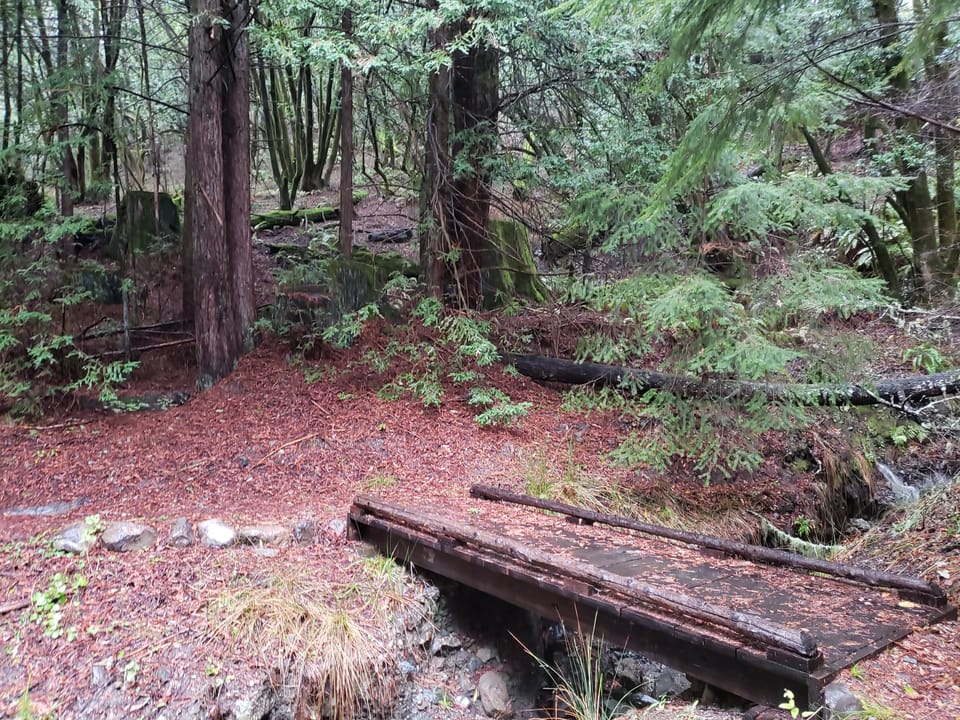
Rivers and pollutionGuide
Getting involved in your watershed: where to start in Sonoma County
Start with one drop-in volunteer day near home, then go back a second time. Type your address in our watershed finder below for the groups and the next event in your watershed.
Listen to this article
Read aloud by an AI voice.
Many of the people caring for Sonoma County's creeks aren't paid to.
We're new here too. So we went looking for who already does the work. Most would be glad to see a new face.
You don't have to do it all. Type your address for a short plan: one thing to show up to, one list to join, one meeting for later.
Find your watershed
- Type your address, or tap anywhere on the map.
- Your home area lights up, along with the path your rain takes to the sea.
- Tap a nearby watershed below the map to see the one over the ridge.
Type an address, or tap anywhere on the map.
Each area with a thin white outline is a subwatershed, the smallest kind. Darker gray lines group them into larger watersheds. Zoom in to see smaller creeks. Use the layers button at the top right of the map to switch to streets or a satellite view.
Coming up
- Tue Oct 20 · 9:30 a.m. to noonGarden stewards workday in a Petaluma demonstration gardenDaily Acts, La Tercera Park, PetalumaAdd to calendarDetails
- Wed Oct 21 · 10 a.m. to 4:30 p.m.Garden volunteer day at OAEC, every WednesdayOccidental Arts and Ecology Center, OccidentalAdd to calendarDetails
- Thu Oct 22 · 9 a.m.Sonoma Resource Conservation District board meetsSonoma Resource Conservation District, Santa Rosa and ZoomAdd to calendarDetails
- Sat Oct 24 · 8:45 to 11 a.m.Guerneville community cleanupRussian Riverkeeper, GuernevilleAdd to calendarDetails
Show 8 more
- Sat Oct 24 · 9:30 a.m. to 2 p.m.Planting day: lawn to water-wise garden at Casa Grande High SchoolDaily Acts and City of Petaluma, 333 Casa Grande Road, PetalumaAdd to calendarDetails
- Sun Oct 25 · 10 a.m. to 4 p.m.Autumn views at Pole Mountain (strenuous hike)Sonoma Land Trust, Meets at Monte Rio BeachAdd to calendarDetails
- Sat Oct 31 · 8:45 to 11 a.m.Geysers Road cleanupRussian Riverkeeper, Geysers RoadAdd to calendarDetails
- Sun Nov 1 · 9 to 11 a.m.Cloverdale Russian River cleanupRussian Riverkeeper, CloverdaleAdd to calendarDetails
- Tue Nov 3 · 5:30 to 7:30 p.m.Forestville Planning Association board meets, all welcomeForestville Planning Association, 6550 Railroad Ave, Forestville, and ZoomAdd to calendarDetails
- Fri Nov 6 · 9 a.m. to noonNative plant garden volunteer dayLaguna de Santa Rosa Foundation, Laguna Environmental Center, Santa RosaAdd to calendarDetails
- Sat Nov 7 · 8:45 to 11 a.m.Guerneville community cleanupRussian Riverkeeper, GuernevilleAdd to calendarDetails
- Sat Nov 7 · 9:30 a.m. to 2 p.m.Planting day: meadow and rain garden at the SRJC Petaluma campusDaily Acts, Santa Rosa Junior College Petaluma campus, 680 Sonoma Mountain Parkway, PetalumaAdd to calendarDetails
All dates are on the events page. Updated every night.
Start with one thing
- Show up once. Pick one drop-in day close to home. No membership, no commitment.
- Show up again. The second time, people remember your name. This is the step most people skip.
- Get on the list. Join that group's newsletter, so you hear about the next one.
- Sit in on one meeting. Conservation districts and many groups meet in public. You can just listen.
- Offer one skill. After a few visits, once you know what they need.
Stopping at step two or three still counts.
Why going back matters
Trust takes time together. A University of Kansas researcher found it takes roughly 40 to 60 hours with someone to become casual friends, and 80 to 100 to become friends.[1]
He also found that working side by side counts for less than time spent just talking. His advice: if you work together, go to lunch.[1]
So pick one group and keep going back. Stay for coffee after the cleanup.
What to say the first time
- "Hi, I'm new. What can I help with?"
- Ask a regular how long they've been coming, and what they wish more people knew.
- Find out when the next one is before you leave.
Pick your way in
Four ways in. Open the one that fits.
Get your hands dirtyDrop-in volunteer days
- Russian Riverkeeper cleanups: Guerneville about monthly, Cloverdale the first Sunday, Santa Rosa Creek the third Saturday. Sign up 48 hours ahead.[2] Calendar: Sat Oct 24Sign up
- Laguna Stewards: one Saturday a month, 9 am to 12:30 pm, September through May. Bilingual, no experience needed.[3] Calendar: Fri Nov 6Sign up
- OAEC garden volunteer day in Occidental: every Wednesday, 10 am to 4:30 pm. Walk-ins welcome.[4] Calendar: Wed Oct 21
- Sonoma Ecology Center: third-Friday workday and social, 9 am to noon, lunch provided.[5] Calendar: Fri Nov 20Sign up
- LandPaths: drop-in stewardship days on its preserves. Tools provided.[6] See their dates
- Friends of the Petaluma River: spring and fall river cleanups.[7] See their dates
- Daily Acts: free planting days and workshops on rain gardens, based in Petaluma. Calendar: Tue Oct 20Join their list
Listen inPublic meetings, in person or on Zoom
- Gold Ridge RCD board, for west county: third Thursday, 3:30 pm, Sebastopol and Zoom.[8] Calendar: Thu Nov 19Ask for notices
- Sonoma RCD board, for the rest of the county: fourth Thursday, 9 am, Santa Rosa and Zoom.[9] Calendar: Thu Oct 22Get the eNews
- Sonoma Water's Water Advisory Committee: first Monday, 9 am, in Santa Rosa. Its members are elected officials, but anyone can attend.[10] Calendar: Mon Nov 2Agendas
- The Russian River Watershed Network plans the river's climate future, project by project. Its meetings are on Zoom.[11] Calendar: Tue Nov 10Join the network
- Want a seat at the table? The Santa Rosa Plain and Sonoma Valley groundwater agencies pick advisory committee members every two years. This round closes October 30.[12] Apply
Start with your streetFire safe and neighborhood groups
Neighbors who know each other get out faster in a fire and help each other after.
- Fire Safe Sonoma's map shows every Firewise site, Fire Safe council, COPE and Map Your Neighborhood group in the county.[13] Open the map
- In west county, Safer West County connects you to your town's fire safe group. Pick your town when you sign up.[14] Sign up
- No group on your street? The county's neighborhood programs help you start one with 15 to 20 homes, and can fund neighborhood projects.[15] How to start one
Join your watershed's groupNeighbors caring for one creek
- Atascadero / Green Valley Watershed Council: Sebastopol, Graton and Forestville. Recently revived, with member field trips.[16] Contact them
- Friends of the Mark West Watershed: upper Mark West Creek. They say they'd welcome volunteers from downstream too.[17] Join their list
- Laguna de Santa Rosa Foundation: the Laguna and Santa Rosa's creeks. Calendar: Fri Nov 6Volunteer
- Sonoma Ecology Center: Sonoma Creek and the Sonoma Valley. Calendar: Fri Nov 20Volunteer
- Friends of the Petaluma River: the Petaluma River. Visit
No group where you live?
Many parts of the county don't have a watershed group, or had one that went quiet.
OAEC's free guide, Basins of Relations, walks through starting one.[18] The Map Your Neighborhood program is a smaller first step: 15 to 20 homes on one street.[15]
Or start by asking your conservation district. They know who's working on your creek.
We check every group on this page once a week. Something out of date, or a group we missed? Tell us.
Photos by Devan Hemmings unless noted.
Sources
- 1. University of Kansas, Study reveals number of hours it takes to make a friend (Jeffrey Hall, 2018)
- 2. Russian Riverkeeper, Events
- 3. Laguna de Santa Rosa Foundation, Laguna Stewards
- 4. Occidental Arts and Ecology Center, Events
- 5. Sonoma Ecology Center, Volunteer
- 6. LandPaths, Participate
- 7. Friends of the Petaluma River
- 8. Gold Ridge RCD, Board meeting documents
- 9. Sonoma RCD, Board meetings
- 10. Sonoma Water, Water Advisory Committee
- 11. Russian River Watershed Resilience, Watershed Network
- 12. Santa Rosa Plain Groundwater Sustainability Agency, Advisory committee application
- 13. Fire Safe Sonoma, Wildfire mitigation groups in Sonoma County
- 14. Safer West County, Fire Safe councils
- 15. Sonoma County Emergency Management, Neighborhood programs
- 16. Atascadero / Green Valley Watershed Council
- 17. Friends of the Mark West Watershed, About
- 18. Occidental Arts and Ecology Center, Publications (Basins of Relations)
Checked 2026-10-19. Rules and programs change. If something here is out of date, the source above wins. Spot an error? See our corrections policy.
Related reads
 Rivers and pollutionHow the Russian River works: dams, minimum flows and floodsTwo dams store winter rain and release it in summer. Sonoma Water draws the water from wells beside the river for over 600,000 people. The state sets how much must stay in the river.Updated Oct 18, 2026
 Rivers and pollutionOnly rain down the storm drainStorm drains carry water straight to the nearest creek. It is not treated. Only rain should go down them.Updated Oct 11, 2026
 Rivers and pollutionEl Niño and Sonoma County water: the river, the reservoirs and your rainNOAA says a strong to very strong El Niño is likely this winter, which tilts California toward a wet one. On the Russian River, strong El Niño winters brought a major flood at Guerneville in 3 of 9 cases since 1951, about twice the usual rate, but the worst floods came in other winters. Get ready for high water and plan to keep some of the rain.Updated Oct 18, 2026