Rivers and pollutionGuide
Where do storm drains go? Straight to the creek, with no treatment
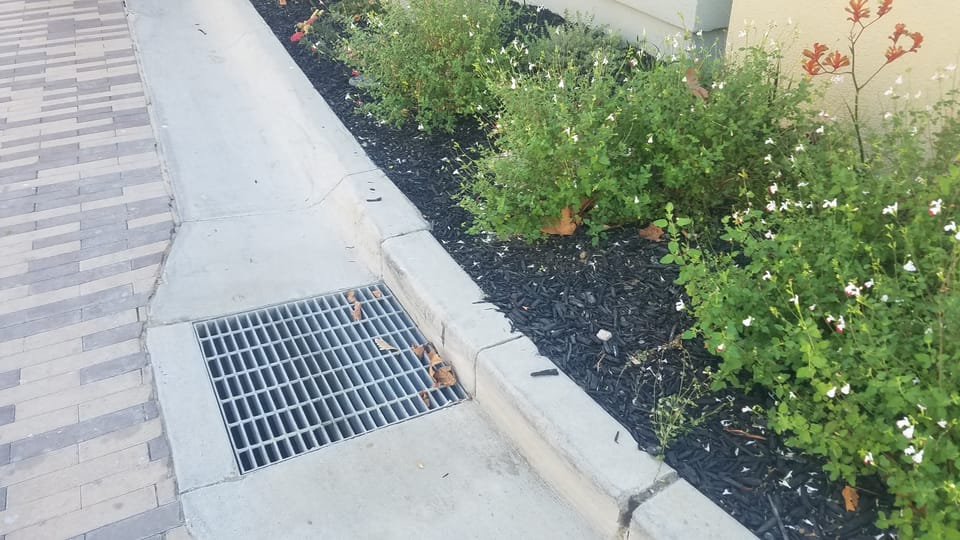
Storm drains carry rain from the street to the nearest creek, river or bay, with no treatment on the way. Anything else that goes down them, from soapy water to oil to leaves, ends up in that water too.
Listen to this article
Read aloud by an AI voice.
By our math, a one-inch rain on a 20 by 20 foot driveway sheds about 250 gallons, enough to fill four and a half 55-gallon drums. On many streets it runs to the curb and drops through a grate. That grate is the start of a pipe that ends in a creek.
Where does a storm drain go?
In most U.S. towns, two sets of pipes run under the street. One carries wastewater from sinks and toilets to a treatment plant. The other collects rain from street drains, driveways and parking lots and carries it to a local creek, river or bay.[1]
That second set of pipes cleans nothing. Whatever goes into the gutter flows into the creek as it is.[2]
Homes on septic send indoor water to their own tank in the yard instead of a sewer. More in where wastewater goes after you flush.
About 700 U.S. communities still have one combined pipe for both, which can overflow untreated sewage into rivers in heavy rain.[1]
What should never go down a storm drain?
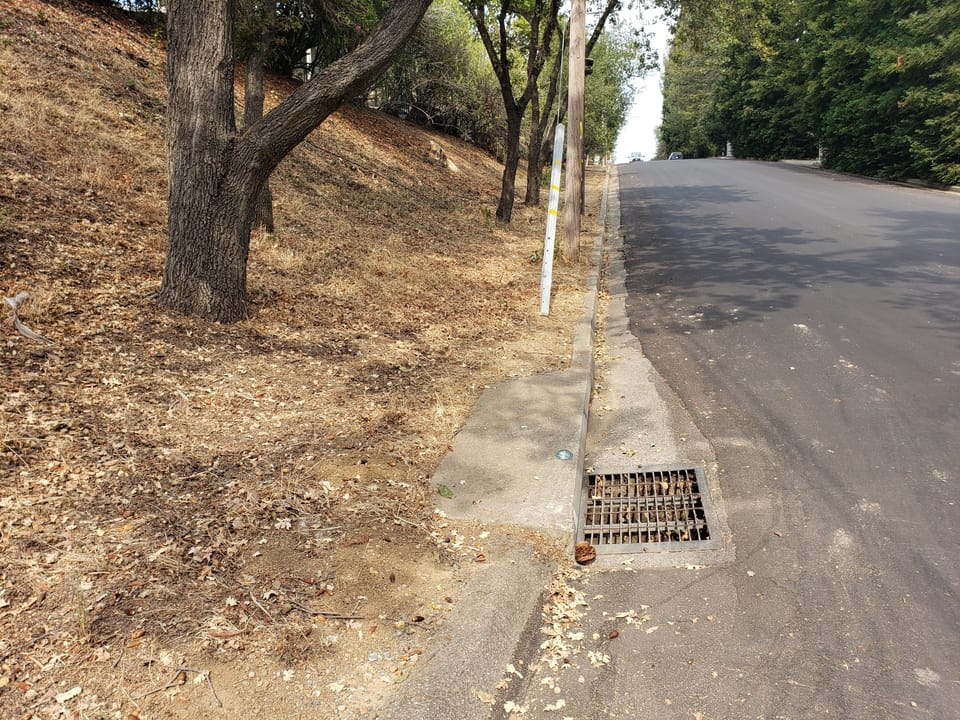
Rain carries whatever sits on pavement and yards to the drain.[3] Much of it comes from ordinary chores, each with an easy swap.
- Car wash water. Wash on the lawn or gravel so the soapy water soaks in.[2]
- Oil, antifreeze, paint and solvents. Take leftovers to a hazardous waste drop-off. Wipe up drips; don't hose them away.[2]
- Fertilizer, weed killer and bug spray. Use as little as you can and follow the label.[2] More in lawn care that keeps chemicals out of the creek.
- Leaves, grass clippings and pet waste. Keep them out of the gutter.[2][3] Compost the yard waste and bag the pet waste for the trash.
- Bare dirt. Mud from digging and grading counts too.[3] Cover it before rain (how to stop erosion on a slope).
Why even rain off a road can kill fish
Some of it comes from driving itself. For years, more than half the coho salmon coming back from the ocean to lay eggs in city creeks around Seattle died after storms, before they could spawn. In 2020, researchers found the main cause: a chemical from car tires called 6PPD-quinone, washed off roads by rain. They found it near Los Angeles and San Francisco too.[4]
A soil mix helps. In a 2015 study by NOAA and partners, runoff from a busy Seattle overpass killed every young coho in it within 12 hours. It often killed mayflies too, small water insects that young salmon eat. Filtered first through two feet of a sand, compost and bark mix, it killed none.[5]
Our take: the best place for rain off your roof and driveway is the ground on your own lot, where soil can filter some of what it carries.
In Sonoma County
- Where it goes. All outdoor drains, yard drains included, flow to the nearest creek, untreated.[3] In much of the county, those creeks run to the Russian River.[6]
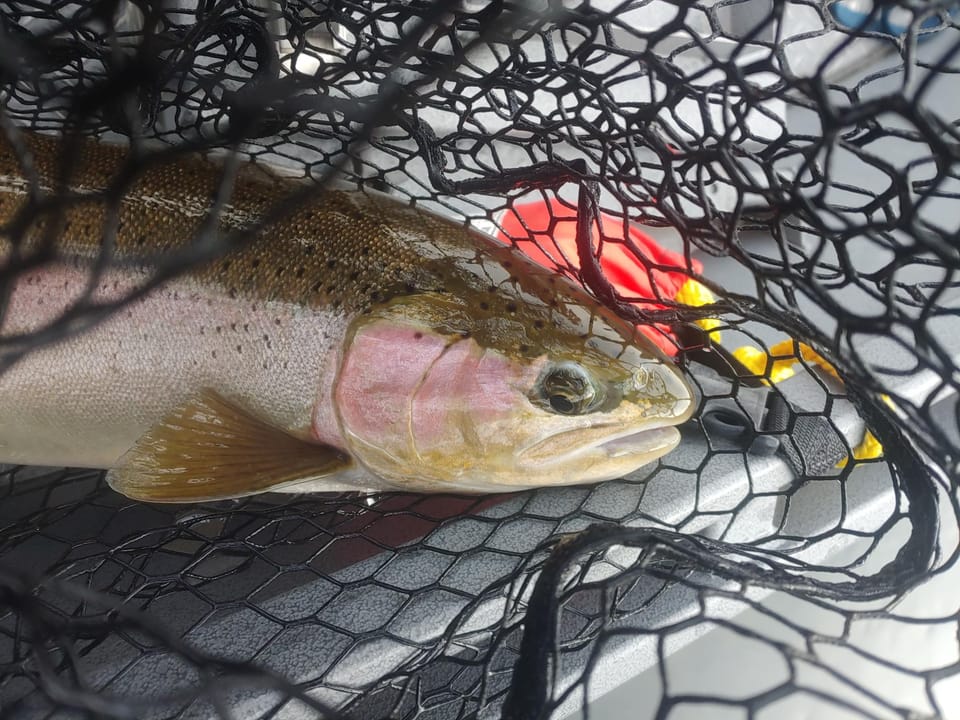
- Who lives there. Sonoma County sits inside the range of Central California Coast coho, an endangered population.[7] It is also in the range of Central California Coast steelhead, a threatened population of sea-going trout.[8] Polluted stormwater is a known risk for many threatened and endangered salmon and steelhead.[5]
- The rule. A county law, the Stormwater Ordinance, bans releasing polluted stormwater into county storm drains.[3]
- Report a spill. Use the form on the stormwater page of Sonoma Water, the county's water agency. Its operations desk is staffed 24 hours: (707) 523-1070.[2]
- Hazardous waste. Find drop-off sites at RecycleNow.org.[2]
- Our numbers. A normal year in Santa Rosa brings about 34 inches of rain.[9] On that 20 by 20 foot driveway, that is about 8,400 gallons a year.
Our calculation from USGS and NOAA data. Method: area times rain times 0.62 gallons per square foot per inch, all of it running off.[10][9] Data and method.
What it means for you
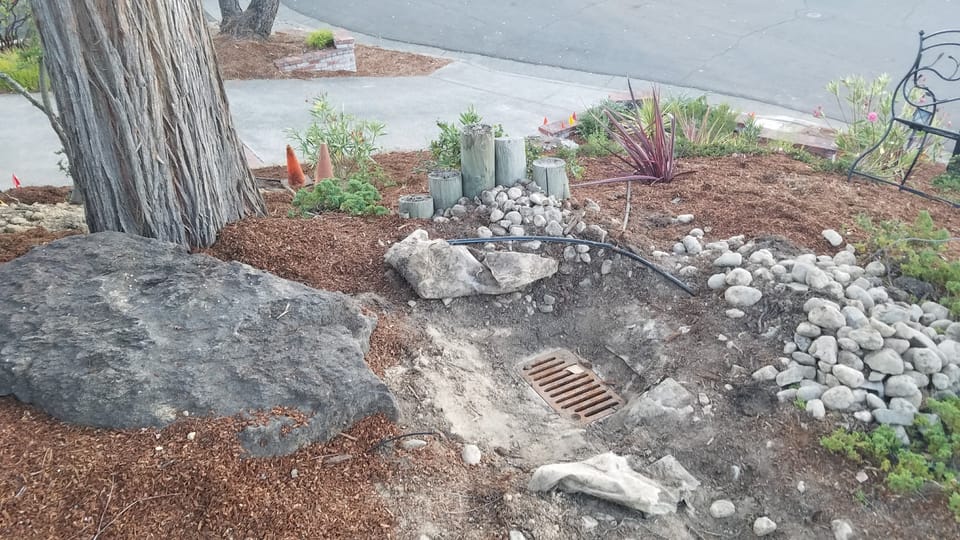
- Aim downspouts at soil. A planted bed or a rain garden (a planted dip that holds rain while it soaks in) works. See how to let rain soak into your yard and where to point a downspout.
- Sweep, don't hose. Sweep the driveway and put what you collect in the bin.
- Report dumping. Search your city's name and "storm drain spill" to find who to call.
Whatever runs off that driveway ends up in a creek. What it carries is up to us.
Photos by Devan Hemmings unless noted.
Sources
- 1. US EPA, Combined Sewer Overflow Basics (updated September 24, 2026)
- 2. Sonoma Water, Stormwater
- 3. Permit Sonoma, Pollution Prevention
- 4. University of Washington, Tire-related chemical is largely responsible for adult coho salmon deaths in urban streams (December 3, 2020), on Tian and others in Science
- 5. NOAA Fisheries, Simple Soil Mixture Reverses Toxic Stormwater Effects (January 20, 2015), on McIntyre and others in Chemosphere
- 6. Water Education Foundation, Russian River watershed protection campaign focuses on keeping storm drains for rain only (Press Democrat, August 26, 2019)
- 7. NOAA Fisheries, Central California Coast Coho Salmon (updated November 13, 2025)
- 8. NOAA Fisheries, Central California Coast Steelhead
- 9. NOAA California-Nevada River Forecast Center, Climate Station Precipitation Summary, Santa Rosa normal 1991 to 2020 (issued November 22, 2026)
- 10. USGS Water Science School, Rain and Precipitation
Checked 2026-11-23. Rules and programs change. If something here is out of date, the source above wins. Spot an error? See our corrections policy.
Related reads
 How the Russian River works: dams, minimum flows and floodsTwo dams store winter rain and release it in summer. Sonoma Water draws the water from wells beside the river for over 600,000 people. The state sets how much must stay in the river.Rivers and pollution · Updated Oct 18, 2026
 El Niño and Sonoma County water: the river, the reservoirs and your rainNOAA says a strong to very strong El Niño is likely this winter, which tilts California toward a wet one. On the Russian River, strong El Niño winters brought a major flood at Guerneville in 3 of 9 cases since 1951, about twice the usual rate, but the worst floods came in other winters. Get ready for high water and plan to keep some of the rain.Rivers and pollution · Updated Nov 13, 2026
 Mud in the creek: how fine sediment can hurt salmon eggs, and what Sonoma County landowners can doFine sediment can fill the gravel where salmon bury their eggs and smother them. The mechanism comes from state and Washington research. In the Russian River's four coho focus creeks, NOAA lists low flow as a top limit in all four and sediment as an egg-stage limit in Willow Creek. What to do: check where your driveway or ranch road drains, and call Sonoma RCD at 707-569-1448.Rivers and pollution · Updated Oct 18, 2026