Rivers and pollutionGuide
The water that moves us: how life moves water, and how we forgot we do too
Water is always moving, and life is part of the movement. Forests help make rain, redwoods pull water from fog, beavers hold it and salmon carry the sea uphill. We move water too, often against the rhythm everything else depends on. This is what we believe, and how people here are learning to move water the way the rest of life does.
Fill a glass at your kitchen sink and look at it for a second. Where has that water been?
Almost everywhere. Some of that water may be older than the Sun. Since it reached Earth, it has moved through oceans, clouds, rocks and living things, over and over, for billions of years. It fell as rain on dinosaurs. Soon it will be moving again. We're going to follow it.
You've probably seen the words "water is life" on a sign or a bumper sticker. The best-known version is a Lakota phrase, Mni Wiconi, and we'll come back to it. The phrase is truer than it sounds, and stranger. Most of us learned the water cycle as weather: sun, cloud, rain, river, sea. Nothing in that picture is alive. But living things are working parts of the cycle. Forests help make rain. Redwoods pull water out of fog. Beavers hold it on the land, and salmon carry the ocean uphill. Rain doesn't just fall on life. Life helps make the rain.
So do we. We dam rivers, pump water up from deep underground and pipe it over mountains. But somewhere along the way we forgot we're part of the movement, and we often move water against the rhythm everything else depends on.
That rhythm gives and takes. The storms that fill Lake Sonoma, the reservoir that supplies much of our county's water, are the same storms that flood Guerneville, a town downstream on the Russian River. Floods built the rich valleys that fed the first cities, and drought and salt helped bring some of those cities down.
This is The Downspout's longest piece, and the one where we say what we believe. We'll follow water from your glass out to the planet and down to a single molecule, through the living things that move it and the history it has moved, and home to Sonoma County: what we've broken, what's coming back, and how people are learning to move water the way the rest of life does. Our watershed is one example. Wherever you live, yours works the same way.
Borrowed water
Start with the glass, because it holds the whole story.
Earth formed about four and a half billion years ago. Where its water came from is still argued over. Some was likely built into the rock that made the planet. Some probably rode in on asteroids.[1] And some seems to be older than the planet itself. In 2023, astronomers found water around a young star with the same chemical fingerprint as water from the cold space between stars. That suggests some of ours, too, was made before the Sun was born.[2]
So the water in your glass didn't really come from the reservoir. The reservoir is just its latest stop.
Since that water arrived, the same supply has kept going around. Ocean to cloud, cloud to rain, rain to river, through roots and leaves and bodies, and back to the sea. Some molecules get split and rebuilt along the way, by plants making sugar and by animals breathing, but the supply is the same one that fell on the dinosaurs.
And it doesn't sit still. A drop that rises into the sky comes back down in about nine days on average.[3] A drop in a river moves on within weeks or months. One that sinks into the deep ocean may stay a few thousand years, and one that soaks far underground can stay longer still.[4] If you poured all of Earth's water into a 26-gallon tank, every river on the planet would be about four drops.[5] The rivers we build towns beside and fight over hold almost none of the world's water. They matter because the water in them keeps coming.
The Greek philosopher Heraclitus noticed this about 2,500 years ago. The line everyone knows is Plato's summary of him: you could not step twice into the same river. What Heraclitus wrote is stranger: "On those who enter the same rivers, ever different waters flow."[6] The river stays the river because its water never does.
That's the strange thing about your glass. Nothing in it is new, and none of it is yours to keep. Every glass is a loan. The dinosaurs had it before you, and something not yet born will have it after.
It also raises a question. What makes water so good at moving, and so good at carrying life along with it?
A molecule built to move
"If there is magic on this planet," the naturalist Loren Eiseley wrote in 1957, "it is contained in water."[7] The magic has a mechanism.
A water molecule is one oxygen atom and two hydrogens. They're arranged so one end carries a slight negative charge and the other a slight positive one. That makes water molecules cling to each other, constantly letting go and grabbing on again. Nearly everything water does, it does because of that cling.[8]
It's why water can be solid, liquid and gas at temperatures life can stand. On a winter morning in Sonoma County you can find frost on a roof, water in the gutter and invisible vapor rising off both as the sun hits them. Each form moves differently, and life uses each one.
Vapor travels. When the Sun warms a puddle, a leaf or the ocean, molecules break free and rise. The sky carries them over mountains and across continents, then lets them fall.
Liquid carries. Because water clings to almost everything, it dissolves almost everything: minerals in the soil, nutrients in your blood, sugar moving through a tree.[9] Because it clings to itself, it can be pulled. As water evaporates from a redwood's needles, it tugs an unbroken thread of water up from the roots, hundreds of feet. That's how the tallest trees on Earth drink.[10]
Ice floats. Most things get denser when they freeze. Water locks into an open, airy pattern and becomes about 9% lighter.[11] So lakes freeze from the top down, and the ice becomes a lid that keeps the water below from freezing solid. Fish and frogs spend the winter alive underneath.
Every one of those gifts has a second edge. The same expansion that floats ice bursts pipes and plant cells, which is why a hard frost kills your tomatoes. The cling that carries nutrients into a root carries fertilizer and pesticides into a creek. And water holds heat stubbornly. That steadies coastlines and bodies, and it's why the ocean has soaked up about 90% of the extra heat from global warming.[12] That heat has to go somewhere, and our own coast has felt it.
You're part of this traffic too. An adult is roughly 50 to 60% water.[13] A 180-pound person carries about 13 gallons, the same as two and a half of those big office water-cooler jugs. It isn't sitting in a tank. It's moving through every cell, carrying food in and waste out, leaving as breath and sweat, and being replaced. Stop the flow, and severe dehydration can turn dangerous within days.[14]
Every living thing we know of runs on water in motion. That's why NASA "follows the water" when it looks for life on other worlds.[15] Which raises the next question: if life is carried by water, how much does life carry water in return?
Life moves water
More than you'd think.
Start with plants. A global study estimated that about 40% of the rain falling on land started as water evaporating from land, much of it breathed out through leaves.[16] Forests are, in part, rain makers, and the rain they make often falls in another watershed or another country. It isn't as simple as "plant trees, get water." Trees drink, and new forests often lower the flow of nearby streams.[17] But the sky and the forest are wired together.
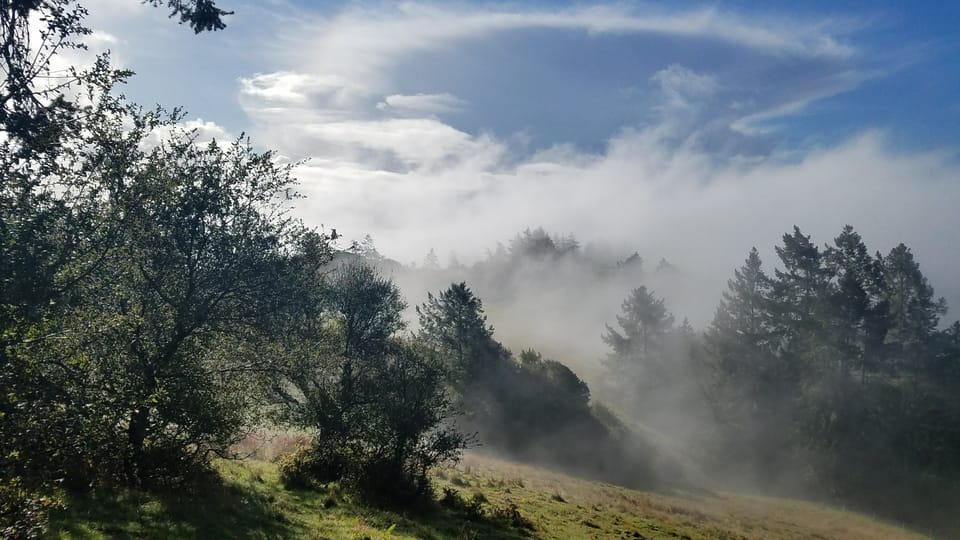
Redwoods go further. They pull water out of the air. In summer, fog drifts in off the Pacific, beads on the needles and drips to the ground. How much that adds varies a lot: about a third of a year's water at one California study site, only about 2% in an old-growth stand here in Sonoma County.[18][19] But fog comes in summer, when nothing else does, and slows how fast the forest dries out. The ferns and shrubs underneath depend on it most.
Beavers hold water on the land. Their dams slow creeks, spread them into ponds and wet meadows, and push water into the ground around them. A creek with beavers works less like a drainpipe and more like a sponge.[20]
Salmon run the river backward. Water carries leaves and soil down to the sea, and salmon carry the sea back up. They grow big in the ocean, swim up creeks to spawn and die. Bears, birds and floods drag their bodies into the woods. In one Pacific coast study, about a quarter of the nitrogen in the leaves of streamside trees came from salmon.[21] The ocean, carried inland by fish, ends up in the forest.
Underfoot, the same work goes on more slowly. Healthy soil, full of roots, fungi and organic matter, holds together in crumbs with tiny pores that soak up rain and release it slowly. Wetlands do the same at a larger scale. Slow water drops its mud, plants and microbes take up nutrients, and floodwater spreads out instead of racing downstream. An acre of wetland can hold about a million gallons of floodwater.[22]
Put those together and the water cycle stops looking like a machine with life riding on top. It's alive at almost every turn. The Sun, the wind and gravity move water. But forests, beavers, fish, fungi and marshes decide a lot about where it goes, how fast, and when it shows up. And the rest of life is timed to that arrival. As John Muir wrote in 1911, "When we try to pick out anything by itself, we find it hitched to everything else in the universe."[23]
Water moves life
On California's North Coast, the year has two seasons: the rain, and the long wait for it.
Most of our rain arrives in a hurry. Atmospheric rivers, long bands of moisture streaming in from the Pacific, bring about 40 to 50% of the Russian River watershed's rain, often in just a few storms. They also cause most of its floods: 87% of the 39 declared floods since 1948.[24] Then come months with almost no rain at all. The storm that fills Lake Sonoma really is the storm that floods Guerneville, and the creeks spend the summer living off what winter left behind.
Living things have built their lives around that rhythm. Foothill yellow-legged frogs lay their eggs in streams just as the winter floods start to drop, which gives tadpoles a full summer to grow. A dam release at the wrong time can scour the eggs away or leave them high and dry. A California study found breeding groups of these frogs averaged five times smaller on dammed rivers than on free-flowing ones.[25]
On the Santa Rosa Plain, the flat valley floor around Santa Rosa, vernal pools fill with rain each winter and dry out each summer. Endangered California tiger salamanders breed in them before the water disappears. Three endangered wildflowers, Sonoma sunshine, Burke's goldfields and Sebastopol meadowfoam, bloom as the pools shrink.[26] Turn a vernal pool into a permanent pond and you destroy it. Here, the dry season is part of the habitat.
The same moving water that times these lives also tears things down and builds them back. A winter flood scours a creek bed, uproots trees and fills living rooms in Guerneville. It also moves the gravel salmon spawn in, carves new side channels, and lays down the rich soil of a floodplain. Erosion strips a hillside and builds a beach. Add fire, and both faces get sharper. After the 2017 Thomas Fire burned the hills above Montecito, in Southern California, a January storm sent mud and boulders through town and killed 23 people.[27] Over longer spans of time, the same mix of fire and water spreads nutrients and opens ground for new growth. Water gives and takes, often in the same storm.
When the rhythm shifts, the losses chain together. Starting in 2014, some of the ocean's stored heat surfaced as a marine heat wave off the North Coast. A wasting disease wiped out sunflower sea stars, the main predator of purple urchins. The urchins, which are native, multiplied about 60-fold at monitored sites and mowed down the kelp. Roughly 95% of the North Coast's bull kelp canopy disappeared.[28][29] Heat, disease and hungry urchins each made the others worse.
People have always lived on water's rhythm too. For most of history, we had no choice.
Water moved us
The first cities grew up beside rivers: Mesopotamia between the Tigris and Euphrates, Egypt on the Nile, the Indus Valley, China's Yellow River.[30] Rivers gave them water, rich soil and roads for boats.
Egypt shows how tightly people were tied to that rhythm. Each summer the Nile rose, spread across the fields and left a fresh layer of silt, and Egyptian farming was timed to it. A low flood meant hunger. A high one could wash away villages and leave fields underwater at planting time.[31]
People learned to move water themselves, and early on they found two ways to do it. The Romans carried it away from rivers, piping it about 30 miles to the city of Nîmes on gravity alone, across a valley on the Pont du Gard, a bridge 160 feet tall.[32] In China, the Dujiangyan system took the other path. Since 256 BCE it has split a river to water fields without a dam blocking its flow, working with the river instead of against it.[33]
Moving water built empires, and moving it badly, or losing it, helped end some. In southern Mesopotamia, watering fields in hot, poorly drained soil left salt behind as the water evaporated. Ancient texts complain of salty ground, though scholars still argue over how much it hurt.[34] In the Maya lowlands, a drought around 800 to 1000 CE cut rainfall by about half in one studied region, alongside war and political upheaval.[35] Angkor, in Cambodia, ran on a network of canals and reservoirs. In the 1300s and 1400s, long droughts and violent monsoons broke parts of it, and the failures spread.[36]
A society that depends on moving water rises and falls with how well it moves it. And when the water runs short, people fight over who gets to move it.
We took over the job
"Rival" comes from the Latin rivalis: a person who uses the same stream.[37]
California learned the meaning early. In 1913, Los Angeles began sending Owens Valley water south through its new aqueduct. By 1924, Owens Lake was a dry lake bed. Angry valley residents turned to sabotage and sporadic violence.[38] The Paiute and Shoshone people of the valley, who had irrigated it long before any of them, lost land and water too.[39]
On the Klamath River, on the California-Oregon border, tribes, farmers and fishing families fought for decades over a river and its salmon. After years of tribal pressure, four hydropower dams came out in 2023 and 2024.[40] We'll come back to what the salmon did next.
We have our own version. Since 1908, the Potter Valley Project in Mendocino County has moved water out of the Eel River and into the Russian. For more than a century, part of our river's water has come from someone else's. In 1922, Scott Dam went in on the Eel and blocked salmon from the river above it.[41] In July 2025, the utility PG&E applied to give up the project and remove the dams.[42] Federal regulators have been reviewing that, along with a plan to keep some Eel water flowing south. As we write, none of it is settled.[43]
Not all of this moving was loss. Piping clean water in and sewage out is one of the best things people have ever built. Between 1880 and 1920, as Massachusetts cities built clean water and sewer systems, child deaths dropped, and one study credits those systems with about a third of the decline.[44] Worldwide, unsafe water and sanitation still contributed to about 1.4 million deaths in 2019.[45]
But pipes also took away the view. A river we lived beside became a tap we turn. Where the water came from, and what it passed on the way, became someone else's job. And once we stopped watching water move, we started moving it against the rhythm everything else is timed to. We pump hardest in summer, when creeks are lowest and fish need the water most. We pave and pipe so winter rain races to the sea instead of soaking in. "When the well's dry," Benjamin Franklin's almanac said in 1746, "we know the worth of water."[46] A creek can go dry long before the well does.
Sometimes you can watch it happen. About a decade ago on Dutch Bill Creek, a salmon stream that runs from near the west county town of Occidental down to the Russian River, researchers found stretches going dry at night. A nearby property was irrigating after dark, and the pumping pulled the creek apart. Once they found the cause, a conservation project cut that property's irrigation needs by about 75%.[47]
Most losses are quieter than that, and we miss them. In 1995, fisheries scientist Daniel Pauly gave a name to why. He called it shifting baselines.[48] Each generation takes the world it first saw as normal. A fisherman who started out in a depleted sea thinks that's what a sea looks like, and his kids start with even less. Over time, an empty creek becomes what a creek looks like.
Measured, the shift is enormous. Worldwide, the 2026 Living Planet Index found that monitored populations of wild animals with backbones have fallen by an average of 73% since 1970, and freshwater species by 85%, the steepest of any group.[49] The animals that live in moving water are losing the most, and changing how water moves is a big part of why.
Sonoma County has shifted too. Historical accounts describe broad wetlands on the Santa Rosa Plain, with grizzly bears and tule elk. Beavers worked the creeks near the coast until trappers took them. We don't know how many of any of them there were. We do know that in the Laguna de Santa Rosa, a network of wetlands west of Santa Rosa, 63% of the historic wetland, creekside and open-water habitat is gone.[50]
People here once lived another way, and some still do.
Tending the cycle
Sonoma County is the homeland of several peoples, including Pomo, Coast Miwok and Wappo, and they are not one culture. They are still here, in nations like the Kashia Band of Pomo Indians, the Federated Indians of Graton Rancheria, Dry Creek Rancheria and Lytton Rancheria.
Dry Creek Rancheria describes its ancestors living in villages and seasonal camps along creeks and rivers, fishing, and actively managing plants and habitat.[51] The Kashia describe moving with the seasons between the coast and inland territory.[52] Both describe people whose lives followed water's rhythm, and who worked the land along it instead of standing outside it.
Muir saw the connections, but he also helped spread a famous mistake: that California was untouched wilderness before settlers arrived. For years, ecologist M. Kat Anderson worked with California Native elders and historical records to document how people harvested, pruned, sowed, tilled and burned across the state. Her book, Tending the Wild, concludes that the landscape early settlers admired "was in fact a cultural landscape, not the wilderness they imagined."[53][54] To many of the elders she learned from, "wilderness" wasn't a compliment. It meant land nobody was caring for. A 2026 review of the evidence from Fort Ross south to Santa Cruz supports deliberate cultural burning in Kashia Pomo, Southern Pomo and Coast Miwok homelands.[55]
That work continues. In 2015, 688 acres and about a mile of coast returned to Kashia ownership.[56] Kashia environmental staff monitor shellfish toxins, survey kelp and work with UC Davis's Bodega Marine Laboratory.[57] Graton Rancheria and the county have co-managed Tolay Lake Regional Park since 2022.[58]
The phrase we started with comes from far from here, from Lakota country on the northern Plains. Mni Wiconi is usually translated "water is life." It traveled around the world in 2016 and 2017 with the Standing Rock protests against the Dakota Access Pipeline.[59] Historian Nick Estes places it inside much older Lakota ideas of kinship.[60] Some speakers put it closer to "water is alive."
After everything above, that second meaning sounds less like a metaphor. Follow water long enough and it gets hard to say where the water ends and the living things begin. And if people are one of its working parts, the question isn't whether we move water. It's how.
Moving water like the rest of life
Some of the best answers come from right here in west Sonoma County.
Brock Dolman helped found the Occidental Arts and Ecology Center, a farm and education center in the hills near Occidental, and co-directs its watershed program. The center credits him with a phrase from the late 1990s that has since spread far beyond Sonoma County: slow it, spread it, sink it.[61] That's what a forest floor, a wetland or a beaver pond does with rain. It's also a recipe for people. Dolman has signed off his emails "Mostly water,"[62] and he likes to say your watershed is your lifeboat.[63]
The center's staff helped put the beaver back on the map, too. In 2013, Dolman and his colleague Kate Lundquist co-wrote a study of historical records showing that beavers once lived along much more of coastal California than the old range maps showed.[64] It was a shifted baseline, corrected. Now California has a beaver restoration program, started in 2023, and the center runs a statewide effort to help landowners live with beavers instead of killing them.[20][65]
When beavers can't do the work, people are copying them. In one Sierra meadow, scientists built 39 small beaver-style dams by hand. The meadow stored about a million extra gallons of water, roughly one and a half Olympic swimming pools.[66]
Copying living things on purpose has a name, biomimicry, popularized by the biologist Janine Benyus in a 1997 book.[67] Water is one of its richest teachers. In a parking lot at UC Davis, a strip of trees and spongy soil designed to drink rain like a forest floor cut runoff by about 89% over 50 storms.[68] In dry coastal places, people string fine nets that catch fog, much as redwood needles do.[69]
The same idea works at the size of a whole farm. In the Alps, the Austrian farmer Sepp Holzer shaped a steep mountain farm into terraces and chains of ponds that hold water on the land.[70] "For me, water is the most important capital," he says in a film about his work. He helped a community in Portugal called Tamera build about 30 lakes and ponds of their own.[71] A student study there found the lakes feeding the groundwater, and also found most of them overloaded with nutrients.[72] Holding water on land works. It doesn't make water from nothing.
At the size of a whole region, the promise and the tradeoffs both grow. On China's Loess Plateau, once among the most eroded places on Earth, communities and governments terraced hillsides, stopped grazing on steep slopes and replanted, restoring about 10 million acres, an area the size of Switzerland. Plant cover rose from about 32% in 1999 to 75% in 2023, and farm incomes rose too.[73] But all those new plants drink. One review found water flowing out of restored areas dropped by about 43%.[74] In India's Rajasthan, villagers built or revived about 8,600 small earthen dams called johads to catch monsoon rain, and water returned to about 1,000 villages.[75]
And the Klamath salmon? In 2024, an estimated 7,742 Chinook swam upstream past the old dam sites. In 2025, it was 13,310.[76] They've already reached 88% of their historic range in the study area. Whether they rebuild a run that lasts will take generations to know. But they found the open river right away. Sometimes moving water like the rest of life means getting out of its way. That's the choice in front of us now on the Eel.
What these stories share is the choice Dujiangyan made 2,000 years ago: work with water's movement instead of against it. The Tao Te Ching, from roughly the same era in China, said it this way: "There is nothing in the world more soft and weak than water, and yet for attacking things that are firm and strong there is nothing that can take precedence of it."[77] Slow it, so it doesn't tear the land. Spread it, so more life can reach it. Sink it, so it's still there in summer.
Which brings us home, where all of these threads run through one watershed.
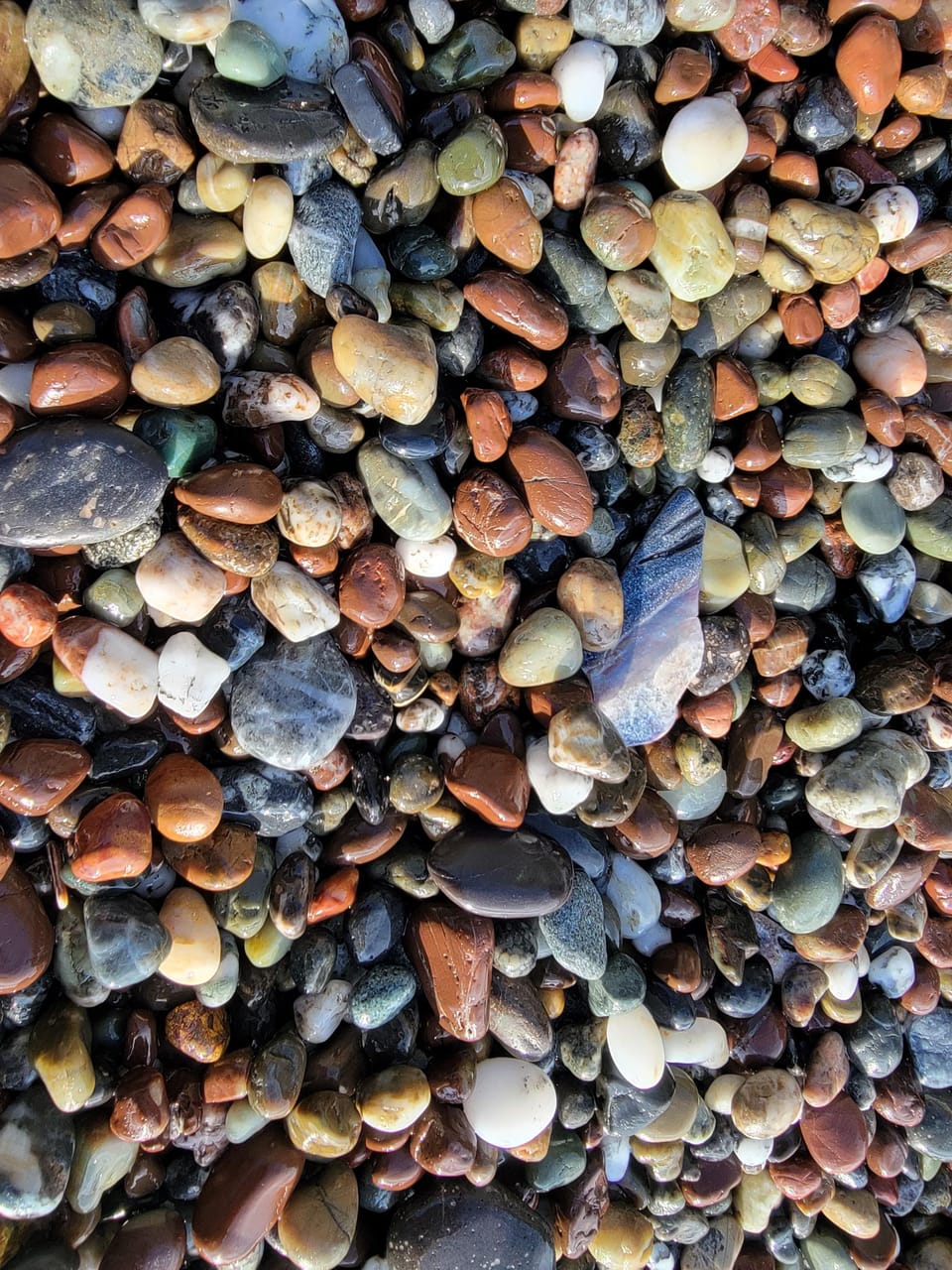
One drop through Sonoma County
Follow one drop. It arrives in a December atmospheric river and lands on a redwood ridge above the lower Russian River. It soaks into forest soil full of roots and fungi and seeps, weeks later, into a creek.
In a shaded pool, it passes young coho salmon, federally endangered. In the winter of 2025 to 2026, biologists estimated only about 60 coho nests across the Russian River basin, the fewest in 12 years.[78] Under the rocks are mayfly, stonefly and caddisfly larvae, which only thrive in cool, clean water full of oxygen.[79] Along the undercut banks of a few low creeks lives the California freshwater shrimp, found almost nowhere else on Earth, which needs water all summer long.[80] Western pond turtles bask on the logs above.
Or the drop falls on the Santa Rosa Plain. It fills a vernal pool where tiger salamanders breed, then sinks into the ground as the pool dries. In a drought summer, a valley oak may reach down for it. Some of it drains into the Laguna de Santa Rosa, a wetland of international importance.[81] The Laguna is clogged with mud and excess nutrients and short on oxygen, and still alive with herons, egrets, river otters and wintering ducks.[82]
From there it joins the Russian River, rides a winter flood past Guerneville, and meets the Pacific at Jenner, beside kelp beds still struggling to come back. Before long it rises again, maybe as the next summer's fog.
We touch that drop at almost every step. A well pumped hard in summer can pull down the creek beside it.[83] Rain running off a vineyard or a lawn picks up fertilizer, pesticides and mud. Rain running off a road picks up tire dust, and a chemical in it, 6PPD-quinone, kills coho.[84] Fill or drain a wet spot and the vernal pool goes with it. And the drop touches us back. We drink it, swim in it and eat the fish that live in it.
But people here are also learning to move it the way the rest of life does. On Porter Creek, a tributary of the Russian River, water stored in winter and released into the creek in summer raised young coho's odds of surviving a dry year by 24 percentage points.[85] At Sears Point, near San Pablo Bay, tides returned to 960 acres of old diked farmland in 2015, and nearby the Sonoma Land Trust is turning nearly a mile of eroded, ditch-like Lakeville Creek back into a wet valley.[86][87] Early monitoring found groundwater there staying higher into the dry season.[88] Neighbors across Sonoma and Mendocino counties have installed rain tanks that, by the state's estimate, will spare tributaries about half a million gallons of summer pumping each year.[89] Nearly all of them do the same thing. They catch winter water and give it back in summer, the way a healthy watershed always has.
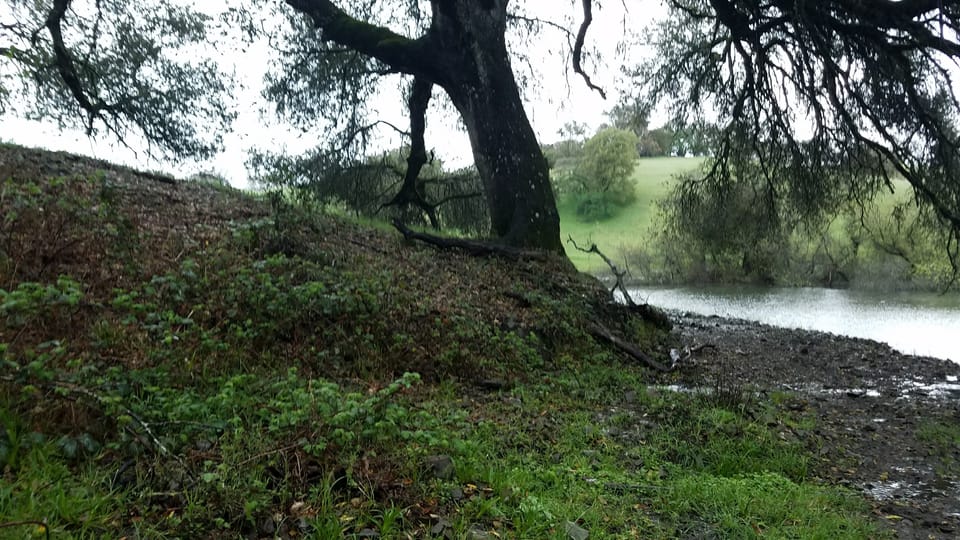
What we believe
Water is always moving, and we move with it. Every glass is borrowed from everything that lived before and everything that will come after, salmon and salamanders, oaks and otters, and the people downstream.
Life is part of the water cycle, not a passenger on it. Forests, beavers, fish, fungi and wetlands decide where water goes and when. So do we.
When water moves matters as much as how much there is. Its rhythm gives and takes, and almost everything alive is timed to it. Here, summer water is the scarce water.
The modern water system gave us clean water and healthy kids, and we should keep every bit of that. We can keep it and still remember we're part of water's path, not just the end of a pipe.
And the best way to move water is the way the rest of life does. Slow it. Spread it. Sink it. Give it back on time.
That's why The Downspout exists: to help you see where your water comes from, what it touches on the way, and how to be a better part of its path. A few places to start, wherever you live:
- Fix leaks. The average household loses more than 9,300 gallons a year to them.[90]
- Water less in summer. Swap thirsty lawn for native plants and mulch.
- Catch winter rain. One inch of rain on a 1,000-square-foot roof is about 623 gallons. A 55-gallon barrel holds less than a tenth of that, so send the overflow into a rain garden. Here's how to set up a barrel.
- Keep the storm drain clean. Pet waste, fertilizer and soapy car-wash water all end up in a creek.
- Leave wet spots wet. That soggy corner might be a vernal pool, and creekside plants shade the water fish need.
- If beavers move in, get advice before removing them.
Now fill that glass again. The water in it fell on dinosaurs. It has been sky, sea, stone and living things, and it will be all of those again. Someday it might be fog on a redwood, or a salamander's winter pool, or a cool pool where a young coho waits out the summer. Water is life. It's moving through all of us. We're only borrowing it, and how we move it decides what we pass on.
Photos by Devan Hemmings unless noted.
Sources
- 1. NASA, NASA-led team links comet water to Earth's oceans (2024)
- 2. European Southern Observatory, Astronomers find missing link for water in the Solar System (2023)
- 3. Van der Ent and Tuinenburg, The residence time of water in the atmosphere revisited (HESS, 2017)
- 4. Minnesota Geological Survey, Water (residence times)
- 5. USGS, How much water is there on Earth?
- 6. AskPhilosophers, on Heraclitus fragment B12 and Plato, Cratylus 402a
- 7. Quote Investigator, If there is magic on this planet, it is contained in water (Loren Eiseley, The Immense Journey, 1957)
- 8. OpenStax Biology 2e, Water
- 9. USGS, Water, the universal solvent
- 10. National Park Service, Coast redwood
- 11. USGS, Water density
- 12. NASA, Ocean warming
- 13. USGS, The water in you: water and the human body
- 14. Kottusch et al., Survival time without food and drink (2009)
- 15. NASA Astrobiology, Why is water so important for life?
- 16. Van der Ent et al., Origin and fate of atmospheric moisture over continents (2010)
- 17. Te Wierik et al., Land use and moisture recycling review (2021)
- 18. Dawson, Fog in the California redwood forest (Oecologia, 1998)
- 19. Ewing et al., Fog inputs in an old-growth Sonoma County redwood stand (Ecosystems, 2009)
- 20. California Department of Fish and Wildlife, Beaver Restoration Program
- 21. Helfield and Naiman, Salmon-derived nitrogen and riparian forest growth (Ecology, 2001)
- 22. US EPA, Wetlands: protecting life and property from flooding
- 23. Sierra Club, John Muir favorite quotations (My First Summer in the Sierra, 1911)
- 24. UC San Diego CW3E, Russian River watershed and atmospheric rivers
- 25. Kupferberg et al., Dam-altered flows and California river-breeding frogs (2012)
- 26. USFWS, Recovery plan for four Santa Rosa Plain species (2016)
- 27. USGS, The January 9, 2018 Montecito debris flow
- 28. Rogers-Bennett and Catton, Marine heatwave tips bull kelp forest to urchin barrens (2019)
- 29. NOAA Greater Farallones National Marine Sanctuary, Kelp in decline
- 30. Metropolitan Museum of Art, Art of the First Cities (2003)
- 31. Metropolitan Museum of Art, An Egyptian Bestiary (1995)
- 32. Pont du Gard, The monument
- 33. ICOMOS, Evaluation of Mount Qingcheng and the Dujiangyan Irrigation System (2000)
- 34. Altaweel et al., Environmental dynamics shaping southern Mesopotamia (Iraq, 2019)
- 35. Evans et al., Quantification of drought during the Classic Maya collapse (2018)
- 36. Buckley et al., Climate as a contributing factor in the demise of Angkor (PNAS, 2010)
- 37. Merriam-Webster, Rival
- 38. Inyo County Water Department, Owens Valley water history chronology
- 39. Owens Valley Indian Water Commission, Water and land history
- 40. NOAA Fisheries, Klamath dam removal to open 420 miles of salmon habitat
- 41. State Water Board, Potter Valley Hydroelectric Project
- 42. PG&E, Potter Valley surrender application (2025)
- 43. FERC, Potter Valley Hydroelectric Project
- 44. Alsan and Goldin, Water and sewerage infrastructure and child mortality, 1880 to 1920 (2019)
- 45. World Health Organization, Improving water, sanitation and hygiene can save 1.4 million lives a year (2023)
- 46. Founders Online, Poor Richard, 1746
- 47. Deitch and Dolman, Restoring summer base flow under decentralized water management (Water, 2017)
- 48. Hobday, Review of Shifting Baselines, citing Pauly 1995 (Oceanography, 2012)
- 49. WWF, Living Planet Report 2026
- 50. SFEI, Restoration Vision for the Laguna de Santa Rosa (2020)
- 51. Dry Creek Rancheria, Environment
- 52. Kashia Band of Pomo Indians, About
- 53. M. Kat Anderson, Tending the Wild (University of California Press)
- 54. Ecology Center, review of Tending the Wild, quoting Anderson
- 55. Fire Ecology, Indigenous cultural burning on the Central California Coast (2026)
- 56. Sonoma County Ag + Open Space, 688-acre Kashia coastal property (2015)
- 57. Kashia Band of Pomo Indians, Environmental Department
- 58. County of Sonoma, Tolay Lake co-management record
- 59. Dhillon and Estes, Standing Rock, #NoDAPL and Mni Wiconi (2016)
- 60. Estes, Our History Is the Future: Mni Wiconi and Native liberation (2017)
- 61. Occidental Arts and Ecology Center, The origin of slow it, spread it, sink it
- 62. San Francisco Chronicle, Deborah K. Rich, on Brock Dolman (2008), reposted by OAEC
- 63. OAEC, Brock Dolman: Your watershed is your lifeboat
- 64. Lanman et al., The historical range of beaver in coastal California (California Fish and Game, 2013)
- 65. OAEC, California Beaver Coexistence Training and Support Program
- 66. Sevier et al., Hydrological responses after restoration in a Sierra Nevada meadow (2024)
- 67. Biomimicry Institute, Janine Benyus
- 68. Xiao and McPherson, Performance of engineered soil and trees in a parking lot bioswale (2011)
- 69. MIT News, How to get fresh water out of thin air (2013)
- 70. Krameterhof, Diversity as a principle
- 71. Water Is Life with Sepp Holzer and Tamera Community (film, English subtitles)
- 72. Daum, Water quality and lake and groundwater interaction at Tamera (University of Tübingen thesis, 2014)
- 73. FAO, Ecological restoration of the Loess Plateau
- 74. Meta-analysis: Loess Plateau restoration and water shortage (2022)
- 75. Stockholm Water Foundation, Rajendra Singh (2015)
- 76. Goodman et al., Rapid recolonization of Chinook salmon after Klamath dam removal (USGS, 2026)
- 77. Tao Te Ching, chapter 78, James Legge translation (1891)
- 78. California Sea Grant and Sonoma Water, Coho and steelhead monitoring, winter 2025 to 2026
- 79. US EPA, Indicators: benthic macroinvertebrates
- 80. USFWS, California freshwater shrimp
- 81. Ramsar Sites Information Service, Laguna de Santa Rosa
- 82. North Coast Water Board, Laguna de Santa Rosa
- 83. Sonoma County groundwater agencies, Interconnected surface water and groundwater-dependent ecosystems
- 84. USGS, 6PPD-quinone research
- 85. Rossi et al., Flow augmentation from off-channel storage improves salmonid habitat and survival (2023)
- 86. California State Coastal Conservancy, Sears Point restoration
- 87. Sonoma Land Trust, Lakeville Creek restoration
- 88. Sonoma Land Trust, May 2025 monitoring update
- 89. CDFW, Neighborhood Rain Catchers project (2026)
- 90. US EPA WaterSense, Fix a Leak Week
Checked 2026-11-05. Rules and programs change. If something here is out of date, the source above wins. Spot an error? See our corrections policy.
Related reads
 Rivers and pollutionHow the Russian River works: dams, minimum flows and floodsTwo dams store winter rain and release it in summer. Sonoma Water draws the water from wells beside the river for over 600,000 people. The state sets how much must stay in the river.Updated Oct 18, 2026
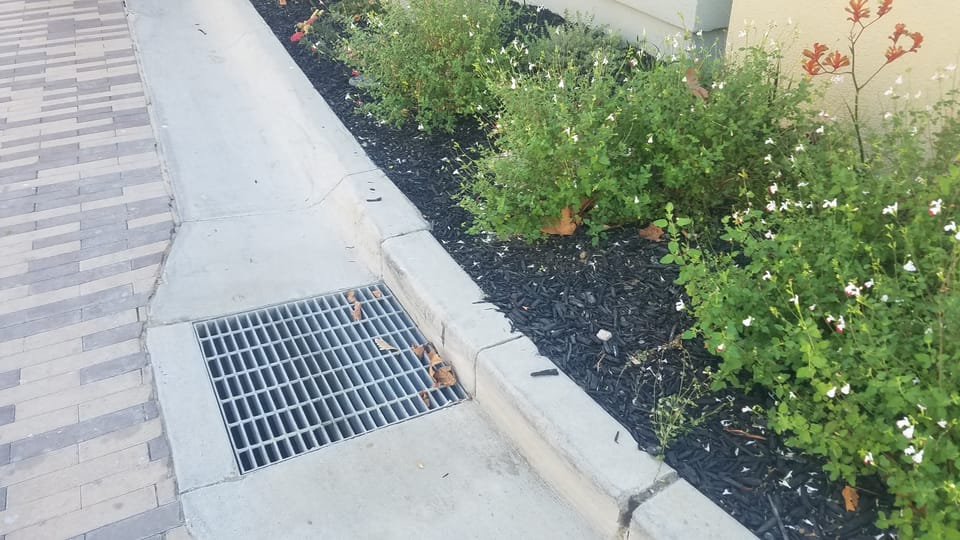 Rivers and pollutionOnly rain down the storm drainStorm drains carry water straight to the nearest creek. It is not treated. Only rain should go down them.Updated Oct 11, 2026
 Rivers and pollutionEl Niño and Sonoma County water: the river, the reservoirs and your rainNOAA says a strong to very strong El Niño is likely this winter, which tilts California toward a wet one. On the Russian River, strong El Niño winters brought a major flood at Guerneville in 3 of 9 cases since 1951, about twice the usual rate, but the worst floods came in other winters. Get ready for high water and plan to keep some of the rain.Updated Oct 18, 2026