
Rivers and pollutionGuide
Wine and water in Sonoma County: what vineyards cost our creeks
A glass of Sonoma County wine takes about 12 gallons of pumped water. The bigger costs are when that water is taken, what washes off vineyards into our creeks, and the land the vines replaced. We follow one vineyard through a year, then say what we think should change.
Sonoma County runs on wine. It's on our hillsides, in our economy, and maybe in your glass tonight. But have you ever wondered what it costs the land and water around us?
Start simple. How much water goes into one glass of wine?
The most common answer is about 30 gallons. That number comes from a global study, and it adds up three kinds of water.[1] Most of it is rain the vines soak up from the soil on their own. Some is water growers pump from wells and creeks. Here on the North Coast, UC Davis puts that pumped part at about 12 gallons a glass, or 61 gallons a bottle, about a bathtub and a half.[2] The rest is pollution. When fertilizer and pesticides wash into a creek, it takes fresh water to dilute them, and the study counts that water too.[1] It's a strange idea, and a revealing one. We'll come back to it.
Of those three, the rain costs our creeks nothing. It would fall on the hillside with or without the vines. The other two are different. Pumping takes water out of our creeks and wells, and pollution puts something into them that doesn't belong. With pumping, when matters more than how much. Taking water in January, when creeks run full, does little harm. Taking the same amount on a freezing April night, or in a dry August, can drain a stream.
When a creek runs dry or turns toxic, salmon are the ones that make the news. But a creek feeds far more than fish: the insects in its gravel, the frogs and birds that eat them, and downstream, our own wells and the river we swim in. What happens to the creek happens, sooner or later, to us.
So this is a story about three things: the water wine takes, what washes off the vineyards, and the land the vines replaced. We love wine here, and that's why it deserves a hard look. Let's follow one vineyard through one year.
Winter: it's pouring, so who cares?
In winter the vines are dormant, and nobody irrigates. If water use were the whole story, winter wouldn't matter.
But winter is when the ground moves. Heavy rain runs down bare vineyard rows and dirt roads, and it carries soil into the creeks. The soil settles as fine silt in the creek-bed gravel. That gravel is where salmon lay their eggs. It's also where mayflies and stoneflies spend most of their lives, and those insects feed fish, frogs and birds.[3] Silt fills the spaces between the stones and chokes that whole nursery at once.
The same rain washes fertilizer and pesticide off the rows. Remember the pollution part of the 30 gallons? This is where it comes from. The creek isn't clean again until enough fresh water dilutes it back to safe levels. That's why scientists count pollution in gallons.[1] Dirtying water uses it up, just like pumping it out does.
What washes off depends on what went on. Fertilizer feeds algae downstream, and we'll get to that in summer. Growers spray copper to fight fungus, even on organic farms, and copper is toxic to life in water.[4][5] Sonoma County vineyards reported using at least 17,000 pounds of copper compounds in 2023.[6] In a creek, even a little copper dulls a fish's sense of smell, so it can't tell a predator is coming.[5]
Now and then, the pollution is the wine itself. In January 2020, a tank failed at Rodney Strong, and about 53,000 gallons of wine reached nearby waterways.[7] In a creek, wine acts a lot like sewage. As bacteria feed on it, they use up the oxygen that fish and insects need to breathe.[8]
How much any of this matters depends on where you look. Across the whole Russian River watershed, vines cover only about 5% of the land. But they aren't spread evenly. In some small creek valleys, vines cover more than three quarters of the ground.[3] For everything living in those creeks, the vineyard is the landscape.
Then the rain stops. And on the coldest nights of early spring, vineyards suddenly need a lot of water, fast.
Spring: frost nights
In March and April, vines push out tender new buds. One hard frost can kill them and take much of the year's crop.
So on cold nights, many growers turn on sprinklers over their vines. As the water freezes on the buds, it gives off a little heat, and the shell of ice holds each bud right at freezing instead of letting it get colder. It sounds backward, but the ice protects the plant.
It works, but it takes a lot of water at once. A typical system sprays about 50 gallons a minute on every acre, like five to ten garden hoses running all night. By morning, that's about 24,000 gallons an acre, more than a backyard swimming pool.[9] And every vineyard in the valley is pumping during the same cold hours.
Much of that water comes straight from creeks, or from wells close enough to draw them down. On some creeks that feed the Russian River, researchers found frost pumping cut the flow by as much as 97%.[10]
Spring is a bad time to drain a creek. Young salmon are growing in the pools, insects are hatching, and frogs are laying eggs in the shallows, where a sudden drop can leave them high and dry.[11] In April 2008, during frost season, Felta Creek dropped and left young salmon and steelhead stranded.[12]
Those fish matter more than most people realize. Russian River coho are endangered and steelhead are threatened.[13] And when salmon die upstream after spawning, their bodies feed insects, birds and the streamside forest, carrying the ocean's nutrients inland.[14]
The state passed a frost rule in 2011, and after a court fight it took effect in 2015. Growers along the river now need an approved plan, and they have to monitor the streams.[15]
That's progress. But look at the order. The fish were stranded first, and the rule took effect seven years later. And the rule was written for the fish, not the frogs or the insects. Keep that in mind, because it happens again.
Summer: the river runs low and warm
By June the rain is long gone, the vines are in full leaf, and the river is dropping. Most irrigation now comes from wells.
In Sonoma Valley, farms pump more than half of all the groundwater, and the water in some deep wells there has dropped more than 150 feet in about 20 years.[16] That's the height of a 15 story building. When groundwater falls, the creeks it feeds fall with it.
Some growers have stopped watering altogether. It's called dry farming. Once vines are established, their roots reach deep enough to live on the water that winter left in the soil. Hamel, a Sonoma Valley winery, dry farms its mature vines and says it saves about 4 million gallons a season. The tradeoff is a smaller crop.[17][18]
Summer is also spray season. Growers report every application to the state, so we can see what went onto Sonoma County's wine grapes in 2023.
Most of it, by weight, fights fungus. Sulfur, sprayed against mildew, came to 1.5 million pounds, far more than anything else.[6] Mineral oil, used against both mildew and pests, came to about 350,000 pounds. Both are allowed on organic farms,[4] and pounds alone don't measure harm. But they show how much goes onto the land.
Then come the insecticides, including a kind scientists have been warning about for years. Growers used about 4,000 pounds of imidacloprid on nearly 6,000 acres, and about 1,200 pounds of thiamethoxam on 8,000 more.[6] Both are neonicotinoids, a family of insecticides linked to the decline of bees. They dissolve easily in water, so when the rains return, they wash into creeks, where mayflies and other aquatic insects are especially sensitive to them.[19] Lose those insects, and the fish, frogs and birds that eat them lose their food.
And there are the weed killers: about 35,000 pounds of glyphosate, the active ingredient in Roundup, and 16,000 pounds of glufosinate.[6] Weed killers do more than kill weeds. Frogs breed in puddles and ditches right next to fields. In a 2005 experiment, Roundup sprayed over outdoor tanks set up like ponds killed 96 to 100% of the tadpoles.[20] Rows kept bare with weed killer also grow no flowers for bees, or for the tiny wasps that eat vineyard pests. And pollinators matter to us too: about one in three bites of our food depends on them.[21]
So where does it all end up? Here there's some good news. Sonoma Water tests the river water it sends to our taps, and from 2018 to 2022 it found no glyphosate or copper there.[22] Out in the watershed, it's a different story. Over those same years, 20 different pesticides turned up in creeks and rivers across Sonoma and Mendocino counties.[23]
Then there's the question everyone on the river asks: are vineyards behind the toxic algae? In August 2015, a dog died after a day on the Russian River, likely poisoned by algae growing in dark mats on the river bottom.[24][25] Algae thrives in warm, slow water and feeds on nitrogen and phosphorus, the same nutrients in fertilizer. The river has plenty of phosphorus. In one state study, it ran high in 35 of 43 samples.[26]
The best clue comes from the Laguna de Santa Rosa, the county's largest freshwater wetland.[27] Wetlands work like the land's kidneys, trapping silt and nutrients before they reach the river. A state model traced where the Laguna's phosphorus comes from. Orchards and vineyards together came to about 12%. Grazing land was 30%, city neighborhoods 23%, and homes on septic systems another 10%.[28] And decades of old pollution in the Laguna's mud keep leaking back into the water.[28]
Here's that breakdown. Look at where vineyards land.
Our read: vineyards are part of the algae problem, but they aren't the main cause. Blaming wine alone lets the rest of us off the hook.
By September the river is at its lowest. And up at the winery, the busiest weeks of the year are just beginning.
Fall: crush
Harvest, which winemakers call crush, moves the water story indoors. Wineries wash tanks, barrels, bins and floors again and again to keep the wine from spoiling.
An efficient winery uses about 1.5 to 3 gallons of water for every gallon of wine it makes. The smallest wineries can use around 20, so small isn't automatically greener.[2]
What leaves the winery matters more than what comes in. Rinse water full of juice and grape skins would do to a creek what that spilled wine did. The best wineries clean it in ponds or wetlands and reuse it on the vines.[8]
Step back from any one winery, though, and a bigger question comes into view. What did all these vineyards replace?
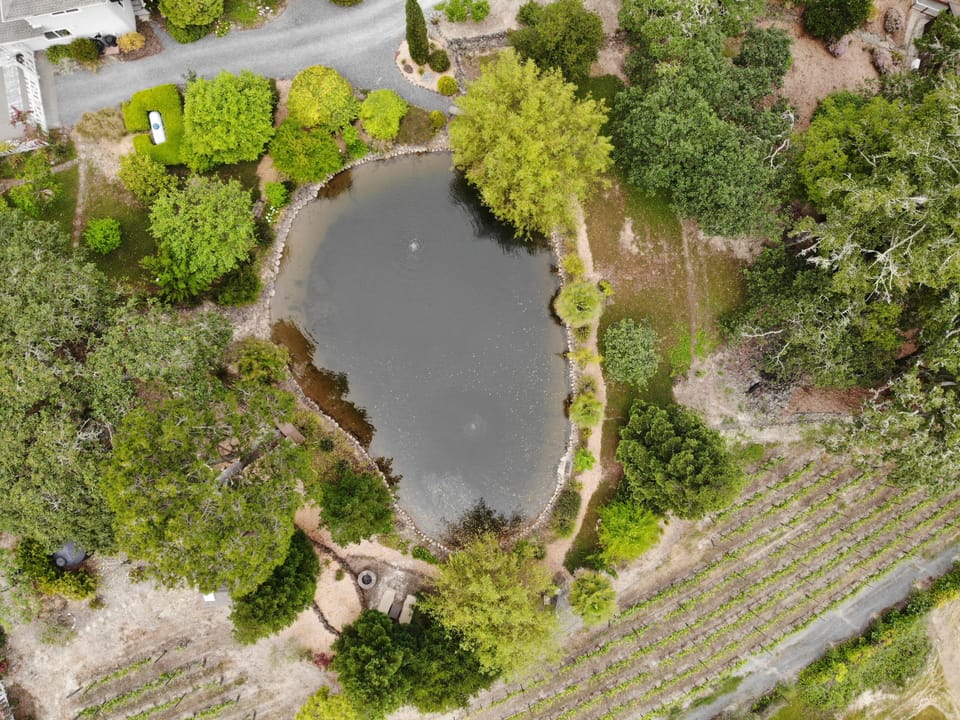
The land
In 1970, Sonoma County had about 12,600 acres of grapes. Today it has more than 56,000.[29][30] That's four and a half times as much. Today's vines would cover about 42,000 football fields.
The chart shows how fast the vines spread.
Much of that land was once orchard. Gravenstein apples, Sebastopol's pride, covered about 4,400 acres of the county in 1970. By 2024, 614 acres were left.[29][31] Not every orchard became a vineyard, but many did, and West County lost much of the apple culture it was known for.
Today grapes make up 71% of the value of everything the county's farms grow.[30] That's a lot riding on one crop. In 2025, with wine sales weak, some grapes went unpicked because nobody would buy them.[30] A county with many kinds of farms can ride out a bad year for any one of them.
Ecosystems work the same way. A vineyard is a monoculture: one kind of plant in neat rows, with almost everything else kept out. A Sonoma study found native predators showed up about 11 times more often along creeks than inside vineyards.[32] And miles of deer fencing block animals moving between the creeks and the hills.[33] On the Santa Rosa Plain, many of the shallow winter pools where Sonoma's endangered tiger salamanders breed have been drained and plowed for farms and towns.[34] Even the soil pays. Ground kept bare with weed killer, row after row, gives its fungi, bacteria and earthworms less to live on.
Now picture the opposite of a vineyard: a food forest. It's a farm designed to work like a natural forest, with layers of fruit and nut trees, shrubs, vines and ground plants, all producing food. In a 2024 study of farms like this in Germany and Luxembourg, researchers found five and a half times as many plant species as on nearby fields, and three times as many birds and earthworms.[35]
Wine grapes don't grow well in a food forest, because they need full sun and moving air.[36] But there's a middle ground. Growers can plant rows of trees between blocks of vines, keep hedgerows and creekside habitat, grow cover crops between the rows, and bring in sheep to graze them. Across 74 studies, vineyards with plants growing between the rows held about 20% more kinds of life than bare ones.[37] Preston Farm & Winery in Dry Creek Valley goes further, growing grapes beside vegetables, olives, grain and livestock on one farm.[38]
And now there's an opening. After decades of growth, grape acreage is shrinking. Every vineyard that comes out is a choice about what goes in next: houses, more vines when prices recover, or orchards, habitat and mixed farms like Preston's.
What we think
After a year in the vineyard, the evidence points one way. Wine's biggest harms aren't about how much water it uses. They're about when and where it takes that water, what it sprays and washes off its land, and what it replaced. Each of those reaches through the creeks to everything that depends on them, and in the end to us.
And the rules are still running behind. The newest is a state permit, adopted in 2025, that requires North Coast vineyards over five acres to control and monitor their runoff, including pesticides. Signups don't start until 2028.[39][3] It's the frost rule all over again: the harm comes first, and the rule comes years later. Growers say it's costly in a bad market, and for the small family farms it covers, they have a point.[40] Our view: help those growers pay for it, publish the results, and measure what matters. Not just salmon, but the insects, frogs and soil too.
Don't count on the label to tell you who's doing it right. You've probably seen the claim that Sonoma County vineyards are "99% certified sustainable."[41] It's true, and it's misleading. The programs are audited and do real work, but they aren't organic, and they still allow glyphosate.[42] Napa Green, the certification program next door, set a goal to phase glyphosate out of its vineyards.[43] Sonoma could set the same bar.
So ask. Next time you're at a tasting room, try three questions. Do you dry farm? Are your vineyards organic, or certified Fish Friendly, which means the farm has a plan to protect its creeks?[44] Do you use weed killers or neonicotinoids? Then buy from the wineries with good answers.
Wine is our biggest crop. That makes it our biggest responsibility.
Want to see where your own runoff goes? Try the watershed finder.
Photos by Devan Hemmings unless noted.
Sources
- 1. Mekonnen and Hoekstra, The green, blue and grey water footprint of crops and derived crop products, Hydrology and Earth System Sciences (2011)
- 2. Daniel Sumner, UC Davis, Water into Wine in California: Economic Perspectives (2016)
- 3. North Coast Regional Water Board, General Waste Discharge Requirements for Commercial Vineyards, Order R1-2024-0056 (adopted June 12, 2025)
- 4. 7 CFR 205.601, synthetic substances allowed in organic crop production
- 5. NOAA Fisheries, How toxic runoff affects Pacific salmon and steelhead (2016)
- 6. California Department of Pesticide Regulation, Sonoma County pesticide use by chemical, 2023 (published 2025)
- 7. North Coast Regional Water Board, Klein Foods (Rodney Strong) liability methodology (2023)
- 8. State Water Board, General Waste Discharge Requirements for Winery Process Water, WQ 2021-0002-DWQ
- 9. Glenn McGourty, UC Cooperative Extension, frost protection presentation to the State Water Board (2009)
- 10. NOAA Fisheries, Russian River frost protection presentation to the State Water Board (2009)
- 11. Kupferberg and others, UC Davis, Pulsed flow effects on the foothill yellow-legged frog (2009)
- 12. State Water Board, Russian River frost protection draft environmental impact report (2011)
- 13. NOAA Fisheries, Salmon Habitat Restoration Priorities in the Lower Russian River (2025)
- 14. Scientific American, The Fish and the Forest: salmon carcasses fertilize streamside forests
- 15. State Water Board, Russian River Frost Protection Regulation
- 16. Sonoma Valley Groundwater Sustainability Agency, annual report fact sheet, water year 2025
- 17. Hamel Family Wines, Vision (the winery's own account)
- 18. KQED, Facing drought, wildfires and heat, Bay Area wineries are changing how they grow grapes (2021)
- 19. Xerces Society, Protecting California's Waters from Neonicotinoid Contamination (conservation group)
- 20. Rick Relyea, The lethal impact of Roundup on aquatic and terrestrial amphibians, Ecological Applications 15(4) (2005)
- 21. US Department of Agriculture, pollinators and one in three bites of food
- 22. Sonoma Water, Watershed Sanitary Survey update (December 2023)
- 23. North Coast Regional Water Board, vineyard order final EIR, responses to comments (2024)
- 24. Interstate Technology and Regulatory Council, Russian River harmful cyanobacteria case study
- 25. California Water Quality Monitoring Council, toxic algal mats guidance (2025)
- 26. North Coast Regional Water Board, Russian River algae and nutrient report (2021)
- 27. Sonoma County Regional Parks, Bird watching: the Laguna de Santa Rosa
- 28. North Coast Regional Water Board, Laguna de Santa Rosa Nutrient Linkage Model: nutrient budget (2020)
- 29. Sonoma County Agricultural Commissioner, crop reports 1970 to 1978
- 30. Sonoma County Agricultural Commissioner, 2025 Crop Report (revised)
- 31. Sonoma County Agricultural Commissioner, 2024 Crop Report
- 32. Hilty and Merenlender, Use of riparian corridors and vineyards by mammalian predators in Northern California, Conservation Biology (2004)
- 33. Sonoma Land Trust, Sonoma Valley Wildlife Corridor management and monitoring strategy (2014)
- 34. US Fish and Wildlife Service, Recovery Plan for the Santa Rosa Plain (2016)
- 35. Reiff and others, Permaculture enhances carbon stocks, soil quality and biodiversity in Central Europe, Communications Earth and Environment (2024)
- 36. UC Agriculture and Natural Resources, grape growing guidance
- 37. Winter and others, Effects of vegetation management intensity on biodiversity and ecosystem services in vineyards: a meta-analysis, Journal of Applied Ecology (2018)
- 38. Preston Farm and Winery, Food and Farm (the farm's own account)
- 39. North Coast Regional Water Board, Vineyard Program
- 40. California Association of Winegrape Growers, comments on the North Coast vineyard permit (May 2025)
- 41. Sonoma County Winegrowers, Sustainability (industry group)
- 42. Press Democrat via Napa Green, Roundup and the controversy over Sonoma County's certified sustainable vineyards (2024)
- 43. Napa Green, herbicide policy announcement (November 2023)
- 44. Fish Friendly Farming, Certification
Checked 2026-11-04. Rules and programs change. If something here is out of date, the source above wins. Spot an error? See our corrections policy.
Related reads
 Rivers and pollutionHow the Russian River works: dams, minimum flows and floodsTwo dams store winter rain and release it in summer. Sonoma Water draws the water from wells beside the river for over 600,000 people. The state sets how much must stay in the river.Updated Oct 18, 2026
 Rivers and pollutionOnly rain down the storm drainStorm drains carry water straight to the nearest creek. It is not treated. Only rain should go down them.Updated Oct 11, 2026
 Rivers and pollutionEl Niño and Sonoma County water: the river, the reservoirs and your rainNOAA says a strong to very strong El Niño is likely this winter, which tilts California toward a wet one. On the Russian River, strong El Niño winters brought a major flood at Guerneville in 3 of 9 cases since 1951, about twice the usual rate, but the worst floods came in other winters. Get ready for high water and plan to keep some of the rain.Updated Oct 18, 2026