Rain and storageGuide
Are rain barrels legal in California? Yes. Here is when you need a permit
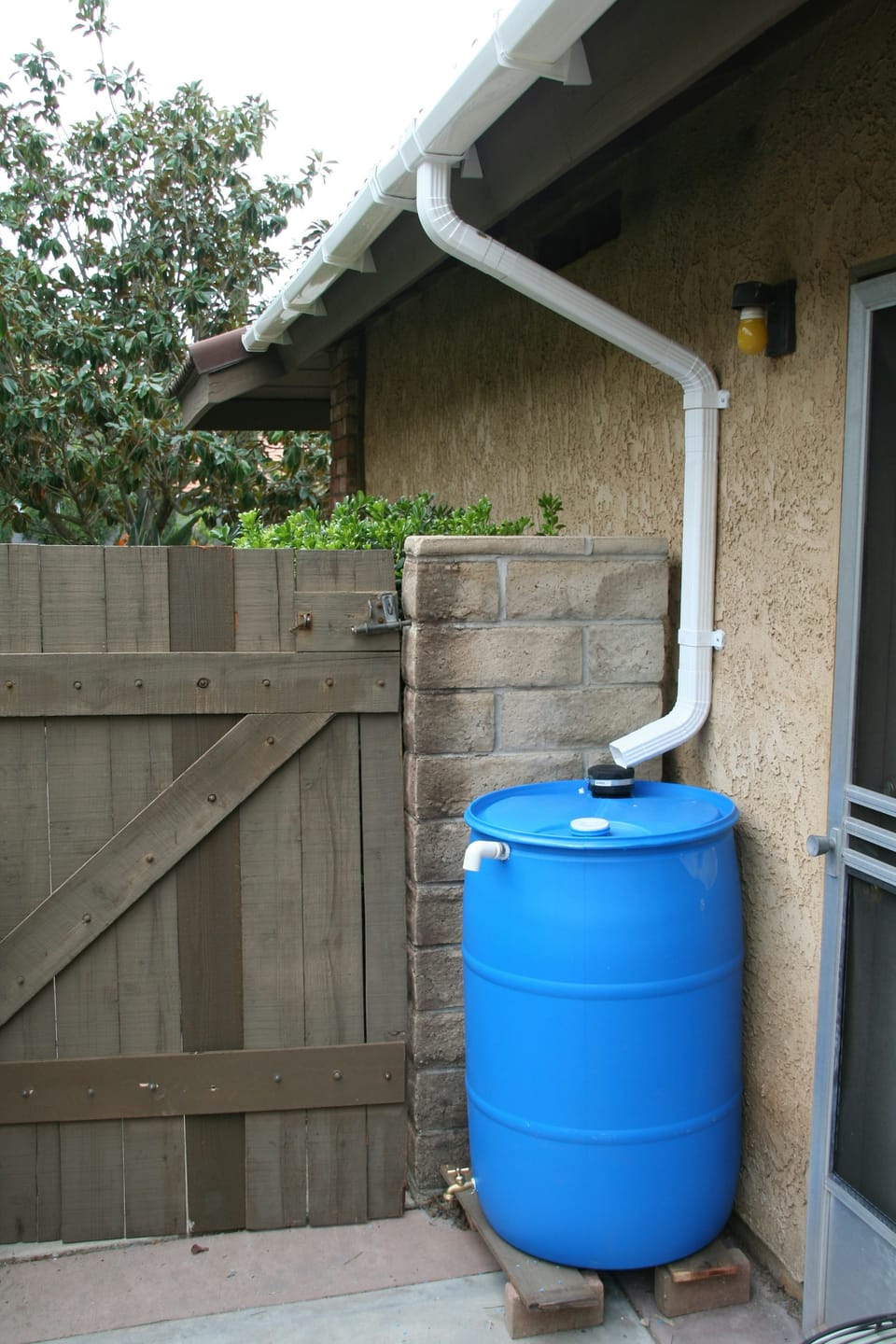
Yes. State law says you do not need a water right to use rainwater from your roof. Under the state plumbing code, a barrel or tank up to 5,000 gallons for drip or hose watering needs no permit if it sits on the ground, is no taller than twice its width, has no pump and is not hooked to tap water.
Listen to this article
Read aloud by an AI voice.
Until 2016, most Colorado homes could not legally use a rain barrel.[1] Today a Colorado household may keep two barrels, 110 gallons in all, and no more.[2]
Why ban a barrel? In much of the West, the water in a river belongs to whoever holds the right to use it, and rain off your roof would have ended up in their river. Colorado lawmakers voted down rain barrel bills over that worry.[1]
California settled it in 2012. The Rainwater Capture Act says using rain collected from a rooftop needs no water right.[3] The law sets no size limit.[3] Size only comes up in the plumbing code, and a barrel fills much faster than most people expect.
Do I need a permit?
For a barrel sitting on the ground, no. For a tank, usually not. The state plumbing code skips the permit for outdoor rain systems that stay simple.[4]
Source: 2025 California Plumbing Code, section 1601.3.[4] Your city or county has the final say.
Where people get tripped up is the 5,000 gallons. It is the limit for the whole system.[4] Our reading: tanks piped together count together, so two linked 3,000 gallon tanks are a 6,000 gallon system and need a permit. Separate tanks on separate downspouts are less clear, and Permit Sonoma's tank bulletin doesn't say how to count them.[5]
Cities can also set where a tank sits.[6] Our take: planning more than one big tank? Call your building department before you buy the second, and read your HOA's rules if you have one. Outside city limits in Sonoma County, that is Permit Sonoma, (707) 565-1900.[7]
How fast does a barrel fill?
Every inch of rain on 1,000 square feet of roof is about 500 gallons, about nine barrels (our math). Here is the formula for your own roof.
Measure the roof flat, as the footprint under it, and count only the part that drains to the downspout your barrel will sit under. The 0.623 is how many gallons one inch of rain puts on one square foot.[8] The 0.8 is our rule of thumb for rain that splashes off or overshoots the gutter. Or let the rain catch calculator do it.
Our calculation from NOAA National Weather Service data: 33.78 inches in an average Santa Rosa year, 80% caught.[9] Our rain calculator starts from Santa Rosa's 31.5 inch town normal, so it shows about 15,700 gallons for the same 1,000 square foot roof. Data and method.
A downspout that drains 250 square feet fills a 55 gallon barrel in less than half an inch of rain. Over a year, the same downspout sheds about 4,200 gallons, enough to fill that barrel 77 times.
And almost none of it falls when the garden is thirsty. In an average year, about 83% of Santa Rosa's rain comes from November to March. June to August bring almost none.[10][11] A full barrel won't carry a garden through summer, either: by our math, 55 gallons waters one 4 by 8 foot vegetable bed for about two weeks in July. See how much water a vegetable garden needs.
So a barrel is a start, not a summer supply. That raises two questions: how to keep the water clean, and what to do with the other 76 barrels.

How do I set one up?
Parts from rain harvesting guides and makers' leaflets.[12][13][14][15] Not to scale.
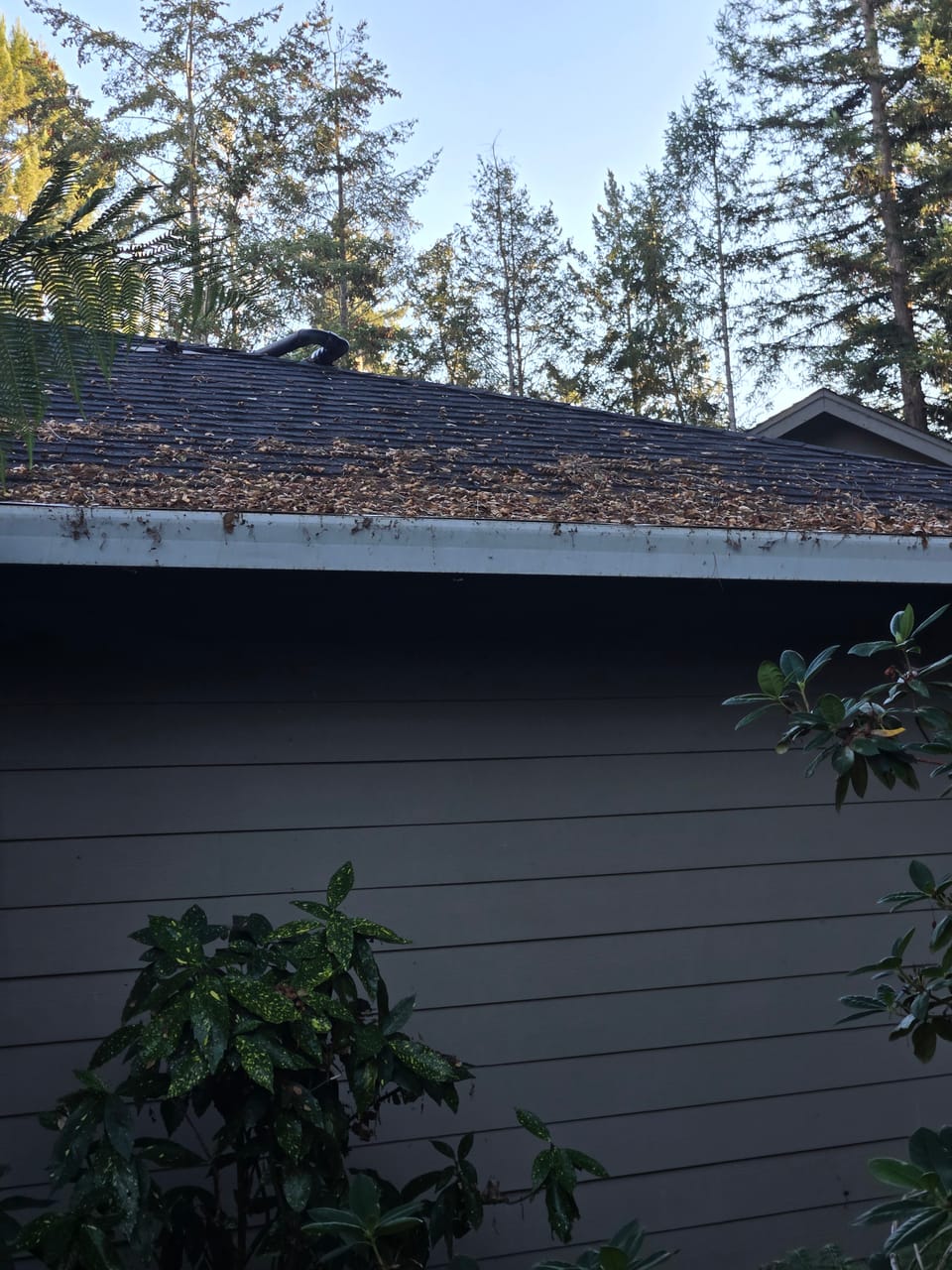
- Screen the gutter and the top of the downspout. Leaves and twigs stay out of the barrel.[12][13]
- Add a first flush diverter. The first water off the roof carries the most dirt and droppings. It fills a short pipe until a floating ball seals it, and the cleaner water flows on to the barrel. Check it after big storms.[13][12]
- Pick a dark barrel. Sunlight through the plastic grows algae.[12]
- Screen every opening with 1/16 inch mesh, under the lid and over the overflow. A mosquito can go from egg to adult in five to seven days. See mosquito larvae (wigglers) anyway? The Marin/Sonoma Mosquito and Vector Control District helps at no added cost: (707) 285-2200.[14]
- Plan the overflow. Point it away from the foundation and septic lines, onto ground that can soak it up.[12]
- Filter before drip lines. Sediment settles in the barrel, so put a filter ahead of drip irrigation.[15][12]
- Mind the roof. Metal and tile give the cleanest water. Skip cedar shakes and badly worn roofs. On asphalt shingles, don't skip the diverter.[8] On food crops, water at the soil with drip, not with sprinklers, since roof water can carry contaminants.[16]
Winter on the way? Here is what to do with a rain barrel in winter.
Where can the rest of the water go?
Most roof water runs to the street. Nearly all storm drains here empty into creeks untreated, and fast runoff carries soil with it.[8] That mud is hard on salmon eggs, as our sediment and salmon story shows. There are two better places for it.
A bigger tank
Watering through August takes far more than a barrel. Permit Sonoma wants a concrete pad under any tank of 5,000 gallons or more.[5] Size one with the tank size calculator. A tank can double as fire water, too. Home Ready Sonoma explains fire water tanks in Sonoma County.
Do you need a pump? Only if the tank sits lower than what you water.[12] Does a pump make it illegal? No. Roof rain needs no water right however you move it.[3] But a pump means the tank needs a plumbing permit, and a new outlet for it usually needs an electrical permit.[4][15]
Flushing toilets or running the washer with rain takes a permit.[4] In Santa Cruz County, for example, that means a plumbing plan, purple pipe and "NONPOTABLE RAINWATER" labels.[17] By our math, a family of four flushing from May to September needs about a 3,900 gallon tank, about 70 barrels, with 1.28 gallon toilets, and nearly three times that with old 3.5 gallon ones.[18][19] Our take: swap the toilet first.
The soil
The ground can hold more than any tank. Send the overflow to a planted low spot or a swale (a shallow, planted ditch that runs level across a slope), and it soaks in instead of running off. Water that sinks in can feed nearby creeks between storms.[8] See slow it, spread it, sink it and swales. Keep it off unstable slopes. Not sure about your spot? Read sink it or shed it.
Our take: every gallon held from winter is one your well or your utility doesn't have to supply in summer. That matters here. In 2025 the Sonoma Valley basin pumped about a fifth more groundwater than it can sustain, and farms pumped 58% of it.[20] See how your basin is doing in Sonoma County groundwater.
Have land? A pond is the biggest version of this. Filling one from your roof is fine; catching a creek needs a water right.[3][21] In unincorporated Sonoma County, digging more than 50 cubic yards (a hole about 30 by 18 feet and 2.5 feet deep), or deeper than 3 feet, needs a grading permit.[22] See ponds in Sonoma County.
Common questions
Can I raise the barrel on blocks?
The code's no-permit list says the tank sits directly on the ground.[4] We found no exception for a small barrel on a stand. If you want it higher, ask your building department first.
Do I have to treat the water?
Not for drip, soaker or underground watering, or for sprinklers fed by 360 gallons or less.[23] Other uses must meet the water quality your city or county sets.[23] For food crops, still use drip, as noted above.[16]
Can I hook it to my house plumbing?
Not directly. A rain system may not connect to your drinking water pipes. Tap water can top up a rain tank only through an air gap, open space between the tap and the tank water, and that setup needs a permit.[24][4]
Can I drink it?
The plumbing code's rain chapter is for water you don't drink.[4] Drinking it means filtering, disinfecting and testing, with your building department's OK first. See is your Sonoma County water safe to drink.
Will my utility pay for it?
Maybe. Santa Rosa lists a rainwater harvesting rebate, with a site visit before you start.[25] Amounts change, so check water rebates and call before you buy.
What it means for you
Colorado caps a household at 110 gallons. A 1,000 square foot roof sheds that in less than a quarter inch of rain (our math). In California, the question isn't whether you may catch rain. It's where you'll put it.
- Set one barrel on level ground under a downspout this month. It needs no permit, and one storm can fill it.
- Decide where the overflow goes before you buy a second barrel.
- Want water for August? Size a tank and keep it within the no-permit rules above.
Correction, Oct 18, 2026: We fixed the plumbing code permit triggers so every part of this page gives the same list, and added that roof water should not go on food crops through overhead sprinklers.
Photos by Devan Hemmings unless noted.
Sources
- 1. Colorado State University, Extension offers fact sheet on how to harvest rainwater under new Colorado rules (May 2016)
- 2. Colorado General Assembly, HB16-1005, Residential Precipitation Collection
- 3. AB 1750, Rainwater Capture Act of 2012, enrolled text (Water Code sections 10570 to 10574)
- 4. 2025 California Plumbing Code, section 1601.3, Permit, and its exceptions (effective Jan 1, 2026; reproduction)
- 5. Permit Sonoma, Water Storage Tanks bulletin (revised August 2018)
- 6. City of Pleasanton Building and Safety, Residential Rainwater Harvesting System handout (rev. Jan 2023)
- 7. Sonoma Water, Graywater (Permit Sonoma phone)
- 8. Sonoma RCD and RCD of Santa Cruz County, Slow it. Spread it. Sink it. Store it!, 2nd edition (June 2015)
- 9. NOAA National Weather Service, California-Nevada River Forecast Center, Climate Station Precipitation Summary (1991 to 2020 normals)
- 10. NOAA NCEI, 1991 to 2020 monthly normals, Santa Rosa (USC00047965)
- 11. NOAA National Weather Service, California-Nevada River Forecast Center, Monthly Precipitation Summary, Water Year 2025
- 12. Hayes, Kirk-Ballard and Timmerman, Rainwater Harvesting for Small Nurseries and Home Gardens, LSU AgCenter Pub. 3900 (Nov 2023)
- 13. JoJo Tanks, First Flush Diverter product leaflet (how the floating ball diverter works)
- 14. Marin/Sonoma Mosquito and Vector Control District, Rain harvesting and mosquitoes (2021)
- 15. County of Ventura Building and Safety, Guidelines for Non Potable Rainwater Catchment Systems (Mar 2015)
- 16. UC Master Gardeners of Sonoma County, Food Gardening With Less Water (Feb 2014)
- 17. County of Santa Cruz Building, Rainwater Harvesting handout (California Plumbing Code Chapter 16)
- 18. WaterDM, Results from 1999 and 2016 Residential End Uses of Water Studies, memo to the Alliance for Water Efficiency (Apr 29, 2020)
- 19. California Health and Safety Code 17921.3 as quoted in AB 723 (2015), introduced text
- 20. Sonoma Valley Groundwater Sustainability Agency, Annual Report Water Year 2025 Fact Sheet
- 21. Bush, Niebrugge, Trotter and Lewis, Registering Your Marin County Farm Pond with the State Water Resources Control Board, UC Cooperative Extension Marin, November 2016
- 22. Permit Sonoma, Frequently Asked Questions about Grading and Storm Water
- 23. 2025 California Plumbing Code, section 1601.7, Minimum Water Quality Requirements (reproduction)
- 24. 2025 California Plumbing Code, section 1602.4, Connections to Potable or Reclaimed Water Systems (reproduction)
- 25. City of Santa Rosa, Rebates and Free Services
Checked 2026-11-04. Rules and programs change. If something here is out of date, the source above wins. Spot an error? See our corrections policy.
Related reads
 Rain catch calculator for your roofA 1,000 square foot roof catches about 15,700 gallons in an average Santa Rosa year. Enter your ZIP and roof size to see yours.Rain and storage · Updated Oct 18, 2026
 How much rain Sonoma County gets, town by town and month by monthSanta Rosa gets about 30 to 34 inches in an average year, depending on the gauge and the years counted. Petaluma gets about 26 and Healdsburg about 43. Most of it falls from November to March.Rain and storage · Updated Oct 18, 2026
 Water storage tank size calculatorAnswer a few questions about your household, animals and garden. The calculator works out your daily use, then the tank size for the days you want to cover, and whether one tank or several fits.Rain and storage · Updated Oct 18, 2026