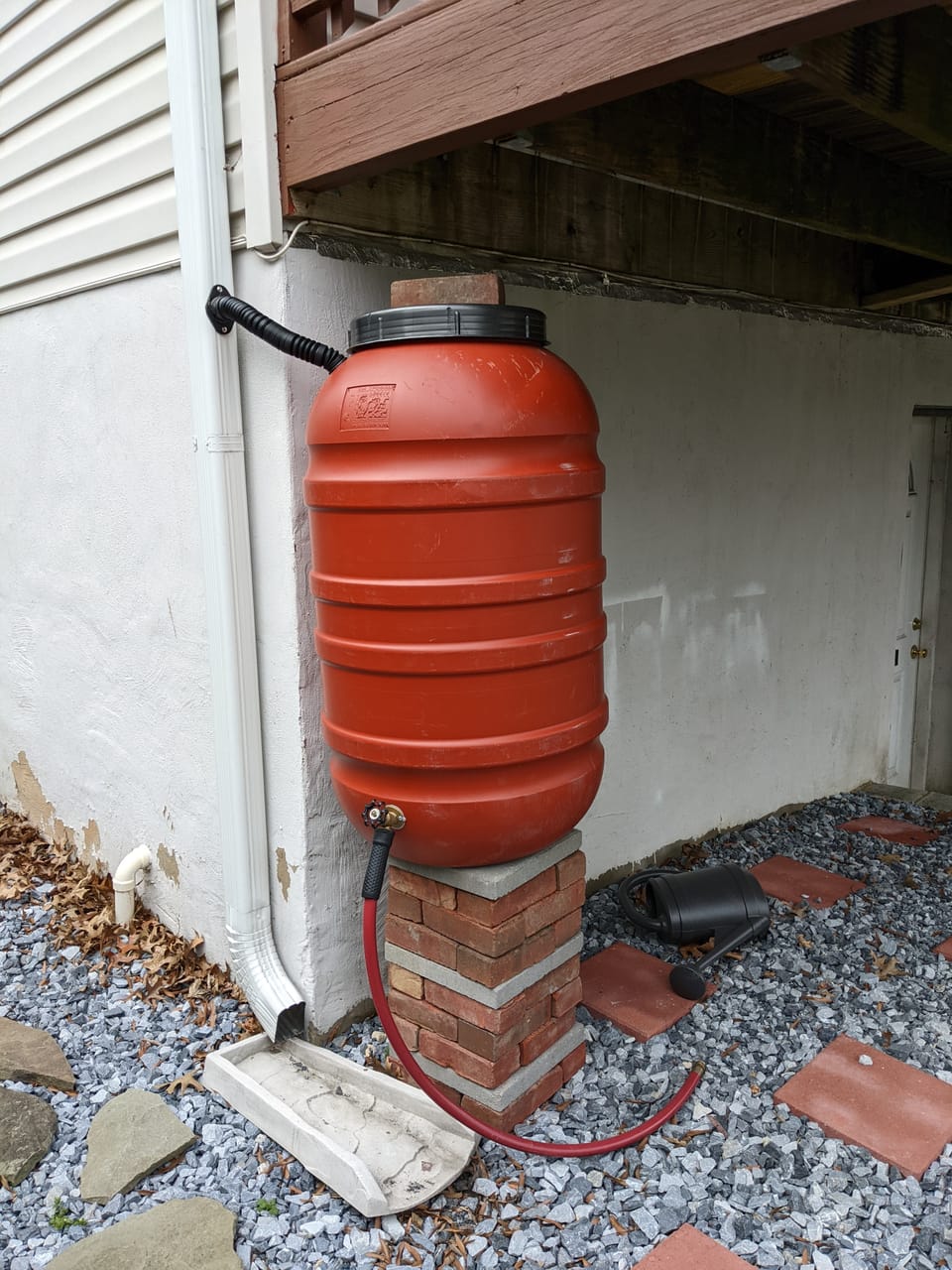
Rain and storageGuide
What to do with a rain barrel in winter: drain it or keep it catching?
It depends on your winter. Where hard freezes last for days, drain the barrel before the first one, leave the spigot open, disconnect it and store it indoors or upside down. Where winter is the rainy season and freezes are brief, keep it hooked up: clean it, check the screens and send the overflow away from the house.
Listen to this article
Read aloud by an AI voice.
Picture the corner of your house where the downspout meets the barrel. Before the next storm, that barrel should be either working or put away. Which one depends on how long your cold lasts. Here is how to tell, and what to do either way.
Drain it or keep it? It depends on how cold your winter gets
Water grows by about 9% when it freezes. That is enough force to split a plastic barrel, especially a full one.[1] So most rain barrel advice, written where winters are long and hard, says the same thing: empty and disconnect the barrel before the first hard freeze.[1][2][3]
The ice that cracks barrels comes from a hard freeze: 28°F or colder for a long stretch.[1] So the real question is whether your nights at 28°F come one at a time, between milder days, or many in a row.
The chart shows the two ends of that range. In Columbus, Ohio, nights at 28°F or colder come for about five months, and almost a month of days never get above freezing: drain the barrel. In Santa Rosa, California, they come for about seven weeks, and the days warm up: keep it catching.[4][5]
To find your own dates, go to weather.gov and pick your local forecast office. Under "Climate and Past Weather", open "Past Observed Weather", choose "first/last dates" and enter 28°F.[1] Somewhere in between? Go by how long your cold spells last. If it stays below freezing for days at a time, put the barrel away.
Where winters freeze hard: put it away
- Drain it before your first hard freeze, and leave the spigot open.[2][3]
- Disconnect it from the downspout and the hose.[6]
- Clean it while it's empty. Hose out the leaves and sludge, and replace torn screens or leaky valves.[1]
- Store it in a shed or garage, or upside down outside, tied to a post so the wind can't take it.[2][7]
- Put the downspout back. If you cut it short for the barrel, reattach the piece you removed, and add an elbow at the bottom so water runs away from the house.[2][6]
Hook the barrel up again after your last hard freeze in spring.[1]
Where winter is the rainy season: keep it catching
In some places, like the San Francisco Bay Area, summers are long and dry and most of the year's rain falls in winter.[8] If that's you, putting the barrel away means putting it away for the rain. Keep it hooked up instead, and do these before the first big storm.
- Clean it out. Drain and scrub the barrel once a year.[8] Do it now, while summer has left it nearly empty.
- Clear the gutters. Falling leaves clog them.[3] Clean the screen on the barrel's inlet after each storm.[7]
- Empty and check the first flush diverter, if you have one. It's a short pipe that catches the first, dirtiest water off the roof, then lets cleaner water on to the barrel. The first storm after a dry summer carries the most dirt.[8] Here is how a barrel and diverter are set up.
- Keep every opening screened, the overflow too. Mosquitoes breed in standing water and can get in through the overflow hole.[6]
- Plan where the overflow goes. In a wet winter, the barrel will likely overflow.[8] Send it onto a lawn, a garden bed or a rain garden (a planted low spot that soaks up water), never toward the foundation, a driveway or a septic system.[7] For how far is far enough, see how far downspouts should be from the house.
That last step matters most, because a barrel fills fast. If a quarter of a 1,200 square foot roof drains to one downspout, a 1 inch rain sends about 185 gallons down it. That fills more than three barrels.[7] So in a big storm, most of the water goes out the overflow. Sent into the ground, it soaks in instead of running to the storm drain, which in most places carries it to a creek untreated.[7]
What about a cold night? Our take: since a full barrel is the one most likely to crack, draw off a few gallons if a night at 28°F or colder is forecast.[1]
If you keep it catching: use the water now, or save it?
An empty barrel has room for the next storm, so stormwater experts say to empty it between storms.[3][7] But where summers are dry, winter rain is worth saving for spring and summer watering.[8] You can do both, at different times of year.
Our take: through the stormy months, drain the barrel slowly onto planted ground a day or two after each storm, so the water soaks in and the barrel is ready again. As the storms thin out in spring, close the spigot and let it stay full. That barrel becomes your first summer watering. Standing water can breed mosquitoes in about a week, so keep every opening screened.[7][3]
In Sonoma County
- Keep it catching. About 83% of Santa Rosa's rain falls from November to March, so stop draining around March.[9]
- Screen it the way the local mosquito district asks. The Marin/Sonoma Mosquito and Vector Control District asks for 1/16 inch mesh under the lid and over the overflow. The district helps with mosquito problems at no added cost: (707) 285-2200.[10]
- Rebate: Santa Rosa Water offers a rainwater harvesting rebate. Get approval before you start any work: (707) 543-3985.[11] Other utilities: see water rebates.
- Is a bigger tank legal? See are rain barrels legal in California.
What it means for you
- Look up your town's hard-freeze dates before you drain anything.
- Before the next storm, clean the barrel and screens and point the overflow away from the house.
- Want more than a barrel holds? Size a tank with the tank size calculator.
Sources
- 1. Penn State Extension, Rain Barrel Winter Maintenance: Don't Forget to Disconnect! (updated December 15, 2022)
- 2. Rutgers Cooperative Extension of Camden County, Winterizing Your Rain Barrel
- 3. Virginia Cooperative Extension, Stormwater Management for Homeowners Fact Sheet 2: Rain Barrels, SPES-10P (June 2024)
- 4. NOAA NCEI, U.S. Climate Normals 1991 to 2020, annual and seasonal, Columbus, Ohio airport (USW00014821)
- 5. NOAA NCEI, U.S. Climate Normals 1991 to 2020, annual and seasonal, Santa Rosa Sonoma County Airport (USW00023213)
- 6. Rutgers Cooperative Extension, Rain Barrels Part II: Installation and Use, FS1118 (February 2025)
- 7. University of Nebraska-Lincoln Extension, Stormwater Management: Rainwater Harvesting with Rain Barrels, G2220 (2014)
- 8. UC Master Gardeners of Alameda County, Managing Bay Area Rainwater in a Changing Climate (August 28, 2026)
- 9. NOAA NCEI, 1991 to 2020 monthly normals, Santa Rosa (USC00047965)
- 10. Marin/Sonoma Mosquito and Vector Control District, Rain harvesting and mosquitoes (2021)
- 11. City of Santa Rosa, Rebates and Services
Checked 2026-11-10. Rules and programs change. If something here is out of date, the source above wins. Spot an error? See our corrections policy.
Related reads
 Rain and storageRain catch calculator for your roofA 1,000 square foot roof catches about 15,700 gallons in an average Santa Rosa year. Enter your ZIP and roof size to see yours.Updated Oct 18, 2026
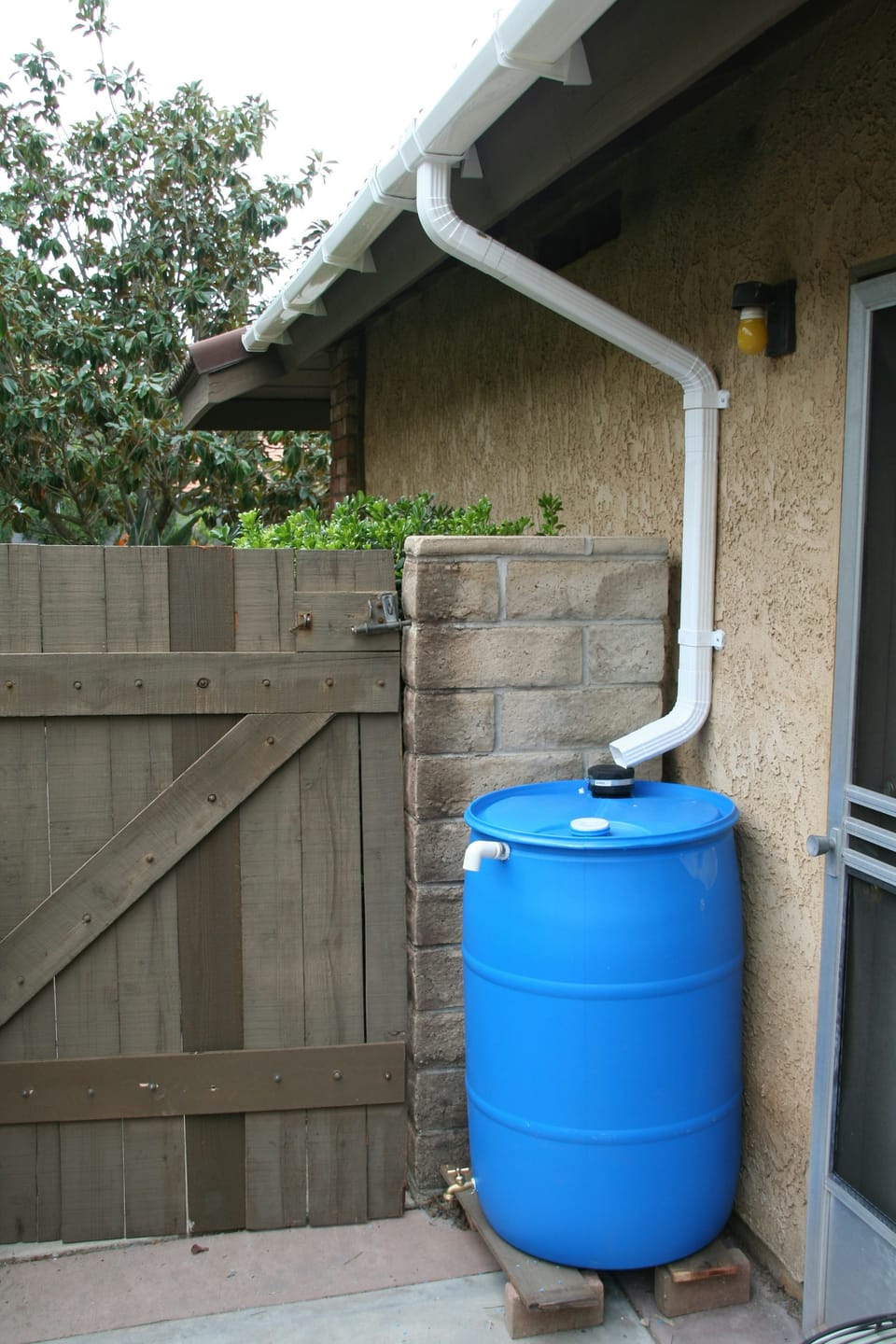 Rain and storageAre rain barrels legal in California? Yes. Here is when you need a permitYes. State law says you do not need a water right to use rainwater from your roof. Under the state plumbing code, a barrel or tank up to 5,000 gallons for drip or hose watering needs no permit if it sits on the ground, is no taller than twice its width, has no pump and is not hooked to tap water.Updated Nov 4, 2026
 Rain and storageHow much rain Sonoma County gets, town by town and month by monthSanta Rosa gets about 30 to 34 inches in an average year, depending on the gauge and the years counted. Petaluma gets about 26 and Healdsburg about 43. Most of it falls from November to March.Updated Oct 18, 2026