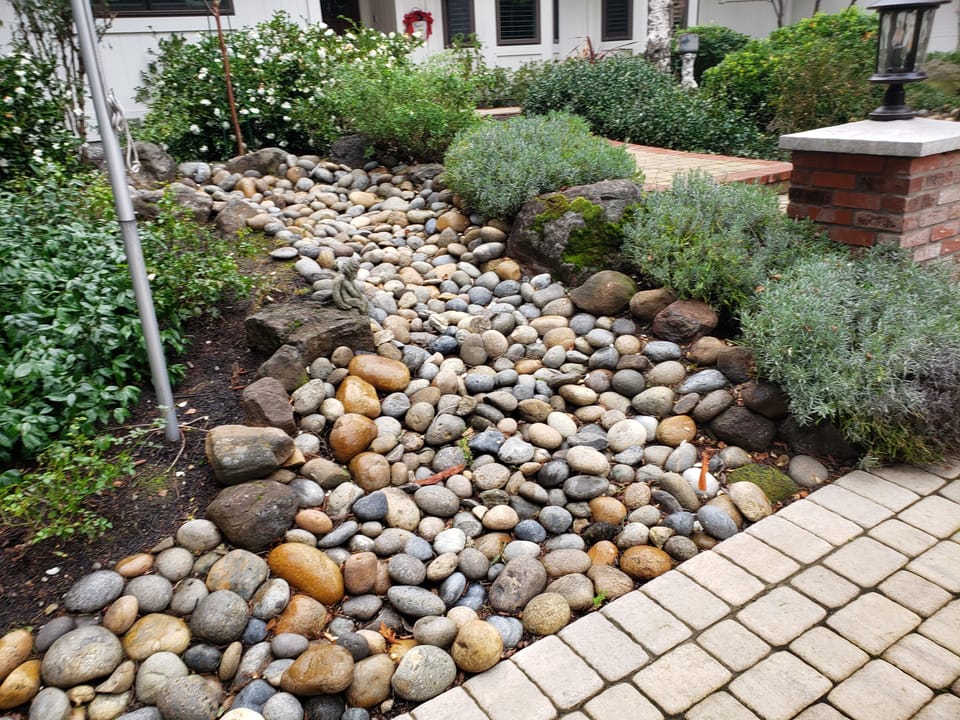
Slow it, spread it, sink it: downspouts, rain gardens and how big to dig
Turn your downspouts toward planted ground, put gravel under the roof edge, and slope the soil away from the house. Then, if a test hole drains within a day, dig a shallow rain garden: about 56 square feet for 1,500 square feet of roof draining to it.
Listen to this article
Read aloud by an AI voice.
You know the spot. The downspout at the corner of the house that dumps onto the driveway, where a little stream runs to the street every time it storms.
That water is gone to the street in minutes, and it takes soil and whatever was on the driveway with it.[1]
It adds up. A 1,500 square foot roof sheds about 31,600 gallons in an average Santa Rosa year (our calculation).[2]
Sonoma County's Resource Conservation District, a local agency that helps landowners care for soil and water, says do the opposite: slow it, spread it, sink it. Keep rain on your land, where it waters plants and soaks toward the groundwater.[1]
Here are the three moves we would make first, how big to dig a rain garden, and what to keep the water away from.
Start with these three moves
None of these needs a designer. Each takes an afternoon or less.
- Turn one downspout toward planted ground. Not the driveway, and not the foundation. A downspout extension or a pad of rock where the water lands keeps it from digging a hole.[1] Have each downspout empty at a spot 20 to 50 feet from the next one, so no one spot gets all the roof water.[1]
- Put gravel under the drip line. The drip line is the strip of ground where rain falls off the edge of the roof. Cover it at least 3 inches deep. On a one-story house, start 6 inches in under the roof edge and go at least 12 inches out past it.[1] Our take: use gravel or washed rock here, not wood mulch. Skip wood mulch in the first 5 feet around the house, because wood mulch burns.[3] Our sister site, Zone Zero Guidelines, covers gravel in that first 5 feet around a home.
- Slope the ground away from the house. It should fall at least 6 inches over the first 10 feet out from the foundation.[1]
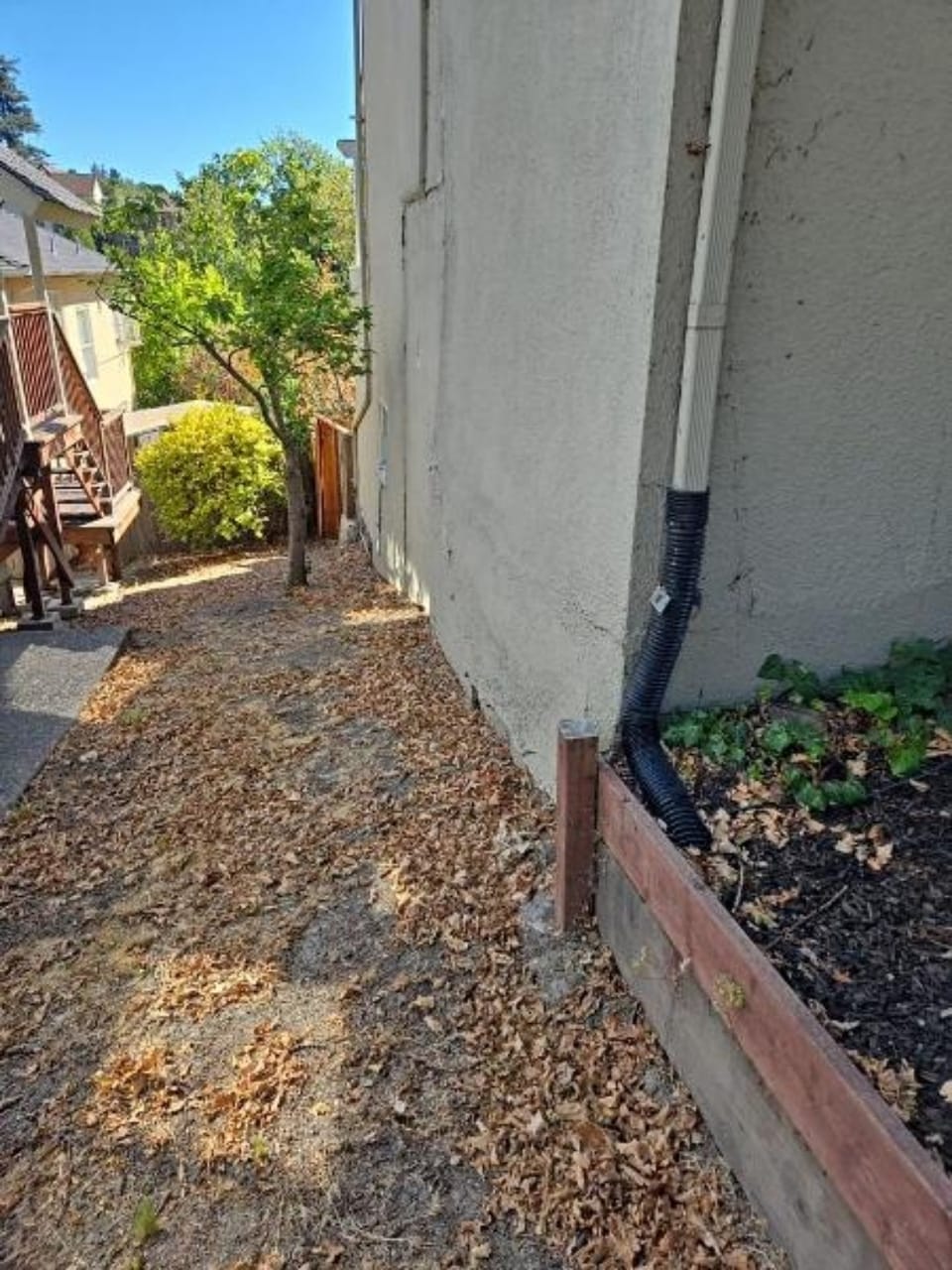
Walk your property in the rain
You cannot plan where water should go until you have watched where it goes now.
- Wait for a real storm, one that drops more than half an inch. Skip the first storm of the season and the first few minutes of rain.[1]
- Walk the property and sketch it. Draw arrows where water runs and where it pools. Take photos.
- Watch what the water does at five places: roofs, decks and other raised structures, walkways and patios, driveways and parking, and bare soil or planted ground.[1]
- Mark your septic system, if you have one: the tank, the leach field (the buried pipes that spread the wastewater), and the spare area set aside for a new leach field. Keep rain water away from all three.[1]
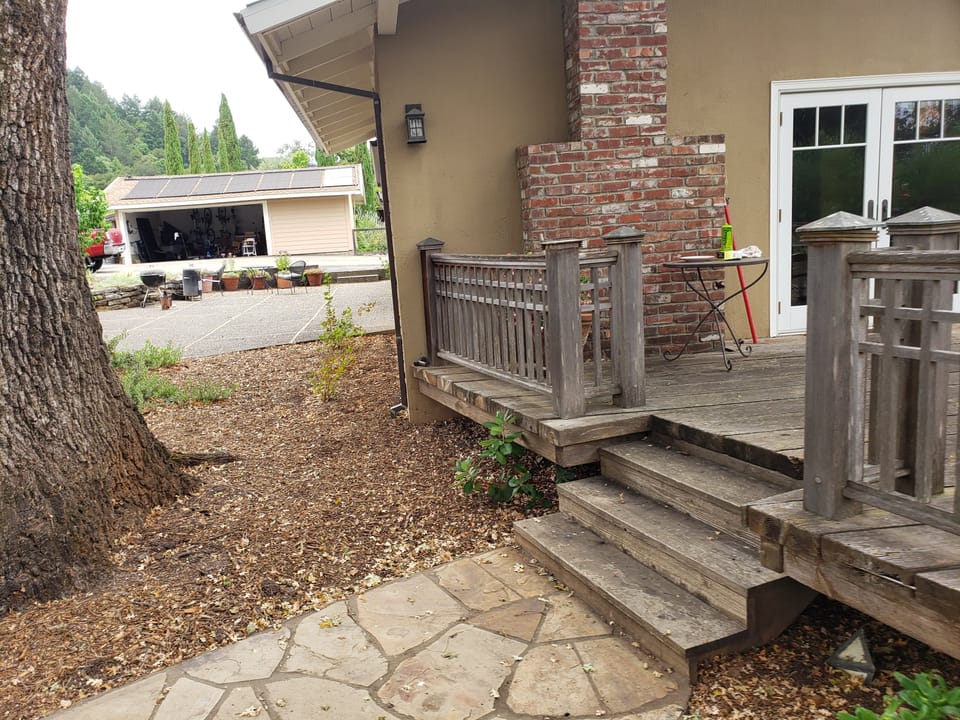
How big should a rain garden be?
A rain garden is a shallow planted dip that catches water from a roof or driveway and lets it soak into the ground.[4] It also helps filter out pollutants, and feeds butterflies and birds.[4]
Our take: if a test hole in your soil drains within a day, make the garden about 4 percent of the roof area that drains to it, and 6 inches deep. That size comes from the Bay Area's stormwater agencies.[5] The University of California (UC) North Coast rain garden guide goes much bigger: at least 20 percent of the roof, about 9 inches deep, so it can hold about an inch of rain.[6] For the same roof, the UC garden is more than five times bigger.
Compare the top bar with the middle one: that gap is what your soil has to soak up while the storm is still falling.
Our calculation from the Bay Area and UC sizes and 1 inch of rain on the roof. Method: garden area times depth.
- The small garden does not hold the whole storm. The soil soaks some in while it fills, and the rest goes out the overflow. That is why every rain garden needs one.
- So test your soil first. Dig a hole 6 inches deep, fill it with water and check it the next day. Gone within 24 hours: the soil can take a rain garden.[7] Test in the rainy season or spring, not when the soil is dry and cracked.[7] The steps are in our 24-hour soak test.
- Why we pick the smaller size. It is a garden most people will actually dig, and with an overflow it still catches the first part of every storm. The Bay Area agencies say to go bigger where soil drains slowly.[5]
- If you have the room, bigger holds more. A UC size garden holds a whole 1 inch storm off the roof, with room to spare (our calculation).[6]
- If the hole still holds water the next day, the soil drains too slowly for a rain garden.[7] See when to sink rain and when to drain it away.
Find the roof area that drains to your garden in the left column. The next column shows the garden size, using the Bay Area rule. The rain calculator explains how to measure a roof.
| Roof area draining to the garden | Garden size | Holds at once |
|---|---|---|
| 500 to 700 sq ft | 24 sq ft | about 90 gal |
| 701 to 900 sq ft | 32 sq ft | about 120 gal |
| 901 to 1,100 sq ft | 40 sq ft | about 150 gal |
| 1,101 to 1,300 sq ft | 48 sq ft | about 180 gal |
| 1,301 to 1,500 sq ft | 56 sq ft | about 209 gal |
| 1,501 to 2,000 sq ft | 70 sq ft | about 262 gal |
Garden sizes from the Bay Area stormwater agencies, for a garden 6 inches deep. Over 2,000 sq ft, add 20 sq ft of garden for each extra 500 sq ft of roof.[5] "Holds at once" is our calculation.
How to build a rain garden
Follow the water from the downspout, left to right.
- Pick the spot. At least 10 feet from the house, so water does not soak toward the foundation.[7] Keep it at least 40 feet from a septic system or a steep slope.[1] Choose fairly flat ground away from big trees and buried pipes.[5][6]
- Call 811 at least two working days before you dig. 811 is the call-before-you-dig number. They get buried lines marked.[1]
- Dig the dip about 6 inches deep. Then loosen the soil below it about a foot down, and mix in about 3 inches of compost.[5]
- Build a berm on the downhill side. That is a low ridge of soil, 3 to 6 inches high, that holds the water in.[6]
- Put rock where the water comes in, so it does not dig a hole.[5]
- Plan the overflow. Decide where the extra goes in a big storm: to other planted ground.[5] Our take: send it away from the house and the neighbor's yard.
- Plant it. Sedges and rushes go in the center, where water stands. Native shrubs that like drier soil go at the edges.[1] UC's North Coast plant list includes common rush, clustered field sedge, yarrow, California fuchsia and yerba buena.[6] More ideas: drought tolerant plants for Sonoma County.
- Watch it after the next storm. The water should be gone within 3 days.[1] Water that stands longer kills plants and can breed mosquitoes.[5]
Bigger moves: swales and soak pits
When one rain garden is not enough, these move or store more water. Swales and soak pits are bigger jobs.
- A sloped swale is a planted ditch that carries water slowly to where it can soak in. It needs a slope of at least 2 percent.[1] Some swales are dug level to hold water instead. Our guide to swales explains both kinds.
- A soak pit or trench is a gravel-filled hole that lets water soak deeper. Have a professional design it. Keep it no deeper than 3 feet. It should drain within 3 days.[1] Thinking of something deeper? Read what a dry well is and where one can go.
- A rain barrel stores some roof water for summer. Cover it with mesh no coarser than 1/16 inch to keep mosquitoes out.[1] See are rain barrels legal in California?
Ground still soggy after these fixes? See do you need a French drain?
What to keep the water away from
Look at the bars: the well gets the widest berth.
- Your septic system. Never send water toward the tank or leach field. Keep rain gardens at least 40 feet away.[1]
- Your drinking water well. Our take: keep rain gardens, swales and soak pits at least 100 feet from it. That is the distance the Resource Conservation District's guide uses for pervious paving.[1] Dirty water should get no shortcut to your drinking water.
- Clay and soggy ground. On clay, or where the ground stays soaked near the surface all winter, never build a rain garden without an overflow.[1] If your test hole still holds water the next day, skip it.[7]
- Bare slopes. Bare soil on a slope washes away before it soaks anything in. See how to stop erosion on a slope.
- Work that needs a permit. If you live outside city limits, Sonoma County needs a drainage permit before any drainage work. Some work is exempt.[8] Ask Permit Sonoma, the county's permit office, before you start. Inside a city, ask the city. See when you need a permit to change drainage.
Why the creeks care
Fast runoff wears away creek banks and harms wildlife habitat.[1] The soil it carries ends up in creeks.[1] There it clogs the spaces between stones where small water insects live.[9] Young salmon eat those insects. So do swallows and bats, once the insects grow wings and fly up off the water.[10] Why that matters for salmon eggs: how fine sediment hurts salmon eggs.
Water that soaks in instead stays in your soil for your plants, and some of it sinks on toward the groundwater. Between storms, most of the water in a creek usually comes from groundwater seeping in.[11] That seepage also keeps the creek's temperature steadier, which matters to salmon and other fish that need cold water.[12] See can your yard recharge groundwater?
What should I do now?
- Go back to that corner downspout. Point it at planted ground this week.
- Do the 24-hour soak test.
- If the hole is empty the next day, dig a rain garden at the size in the table above.
- Give every rain garden an overflow, and keep it away from the house, the septic system and the well.
Next: see how many gallons your roof sheds with the rain calculator. Want help? Our directory lists local groups that teach rain garden workshops and landscapers who build them.
Photos by Devan Hemmings unless noted.
Sources
- 1. Sonoma Resource Conservation District and RCD of Santa Cruz County, Slow It. Spread It. Sink It. Store It! A Homeowner's Guide to Beneficial Stormwater Management (2nd ed., June 2015)
- 2. NOAA California-Nevada River Forecast Center, Climate Station Precipitation Summary, Oct 17, 2026 (Santa Rosa 1991 to 2020 normal)
- 3. UC Master Gardeners of Sonoma County, Types of mulch
- 4. US EPA, Soak Up the Rain: Rain Gardens (archived January 2025)
- 5. Bay Area Stormwater Management Agencies Association, Rain Gardens: Stormwater Control for Small Projects (2012)
- 6. Myers, Swain and Giraud, California Sea Grant and UC Cooperative Extension, North Coast Rain Gardens
- 7. University of Nebraska-Lincoln Extension, Rain Garden Design for Homeowners (G1758)
- 8. Permit Sonoma, Storm Water (Drainage) Permits
- 9. Gragson and Cooley, Alabama Cooperative Extension System, Sediment's Impact on Waterways and Aquatic Life (ANR-3168, August 2025)
- 10. Nicholas Wright, Hidden links between aquatic and terrestrial ecosystems, part 3: Eel River (California WaterBlog, UC Davis Center for Watershed Sciences, Sept 10, 2023)
- 11. US Geological Survey, Circular 1139, Ground Water and Surface Water: A Single Resource (1998), natural processes
- 12. US Geological Survey, Using temperature to study stream-ground water exchanges (Fact Sheet 2004-3010)
Checked 2026-10-19. Rules and programs change. If something here is out of date, the source above wins. Spot an error? See our corrections policy.
Related reads
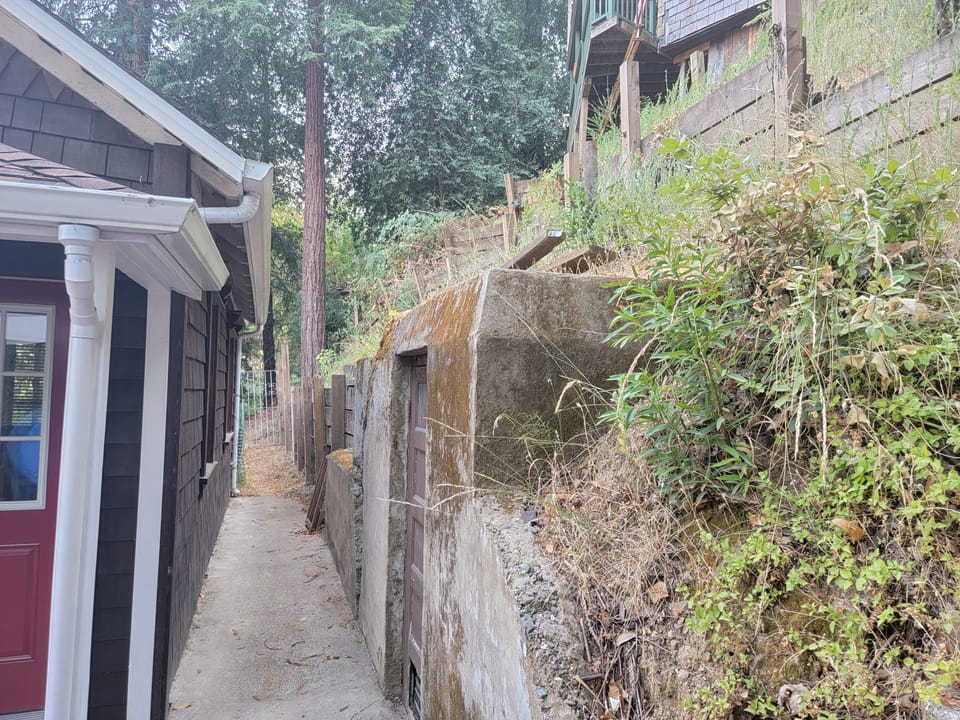 Sonoma County grading and drainage permits: when your yard project needs oneOutside city limits, Sonoma County needs a grading permit to dig out or fill in more than 50 cubic yards of soil, to go more than 3 feet deep, and for some smaller jobs on slopes or in flood zones. Building or changing a drain or ditch needs a drainage permit, except for repairs, some small pipes and ditches, and a few other cases.Stormwater and drainage · Updated Nov 21, 2026
 Sink it or shed it? When to keep rain on your land and when to drain itMost properties need both. Sink clean water where the soil can take it and nothing will be harmed. Shed water, slowly and safely, where soaking it in would threaten a foundation, a slope, a septic system or a neighbor. The craft is deciding which water goes where.Stormwater and drainage · Updated Oct 18, 2026
 Swales: what they do, how to build one, and when not toA swale is a shallow ditch that slows rainwater. Dug level across a slope, it holds water so it soaks in. Built with a gentle fall, it carries water away slowly. Both work only in the right place, and both need a planned overflow. Start by watching your slope in the next storm.Stormwater and drainage · Updated Oct 18, 2026