Sonoma County grading and drainage permits: when your yard project needs one
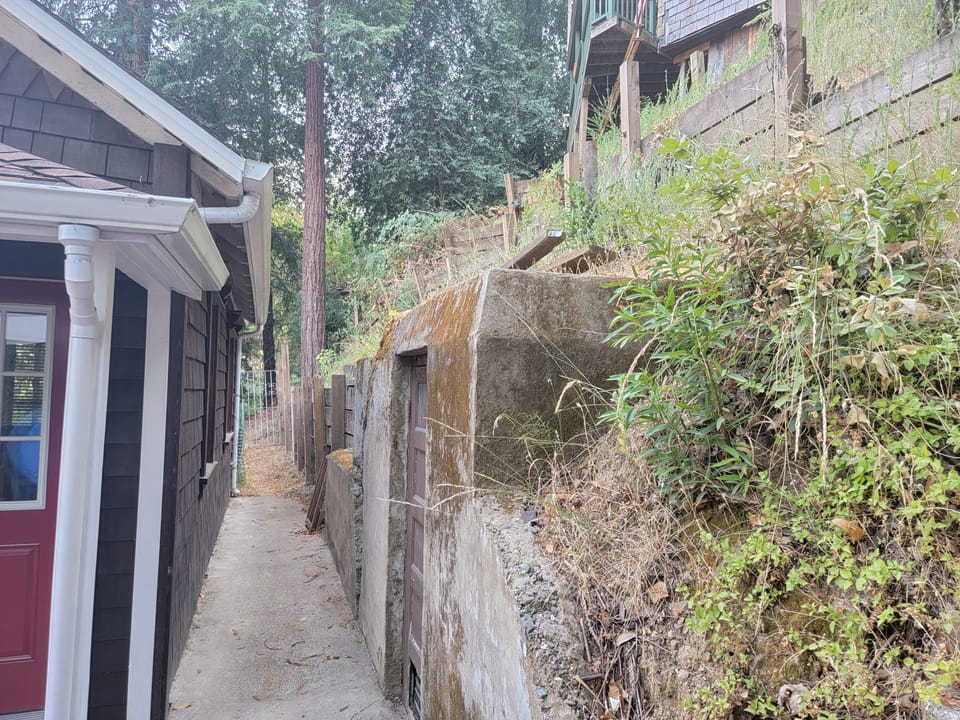
Outside city limits, Sonoma County needs a grading permit to dig out or fill in more than 50 cubic yards of soil, to go more than 3 feet deep, and for some smaller jobs on slopes or in flood zones. Building or changing a drain or ditch needs a drainage permit, except for repairs, some small pipes and ditches, and a few other cases.
Listen to this article
Read aloud by an AI voice.
A drainage permit covers almost any new or changed drain, ditch or pipe.[1][2]
Not sure? Call Permit Sonoma, the county's permit office, at (707) 565-2268.[3] Inside Santa Rosa, Petaluma or another city, the county rules don't apply; ask that city's building or public works office.[2]
Do I need a permit for my project?
Walk down the three steps. Grading means digging soil out (a cut) or piling it up (a fill).[4]
Grading: Permit Sonoma's list.[4] Drainage: the county code.[2]
How much soil is 50 cubic yards?
Here is how big a patch 50 cubic yards covers at different depths.
| Depth | Area covered | About the size of |
|---|---|---|
| 3 inches | 5,400 sq ft | 60 by 90 feet |
| 6 inches | 2,700 sq ft | 45 by 60 feet |
| 1 foot | 1,350 sq ft | 30 by 45 feet |
| 3 feet | 450 sq ft | 15 by 30 feet |
Our calculation: 50 cubic yards is 1,350 cubic feet. Divide by the depth to get the area.
If your job is close to any line in the chart, call before you dig. Routine farming does not count as grading.[4]
Which drainage work is exempt?
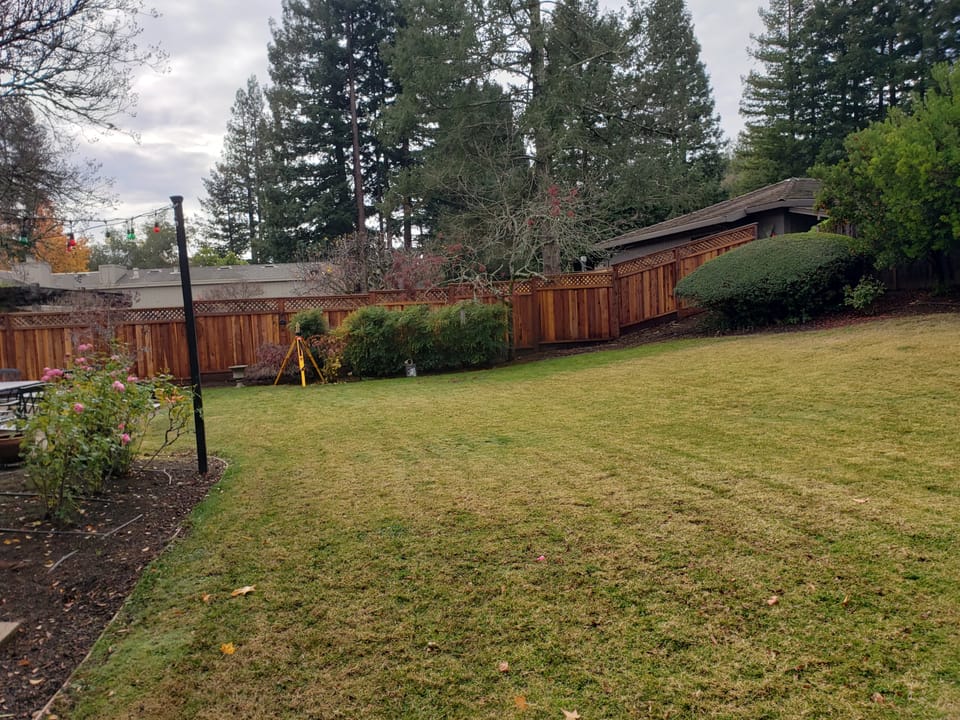
No drainage permit is needed for these:[2]
- Repairs. Fixing or replacing an existing, legal drain in the same place, without changing its size.
- A small pipe or swale. A swale is a shallow grassy or rocky ditch. All of these must be true:
- Less than half an acre of land drains into it (a quarter acre for corrugated pipe, the ridged kind).
- It is outside the county's mapped flood-prone urban area.
- A pipe is a single run, at least 8 inches across. A swale is no deeper than 9 inches, with sides no steeper than 1 foot up for 2 across.
- It drops 2% to 4%, about 2½ to 5 inches every 10 feet (our conversion).
- Part of a bigger permit. Drainage built under a grading, building or septic permit is covered by that permit.
- Emergencies. You may do only what stops an immediate danger. Tell the county by the next business day and apply within 10 days.
Our reading: a French drain or a buried downspout line is a pipe. So it needs a drainage permit unless it passes the small-pipe test or replaces an old one at the same size.
Near a creek, pond or wetland?
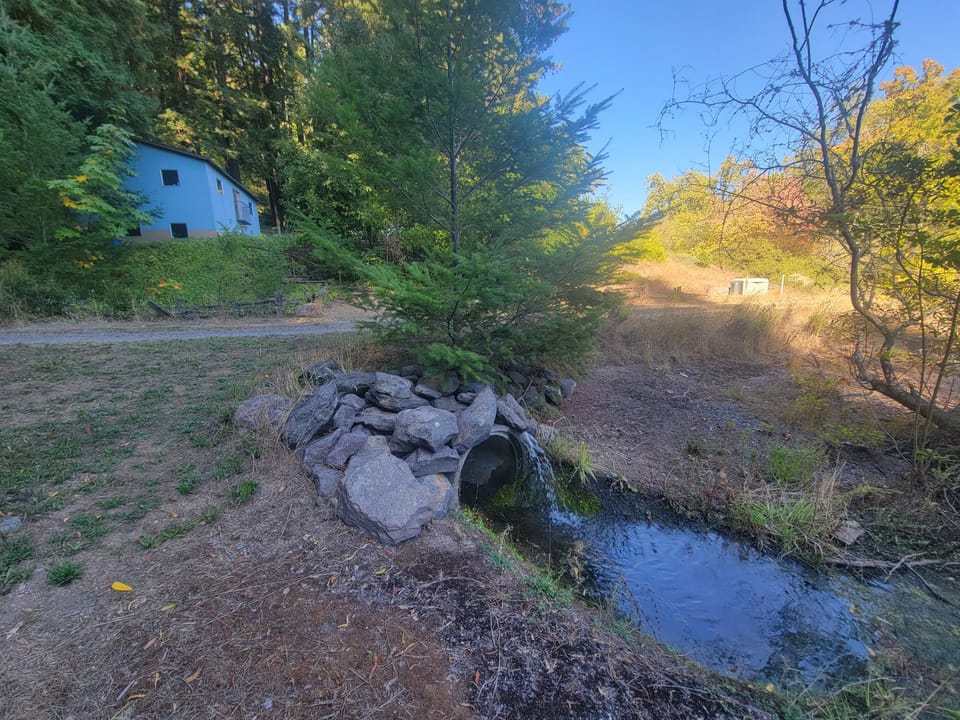
The rules exist partly to keep soil out of streams, lakes and wetlands.[4] Mud that washes into a creek settles in the gravel where salmon lay eggs; see how fine sediment hurts salmon eggs.
- Stay back. Grading stays at least 25 feet from the top of a creek bank and 50 feet from a pond or lake. A parcel's zoning can require more, and wetlands usually need 50 to 100 feet.[5] Plants in that strip help the creek: trees and shrubs catch soil before it reaches the water, shade the water to keep it cool, and give fish, insects and other wildlife a place to live.[6]
- Tell the state first. Work that substantially changes a creek's bed or bank, or blocks or diverts its flow, needs written notice to the California Department of Fish and Wildlife, a fee and its reply before you start.[7]
What does a permit cost, and how long does it take?
- Cost. Most grading permits run about $2,000 to $4,000.[4] Drainage fees depend on the site, and the county sets them only once it accepts the application.[8]
- Time. Staff aim to send first comments within six weeks of a complete application. There is no set deadline.[4]
- Who draws the plans. The owner can for small jobs. Bigger, deeper or steeper jobs, and jobs in flood or landslide zones, need a civil engineer.[4][1]
- After approval. A grading permit lasts three years. Work starts after a meeting with county staff and ends with a final inspection.[3][4]
- Starting early. Even clearing the site before the permit is issued breaks county code and can bring fines.[3]
What it means for you
- Still not sure? Permit Sonoma has a grading questionnaire you can fill out before you call.[3]
- Fixing a soggy yard? Start with do you need a French drain?, which covers what to try before you dig.
- Want to keep rain on your land? See slow it, spread it, sink it.
Photos by Devan Hemmings unless noted.
Sources
- 1. Permit Sonoma, Storm Water (Drainage) Permits
- 2. Sonoma County Code, Chapter 11: Grading, Drainage, and Vineyard and Orchard Site Development (Ord. No. 6338, 2021), sections 11.04.010 and 11.06.010
- 3. Permit Sonoma, Grading Permits (with the GRD-002 Grading Permit Questionnaire)
- 4. Permit Sonoma, Frequently Asked Questions about Grading and Storm Water
- 5. Permit Sonoma, DRN-005 Waterway Setback Requirements (revised Jan 31, 2019)
- 6. USDA Natural Resources Conservation Service, California, Conservation Practice Standard: Riparian Forest Buffer (Code 391, July 2022)
- 7. California Fish and Game Code section 1602
- 8. Permit Sonoma, Storm Water Fees
Checked 2026-11-21. Rules and programs change. If something here is out of date, the source above wins. Spot an error? See our corrections policy.
Related reads
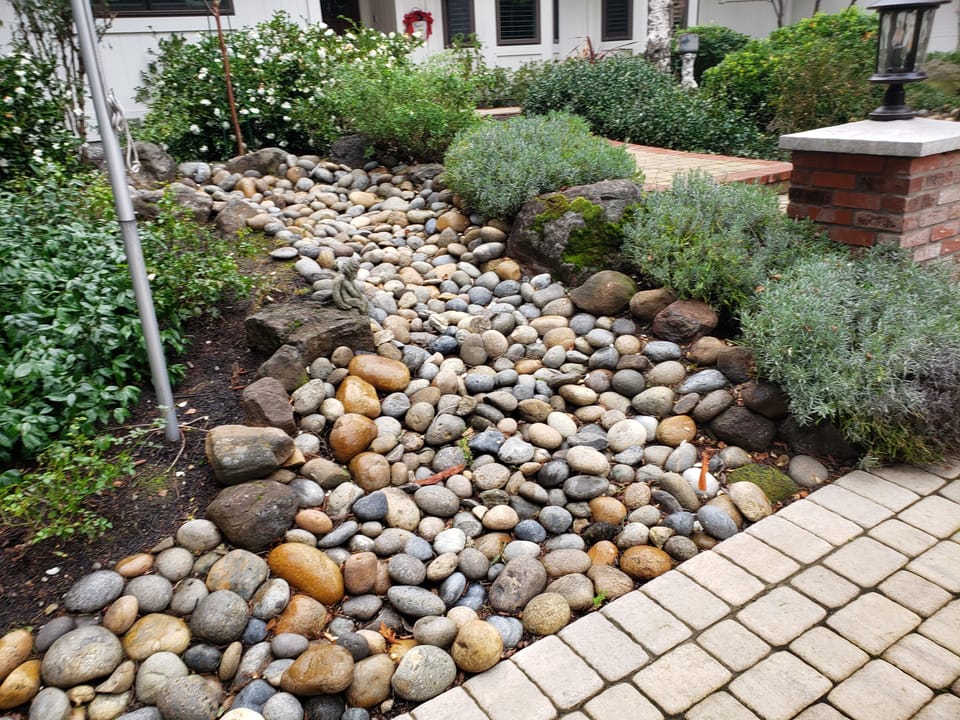 Slow it, spread it, sink it: downspouts, rain gardens and how big to digTurn your downspouts toward planted ground, put gravel under the roof edge, and slope the soil away from the house. Then, if a test hole drains within a day, dig a shallow rain garden: about 56 square feet for 1,500 square feet of roof draining to it.Stormwater and drainage · Updated Oct 19, 2026
 Sink it or shed it? When to keep rain on your land and when to drain itMost properties need both. Sink clean water where the soil can take it and nothing will be harmed. Shed water, slowly and safely, where soaking it in would threaten a foundation, a slope, a septic system or a neighbor. The craft is deciding which water goes where.Stormwater and drainage · Updated Oct 18, 2026
 Swales: what they do, how to build one, and when not toA swale is a shallow ditch that slows rainwater. Dug level across a slope, it holds water so it soaks in. Built with a gentle fall, it carries water away slowly. Both work only in the right place, and both need a planned overflow. Start by watching your slope in the next storm.Stormwater and drainage · Updated Oct 18, 2026