
Policy and rulesGuide
Can I pump water from a creek on my property? Riparian water rights in Sonoma County
In August 2021, the state ordered hundreds of upper Russian River water users to stop pumping. In most years, though, the answer is yes: if your land touches a creek, you may take its natural flow for use on that land. That is a riparian right. You can't store the water for later, you must report it every year, and in a drought the state can order you to stop.
On August 2, 2021, the State Water Board told all 861 people and groups with rights to take water from the upper Russian River to stop, except for health and safety needs.[1] Within days, orders reached the lower river too.[1][2] In June 2022, every right holder in the watershed got an order on their status, and the limits reached riparian rights too: the rights that come with owning land along a creek.[2]
Most years, nobody tells a creekside owner to stop. Those orders have ended, but the water rights rules under them apply every year, and many owners have never read them.
Here is what a riparian right lets you do, what it doesn't, and the winter fix that helps you and the creek at the same time.
What is a riparian right?
Riparian means "of the riverbank." In California, a riparian right is the right to use the natural flow of a creek, river or lake on land that touches it.[3] It comes with the land. You don't apply for it, and you don't lose it by not using it.[3]
It has four limits, and they matter.
- The land must touch the water. If land is split so that a piece no longer touches the creek, that piece loses its right, unless the right was kept when the land was divided.[3]
- The water stays in its watershed: all the land that drains to that creek. You may use it only on land that drains back to the creek you took it from.[3]
- Natural flow only, used as it comes. You can't store water in a wet time to use in a dry time under a riparian right.[3] Where does using it as it comes end and storing begin? A 2017 plan for Dutch Bill Creek draws that line at about 30 days.[4]
- You share it. All riparian owners on a creek have the same standing. When there isn't enough, they share by need, and household use inside the home generally comes first.[3]
Here is how the first two limits play out on three neighboring lots. Find the one that looks like yours.
Based on the State Water Board's water rights questions and answers.[3]
If your land doesn't touch the creek, or you want to store water, a riparian right won't cover you. You need a different kind, called an appropriative right. Today that means a permit from the State Water Board or, for small uses, a registration. A few older rights from before 1914 still exist, but only a court can confirm one.[3] Water from a well works differently. See wells, tanks and pumps.
How many people take water from creeks here?
More than you might guess. We counted every place on the state's records where water is taken from a creek, river, spring or pond in Sonoma County. Each bar is one kind of claim. The blue bar is statements: the yearly report filed by riparian owners and by people with pre-1914 rights. They make up about a third.
Source: State Water Board records, October 2026.[5][6] How we counted.
- About a third are claims, not permits. 998 of the 3,166 points are filed under statements, the yearly report for riparian and pre-1914 rights.[5][6]
- On some salmon creeks, riparian claims lead. Around Green Valley Creek, home to endangered coho salmon, 54 of 93 places water is taken are statements.[5][7]
- The real number is higher. The records show only what was filed. In 2016, after asking landowners on Green Valley, Dutch Bill, Mill and Mark West creeks to report, the state said several creek diversions there had never been reported.[8]
Why does a small pump matter?
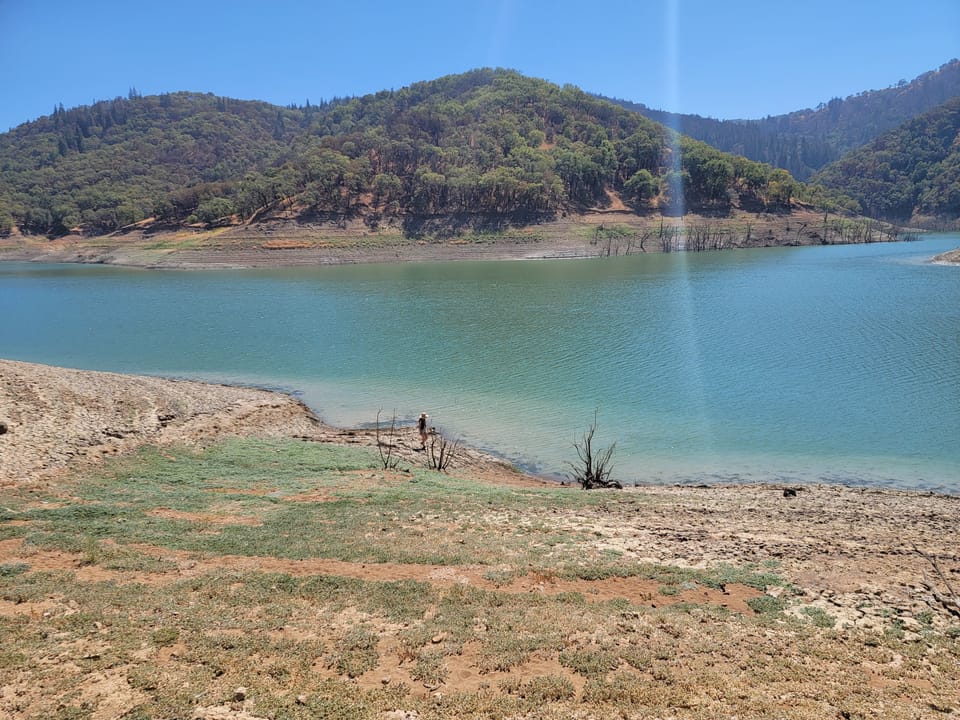
In a dry summer, small creeks here can break into a chain of pools with little or no water running between them.[9] Young coho salmon spend their first summer in creeks like these. The longer their pools stay cut off, the fewer survive.[10]
Central California Coast coho are listed as endangered.[11] In 2015, mapping on Green Valley, Dutch Bill, Mill and Mark West creeks found the fish "in peril" as riffles (the shallow, fast stretches between pools) and pools dried back.[7] The state said more pumping from creeks and wells meant low flows, isolated pools, low oxygen and water warm enough to kill fish.[9]
The surprise is how little water it takes to keep pools linked: about 4.5 to 45 gallons a minute, by researchers' findings in these creeks.[10] In the unit used to measure creek flow, that is a hundredth to a tenth of a cubic foot per second.
That is why no single big pump is the problem. A group of local conservation districts, nonprofits and university researchers that studied these creeks, the Russian River Coho Water Resources Partnership, found that big diversions there "simply do not exist." They called it death by a thousand straws.[10]
What happens in a drought?
The state can step in.
- 2015: the State Water Board adopted an emergency rule for Green Valley, Dutch Bill, Mill and Mark West creeks, covering about 13,000 landowners. It banned watering ornamental lawns, limited other outdoor watering to twice a week, and required owners to report their water use.[9][8]
- 2021 to 2023: curtailment orders, meaning orders to stop diverting, went out across the Russian River watershed. All of them were lifted on March 29, 2023.[1][2]
- Health and safety came first. Under the 2021 orders, people could keep taking up to 55 gallons per person per day for drinking, cooking and sanitation without asking first. More than that needed approval.[12]
Not everyone agreed with the limits. The cities of Ukiah and Cloverdale asked the board to reconsider its 2021 orders and were turned down.[2] The 2015 rule left commercial farms out of its watering limits.[9] Anyone who got a 2021 order could ask the board to reconsider within 30 days.[12]
Ignoring an order was costly: fines of up to $1,000 a day and $2,500 per acre-foot taken.[12] An acre-foot is about 326,000 gallons.
What worked: catch it in winter, leave it in summer
Westminster Woods, a camp on Dutch Bill Creek near Occidental, used to pump its summer water straight from the creek. At 100 to 120 gallons a minute, the old pump could take more than the creek was carrying, which disconnected riffles and dried the streambed.[4]
So it changed the season. The camp stopped pumping from the creek in summer and built two tanks holding 175,000 gallons. It now fills them in the wet season from springs, at about 1.3 gallons a minute, 99% less than the old pump, under a new water right it applied for.[4] Local conservation groups call this storage and forbearance: store water in winter, hold off pumping in summer.
Homes have done it too, mostly with rain from the roof.
- Salmon Creek: Gold Ridge Resource Conservation District built eight rainwater systems for homes and small farms, part of a project it estimated leaves 17 acre-feet a year in the creek, about 5.5 million gallons.[13]
- Mill and Mark West creeks: Sonoma Resource Conservation District says it has installed more than 350,000 gallons of rainwater storage in the two watersheds.[14] Its Mill Creek work after the 2020 Walbridge Fire aimed for at least 18 systems on burned properties.[15]
The limits are real. Tanks and permits cost money, and the coho partnership said most permit processes "were designed to regulate rather than to restore."[10] Gains in summer flow from home tanks were mostly estimated, not measured. Still, the evidence points one way: in these creeks, leaving a little water in August goes a long way.
Our take: if you live on a coho creek, storing winter water is the best thing you can do for it.
Can I store creek water for summer?
Not under a riparian right. Storing creek water needs an appropriative right. For a home, that is usually a small domestic registration.[4][3]
- Limits: up to 10 acre-feet a year into storage, about 3.3 million gallons. Or, if you don't store it, up to 4,500 gallons a day.[16]
- Cost: $250 to register, then $100 a year, renewed every five years.[17][18]
- Season: in Sonoma County, new rights can usually take creek water only from December 15 to March 31, unless a study of that creek shows a longer season is safe. Even then, water can be taken only when enough is flowing to meet a set minimum flow. This comes from a state policy for North Coast creeks.[19][20]
- Fish and Wildlife gets a say. The state shares each registration with the Department of Fish and Wildlife, which can add conditions.[18]
- Some creeks are closed. No registration is allowed on a stream the board has declared fully appropriated, meaning already spoken for, in the season you want.[16]
Here is the year at a glance. The key thing: a riparian right covers any month, but new rights can usually take water only from December 15 to March 31.
Details from the State Water Board and state law.[20][21][22]
Rain from your roof is simpler. State law says it needs no water right.[22] See are rain barrels legal in California, and size a tank with the tank size calculator. Thinking of a pond? See ponds in Sonoma County.

What to do if you pump from a creek
- Find out what you have. Look up water rights for your property in CalWATRS, the State Water Board's water rights system, where statements are also filed. Search by owner name or on the map, not by parcel number.[3][23] The first letter of a water right ID tells you its type: S for a statement, A for a permit, D for a small domestic registration. If you can't find it, call the Division of Water Rights at (916) 341-5300.[6] If you find an S, or nothing at all but your land touches the creek and you pump from it, go to step 2.
- File your statement. If you take creek water under a riparian claim, you must file a Statement of Water Diversion and Use each year, before February 1, covering October 1 to September 30 of the past year.[23][21] Not filing can cost up to $1,000, plus $500 a day if you still haven't filed 30 days after the board notifies you.[23] A statement records your claim. It doesn't prove you have a right.[23]
- Measure if you take a lot. Taking more than 10 acre-feet a year means you must measure your use as well as report it.[24] Most homes take far less.
- Tell Fish and Wildlife before you work in the creek. Putting in or fixing a water intake, the pipe end that draws water from the creek, usually needs notice under their Lake and Streambed Alteration program. If you're not sure, ask their regional office first.[25]
- Screen the intake. In streams with salmon and steelhead, the law can require a screen on a new diversion to keep fish out.[26] Ask Fish and Wildlife what they need.
- Get help with storage. Sonoma Resource Conservation District and Gold Ridge Resource Conservation District work with landowners on tanks and water use. Both are in our directory.
We are not lawyers, and water rights get complicated fast. Our take: start with a call to the Division of Water Rights. If your case is complicated, then talk to a water rights attorney.
Is there good news for the fish?
Some. In winter 2023 to 2024, an estimated 825 hatchery-raised adult coho came back up the Russian River past Duncans Mills, the most since counting began there in 2012. Dutch Bill Creek also had its highest count, about 129 adults.[27]
The young fish those adults leave behind will spend their first summer in the same small pools. That is where a creekside home makes the difference.
What it means for you
- If your land touches a creek, you probably have a riparian right. Use the natural flow on that land, as it comes.
- Report it. Your next statement is due before February 1.
- Our take: fill tanks in winter, not from the creek in August. Roof rain needs no permit. If this turns out to be a wet El Niño winter, see what El Niño could mean here.
- In a drought, expect limits. In past orders, health and safety use was protected. Lawns and gardens were not.
Next: learn how to heal a creek bank with willows and plants, or work out your roof's catch with the rain calculator.
Photos by Devan Hemmings unless noted.
Sources
- 1. State Water Board, Curtailment orders issued in the Upper Russian River (press release, August 2, 2021)
- 2. State Water Board, Russian River Drought Response (curtailment orders and their rescission, March 29, 2023)
- 3. State Water Board, Water Rights Frequently Asked Questions
- 4. Russian River Coho Water Resources Partnership, Dutch Bill Creek Streamflow Improvement Plan (March 2017)
- 5. State Water Board water right points of diversion (eWRIMS), Sonoma County GIS layer, our count, pulled October 30, 2026
- 6. State Water Board, Know Your Water Right for Measurement Regulations (Water Right ID letters)
- 7. California Department of Fish and Wildlife, Russian River tributaries wet-dry mapping
- 8. State Water Board, Resolution 2016-0012, readopting the Russian River tributaries emergency regulation (March 1, 2016)
- 9. State Water Board, Fact sheet: proposed emergency regulation for four Russian River tributaries (June 2015)
- 10. Russian River Coho Water Resources Partnership, Summary Report (January 2022)
- 11. NOAA Fisheries, Central California Coast Coho Salmon
- 12. State Water Board, Russian River curtailment orders fact sheet (August 2, 2021)
- 13. Gold Ridge Resource Conservation District, Salmon Creek water conservation and rainwater catchment project summary (North Coast Resource Partnership)
- 14. Sonoma Resource Conservation District, rainwater storage in the Mill Creek and Mark West Creek watersheds (May 22, 2025)
- 15. Sonoma Resource Conservation District, water storage for fire-affected properties in the Mill Creek watershed (September 14, 2023)
- 16. State Water Board, Registrations: frequently asked questions
- 17. State Water Board, Water rights fee schedule summary, fiscal year 2026-27
- 18. State Water Board, Water Right Registrations
- 19. State Water Board, Policy for Maintaining Instream Flows in Northern California Coastal Streams
- 20. State Water Board, Policy for Maintaining Instream Flows in Northern California Coastal Streams, adopted text (effective February 4, 2014)
- 21. State Water Board, Statements of Water Diversion and Use: frequently asked questions
- 22. AB 1750, Rainwater Capture Act of 2012, enrolled text (Water Code sections 10570 to 10574)
- 23. State Water Board, Statements of Water Diversion and Use
- 24. State Water Board, Water Measurement and Reporting Regulation FAQ (2024)
- 25. California Department of Fish and Wildlife, Lake and Streambed Alteration Program: questions and answers
- 26. California Fish and Game Code section 6100 (screens on diversions in salmon and steelhead streams), via FindLaw
- 27. California Sea Grant and Sonoma Water, Russian River Salmon and Steelhead Monitoring, 2023-2024 Winter Report (July 2024)
Checked 2026-10-30. Rules and programs change. If something here is out of date, the source above wins. Spot an error? See our corrections policy.
Related reads
 Policy and rulesSonoma County groundwater: who manages it, the well fee, and how the basins are doingThree local agencies manage groundwater in the Sonoma Valley, Petaluma Valley and Santa Rosa Plain basins. Each has a state-approved plan to bring its basin into balance by 2042. If your well is in one of them, you pay a yearly fee on your property tax bill.Updated Oct 18, 2026
 Policy and rulesWho makes the water rules in Sonoma CountyIt depends on the problem. Your utility handles your tap and your bill. Permit Sonoma handles wells, septic and graywater permits. State water boards set drinking water and pollution rules. The table below shows who to call for what.Updated Oct 18, 2026
 NewsSanta Rosa Council scheduled to consider an El Niño local emergency and a county hazard plan on November 10On Tuesday, November 10, 2026, the Santa Rosa City Council is scheduled to consider two storm-related items. Staff propose that the Council declare a local emergency over the threat of storms and flooding tied to this winter's El Niño. The Council will also hold a public hearing on the 2026 Sonoma County hazard mitigation plan. Neither is decided. The city says the emergency step is preparation and does not mean a major storm is coming.Posted Oct 30, 2026