Rivers and pollutionGuide
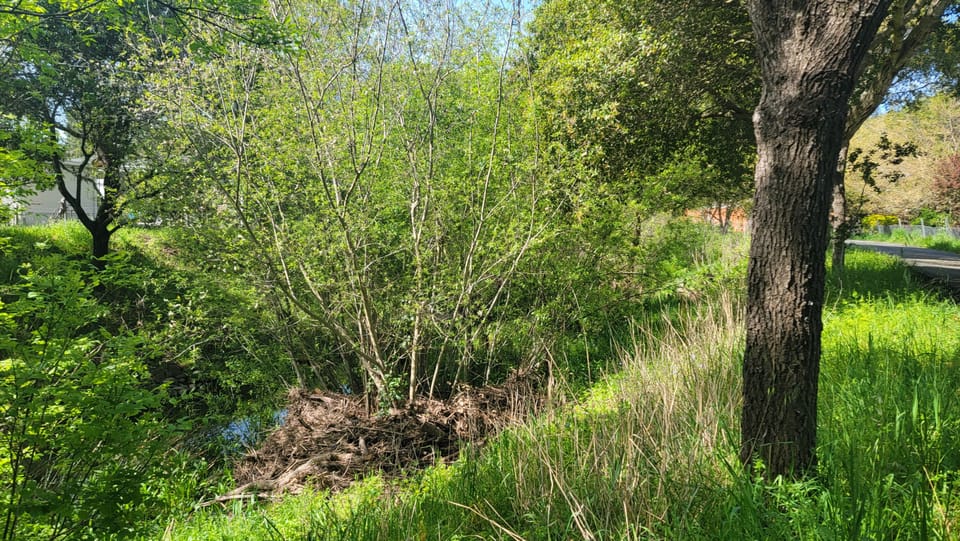
Creek bank erosion: how Sonoma County creekside owners can heal a bank with willows, plants and wood
Most creek banks heal best with living materials. Keep the native plants, pull invasive ones, and put willow to work: cuttings pushed into the bank, bundles called wattles, or woven willow walls, built in October or early November before the biggest storms. Leave logs in the water. Anything that moves soil or rock in the creek needs permits first.
Listen to this article
Read aloud by an AI voice.
Owning a creek is a bit like owning a very old, very calm dog. It sleeps most of the summer. Then one winter night it runs through the yard and moves the furniture.
When it takes a bite out of the bank, the best repair is usually alive. Willow branches that root where you push them in. Bundles of cuttings that turn into a hedge. Native plants that hold the soil while they shade the water. Here is how those fixes work, which ones a homeowner can do, and what to leave to a pro.
Who lives on a creek bank?
More than you might think. The strip of plants along a creek is called the riparian corridor: the creek plus the plants and animals that live along it.[1] The flat ground beside a creek, where floods spread out, is some of the most important habitat in California for native birds and other wildlife.[2]
- Birds. In replanted creekside sites in Marin and Sonoma counties, bird counts grew from a few species to over 20 within 10 to 15 years, many of them songbirds that winter in Central and South America.[2]
- Frogs and turtles. California red-legged frogs and western pond turtles benefit from creeks that are not choked with eroded soil.[2] The red-legged frog is threatened. Sonoma Mountain is critical habitat for it.[3]
- Fish and the bugs they eat. Insects living on willow branches fall into the creek and feed fish, including salmon.[4] The Russian River's coho salmon are endangered.[5]
It is your water, too. Plants along a creek filter soil and pollution out of runoff,[6][2] and help clean water soak down to the groundwater that wells draw from.[7]
And most of it is in private hands: in West County, landowners control more than 90 percent of the land along the creeks.[7]
Why is my creek bank washing away?
Some erosion is just a creek being a creek. Banks shift over time, and fixing them is not always needed.[8] It speeds up when roofs, driveways and streets send more water into the creek, faster.[8] When a bank slides, it is usually one of three things:[8]
- The bottom gets cut away. Fast water undercuts the foot of the bank, called the toe, and the soil above slides down.
- The top gets soaked. Runoff pouring over the top waterlogs it until it gives way.
- Something blocks the channel. A jam of branches can push the water sideways into the bank.
Walk the bank and look. The cause points to the fix.
When should I do the work?
Before the big storms. On Mark West Creek, measured near Mirabel Heights, the year's biggest flow came between December and February in 12 of the 17 years on record. Look at the blue bars.[9]
Source: USGS, the federal agency that measures stream flow.[9] Data and method.
The biggest came on February 28, 2019: about 116,000 gallons going past every second.[9]
That lines up with willow's calendar. Cut and plant willow while it is dormant, from late September through December. October and early November are the best months to build living repairs, so they get a head start on the winter flows.[2]
What does a healthy creek bank look like?
Picture a white alder at the water's edge, its roots gripping the toe of the bank. Above it, an arroyo willow and an Oregon ash. Higher up, a coast live oak shading the water. Read the drawing from the water up: the lower a plant grows, the more flooding it can take.[10] The dashed line is the top of the bank, where the county's protected streamside strip starts (more in the rules below).
A sample of native plants for each zone, from the California Native Plant Society.[10] Setbacks from the county.[11][6]
Willows belong mid or upper bank: lower down, a grown thicket can clog the flow.[12] Mix trees, shrubs and grasses, and plant extra trees on the south bank, where they shade the water.[2]
Watch for two invaders: Himalayan blackberry, which forms prickly thickets up to 15 feet tall (the native California blackberry is fine),[13] and Arundo, a tall cane that uses more water than native plants and crowds out willows.[14]
Start with the gentle fixes
- Keep the native plants. Once they are cleared, the bank erodes much faster.[2]
- Pull invasive plants by hand, in patches. The county allows hand removal of invasive plants in its streamside zone.[11] Replant as you go, so bare soil does not face the winter.[12]
- Point the downspouts away from the bank. Soaked soil at the top is one way banks fail.[8] Send roof water to a planted spot well back from the edge. Our guide to slowing and sinking rain shows how.
- Keep piles off the bank. Dumping yard waste, soil or concrete where it can wash into a creek needs Fish and Wildlife's review first.[15]
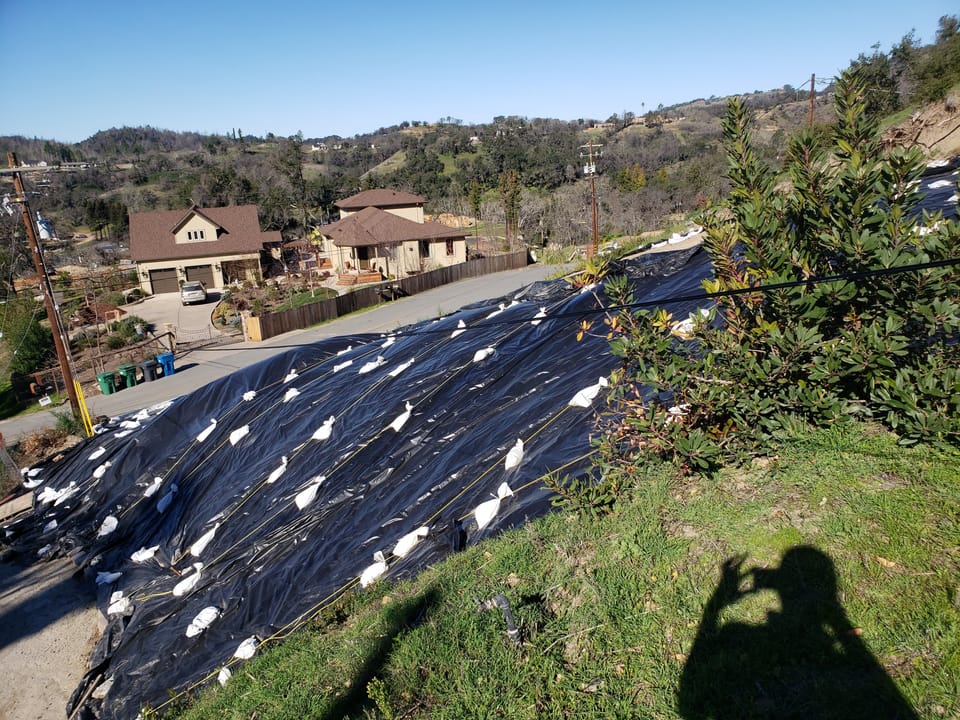
- Cover a fresh slump. A tarp, rice straw or jute netting slows more erosion until a lasting fix goes in.[8]
Willow, the bank builder
Willows are the backbone of many coastal California creeks. They are often the first woody plant to move into bare ground, they root easily, and once established they can survive high flows.[2] Their deep roots hold soil, and they shade and feed the creek.[4] They need sun, so skip willow in a deeply shaded redwood stretch.[2]
Live stakes: start here
A live stake is a cut willow branch pushed into moist ground, where it grows roots.
- Cut the right size. About 3 to 5 feet long and ¾ to 1½ inches thick. Cut the bottom end to a point so you know which end goes down.[12] A stake planted upside down dies.[16]
- Soak, then plant. Soak the stakes in water for at least 48 hours.[12] Never let a cut stake dry out.
- Plant deep, in the sun, partway up the bank. Push two thirds of the stake into the ground, leaving at least 4 to 6 inches showing, 2 to 4 feet apart, where it gets at least 6 hours of sun.[12] Keep them off the channel bottom and away from bridges and culverts.[2]
- If spring turns dry, water by hand the first year. Drip lines cannot go in the active channel.[12]
Usually 60 to 90 percent survive.[12] One row along 60 feet of bank, 3 feet apart, is 21 stakes, so expect about 13 to 19 to make it. Fill the gaps the next winter.[16]
Wattles: bundles that become a hedge
A wattle, also called a live fascine, is a bundle of live willow cuttings tied with rope. The bundles run 6 to 9 inches thick and are laid in shallow trenches across the slope, half to two thirds buried, then staked. They are a classic volunteer project, easier with many hands, even small ones.[2] As the cuttings root, they hold the soil, slow the water and sprout new growth.[4]
Willow walls: a living retaining wall
Willow poles are driven into the bank and long willow branches are woven tightly between them, with soil packed behind. Both the poles and the branches sprout into a dense thicket. You can usually build one without a designer if it is a single wall no more than 30 inches high, tied into sturdy features like trees.[2]
In January 2025, staff from Sonoma RCD, a local agency that helps landowners with soil and water, helped build wattles and willow walls on an eroding bank of Lagunitas Creek in Marin. Slow work, they said, but cheap and made almost entirely of natural materials.[4]
Bigger fixes
- Coir logs are tough rolls of coconut fiber, staked along the toe of a bank in slow water. Stake them very securely: a loose log can divert flow.[2]
- A brush mattress is a thick layer of branches staked and roped over the bank, with the cut ends buried in a trench at the toe. Willow branches sprout if there is enough sun and moisture.[2]
- Brush layering and fabric-wrapped fill stack layers of live brush between layers of soil. The fabric version wraps each layer in coconut matting, like a stack of quesadillas. These need a licensed designer, such as a civil engineer, and heavy equipment.[2]
Two tricks make any of these last. Tie the ends into something solid, such as an existing tree with a big root mass, so the first storm cannot peel the repair off. And use wood stakes and natural rope, not rebar, wire or nylon, so nothing is left to strangle roots or hurt animals later.[2]
Rock or roots?
The case for rock. An engineered repair that reinforces the toe with rock, logs or live willows gives the most stable bank where erosion is severe or active.[8]
The case for roots. Rock and concrete lock a creek in place. Storm water speeds past them with more force, which can worsen erosion downstream, and walls can fail as water builds behind them. They offer wildlife little, and agencies have grown less willing to approve them.[2]
Our take: start with the lightest living repair. Save rock, with a licensed designer, for places where a home or road is at risk.
Should I pull the logs out of the creek?
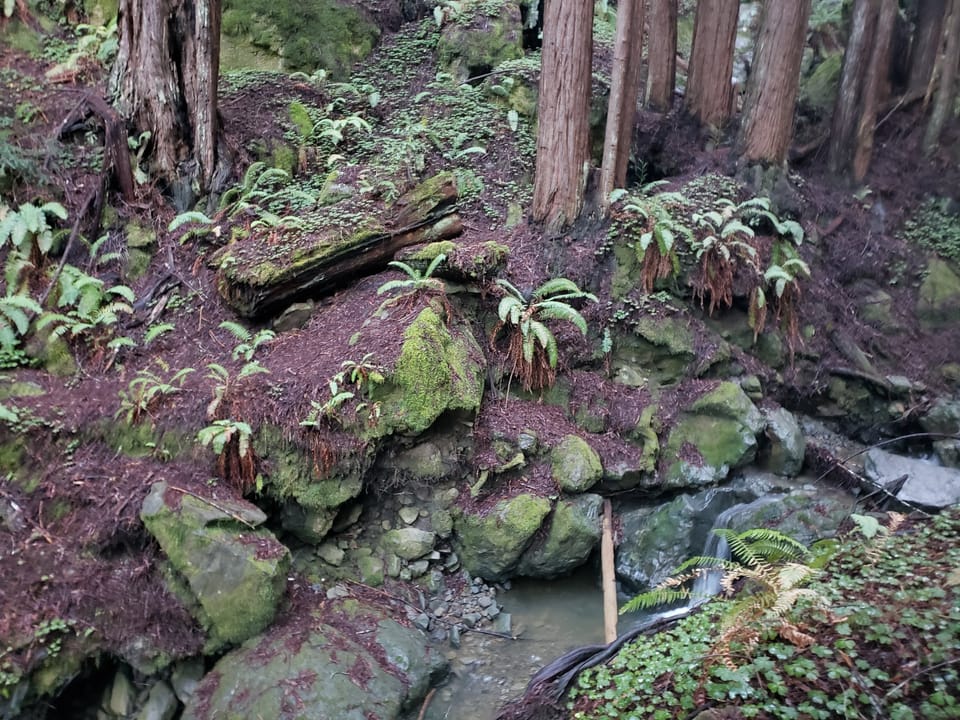
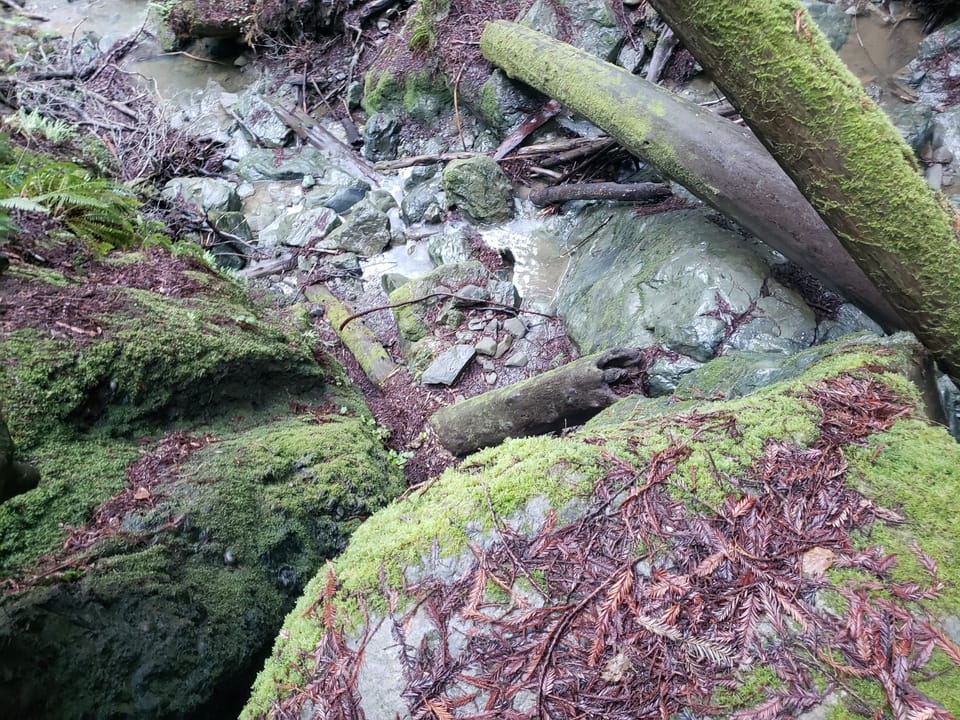
Usually not. Fallen trees and branches trap gravel for fish to spawn in, feed the insects at the base of the creek's food web, and make pools, shade and hiding places. Birds and turtles use them as perches. They can also push water into a bank.[2]
Our take: leave wood where it lies unless it is aiming the flow at a bank, a bridge or a building. Then call Sonoma RCD before you move it.[7]
Before you dig: the rules in brief
- Moving soil, rock or wood in or beside a creek almost always needs permits.[17] Outside city limits, call Permit Sonoma, the county permit office, at (707) 565-1900. Inside a city, call the city.[18][17]
- Fish and Wildlife wants notice before work that may substantially change a creek's bed, channel or bank, even on creeks that run dry in summer.[15][19] Bay Delta office: (707) 428-2002.[8] In a true emergency you can start first and notify within 14 days.[19]
- The streamside zone. Outside city limits, many creeks have a protected strip of 50, 100 or 200 feet on each side, from the top of the bank, where grading, clearing and new buildings need an exception.[1][11] Check Permit Sonoma's riparian corridor maps.[20] Buildings also sit back 2.5 times the bank's height plus 30 feet from the toe, at least 30 feet from the top.[6]
Who can help?
- Sonoma RCD at (707) 569-1448, or Gold Ridge RCD in West County at (707) 823-5244, for planting and erosion advice.[17][7][21] Bank repair help is usually fee-for-service.[8]
- Point Blue Conservation Science runs STRAW, which brings school classes out to replant creek banks. Ask about hosting at info@pointblue.org.[8]
- Farms and ranches can ask Sonoma County Ag + Open Space about protecting the streamside part of the land: (707) 565-4292.[22]
Creek groups near you are in our guide to getting involved in your watershed.
What it means for the creek
Our view: a planted bank is one of the few things one household can do that the whole creek notices, from songbirds overhead to salmon eggs downstream, where fine sediment can smother them.
What it means for you
- This fall: walk the bank. Look for an undercut toe, water pouring over the top, or a jam aimed at you.
- This weekend: move piles off the bank, point the downspouts away and start pulling Himalayan blackberry.
- October to December: after a call to the RCD, cut and plant willow stakes, or join neighbors to build wattles.
- Before any digging: call Permit Sonoma or your city, then Fish and Wildlife.
Next: if the slope above the creek is bare too, see how to stop erosion on a slope. To hire help, see finding a licensed pro and the directory. They are listings, not recommendations.
Photos by Devan Hemmings unless noted.
Sources
- 1. Permit Sonoma, Riparian Corridor ordinance No. 6089, adopted zoning code amendments (November 24, 2014)
- 2. Marin Resource Conservation District and Marin County Stormwater Pollution Prevention Program, Groundwork: A Handbook for Small-Scale Erosion Control in Coastal California, 2nd edition
- 3. Sonoma State University Center for Environmental Inquiry, California red-legged frog studies (2016 to 2019)
- 4. Sonoma Resource Conservation District, Hands-On Restoration: Learning Natural Solutions for Streambank Erosion (March 18, 2025)
- 5. NOAA Fisheries, Habitat Focus Area: Russian River, California (updated September 30, 2026)
- 6. Permit Sonoma, DRN-005 Waterway Setback Requirements (revised January 31, 2019)
- 7. Salmon Creek Watershed Council, Neighborhood Handbook, Western Sonoma County (July 2020)
- 8. Sonoma Resource Conservation District, Streambank Erosion: A Resource Guide for Sonoma County Residents with Streamside Erosion Concerns (2025)
- 9. USGS, annual peak streamflow, Mark West Creek near Mirabel Heights (site 11466800), retrieved October 26, 2026
- 10. California Native Plant Society, Marin Chapter, Native Plants for Riparian Habitats
- 11. Permit Sonoma, Exhibit A: Article 65, RC Riparian Corridor Combining Zone
- 12. Friends of Corte Madera Creek Watershed, Creek Care: Growing Willow from Stakes (Laura Lovett, 2025)
- 13. California Invasive Plant Council, Himalayan blackberry (Rubus armeniacus) identification card
- 14. California Invasive Plant Council, Arundo donax (giant reed)
- 15. California Department of Fish and Wildlife, Lake and Streambed Alteration Program
- 16. King County, Washington, Live stake plantings
- 17. Sonoma Resource Conservation District, Navigating the Permitting Process (2018)
- 18. Permit Sonoma, About Us
- 19. California Department of Fish and Wildlife, Lake and Streambed Alteration: Questions and Answers
- 20. Permit Sonoma, Riparian Corridors (maps by planning area and contact)
- 21. Sonoma Resource Conservation District, Assisting Residents
- 22. Sonoma County Ag + Open Space, Riparian Conservation Program
Checked 2026-10-26. Rules and programs change. If something here is out of date, the source above wins. Spot an error? See our corrections policy.
Related reads
 Rivers and pollutionHow the Russian River works: dams, minimum flows and floodsTwo dams store winter rain and release it in summer. Sonoma Water draws the water from wells beside the river for over 600,000 people. The state sets how much must stay in the river.Updated Oct 18, 2026
 Rivers and pollutionOnly rain down the storm drainStorm drains carry water straight to the nearest creek. It is not treated. Only rain should go down them.Updated Oct 11, 2026
 Rivers and pollutionEl Niño and Sonoma County water: the river, the reservoirs and your rainNOAA says a strong to very strong El Niño is likely this winter, which tilts California toward a wet one. On the Russian River, strong El Niño winters brought a major flood at Guerneville in 3 of 9 cases since 1951, about twice the usual rate, but the worst floods came in other winters. Get ready for high water and plan to keep some of the rain.Updated Oct 18, 2026