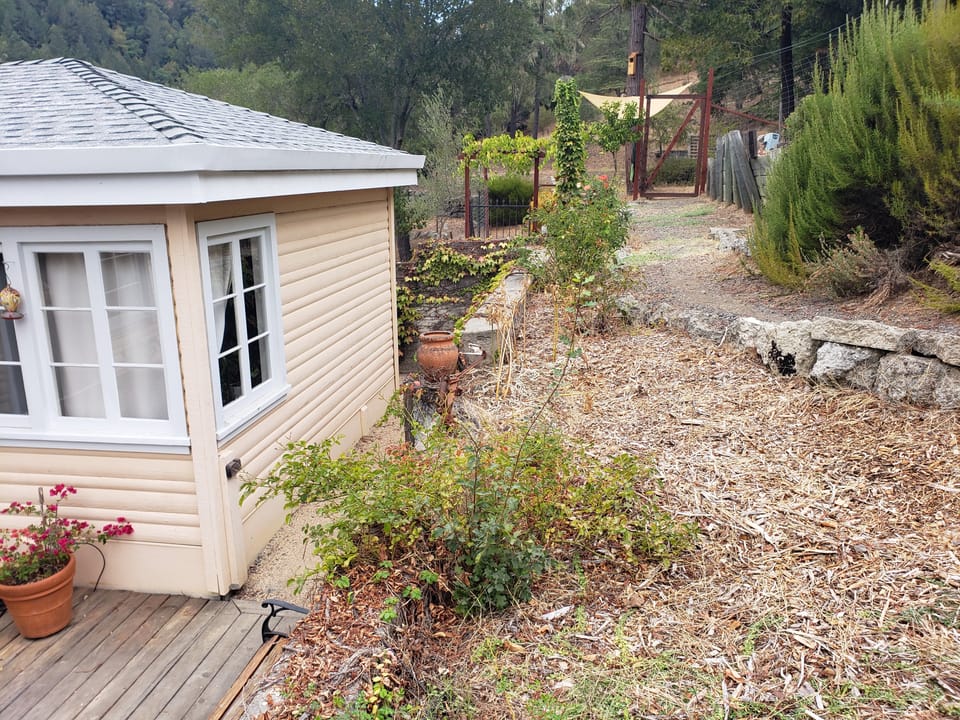
Graywater and reuseGuide
Laundry to landscape: reuse washing machine water in your Sonoma County garden
A laundry to landscape system sends your washing machine's used water through a valve and 1 inch pipe and tubing to mulch basins, shallow pits filled with wood chips, around trees and shrubs. An average household's washer puts out about 1,400 to 2,000 gallons from June to September, when almost no rain falls. Call Permit Sonoma, the county's permit office, or your city before you build.
Listen to this article
Read aloud by an AI voice.
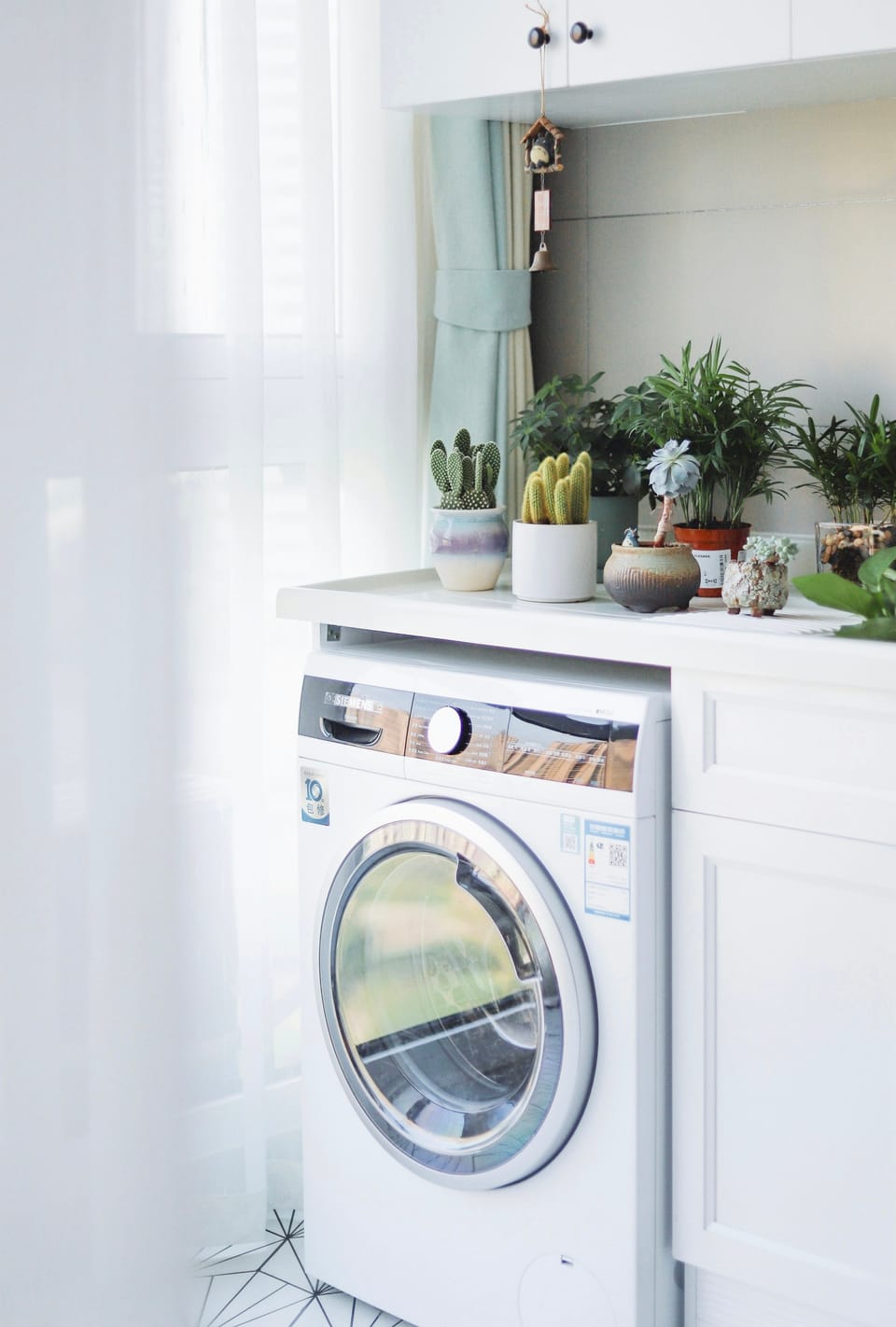
Behind most washing machines, a gray drain hose hooks into a pipe in the wall. Every load, it sends 14 to 20 gallons of water down to the sewer or the septic tank.[1]
In Sonoma County, that keeps happening all summer, when almost no rain falls.[2] Meanwhile the fruit trees outside get watered from the hose.
Laundry to landscape is the simplest fix. That used washer water is called graywater: water from washers, showers, tubs and bathroom sinks, but not toilets, kitchen sinks or dishwashers.[3] A valve behind the washer sends it out through 1 inch pipe and tubing to trees and shrubs instead.
Try this first: look behind your washer. Is it on an outside wall, or over a crawlspace? Is the yard beside it flat or downhill? If yes to both, this system can probably work for you.[4]
Here is the whole system, from the washer to the trees.
Drawn from the San Francisco Graywater Design Manual and Greywater Action.[4][5]
Why washer water is worth catching here
Santa Rosa's normal rain, the 1991 to 2020 average, from June through September adds up to less than half an inch.[2] An average household runs about 300 loads of laundry a year, about 100 of them in those four months.[1]
Compare the tiny rain bar with the two washer bars.
Our calculation from NOAA (the federal weather agency) normal rain for 1991 to 2020 and ENERGY STAR washer data. Method: loads times gallons a load, against normal rain on a 10 by 10 foot bed.
That washer water arrives every week, right when gardens are driest. It is water you would otherwise pull from the hose.
It also eases the summer draw on local water. Sonoma Water, the county's wholesale water agency, draws its supply from the Russian River, fed by water stored in Lake Sonoma and Lake Mendocino.[6] Garden water that comes from the washer is water your utility does not have to deliver in the driest months. See where your tap water comes from.
In winter the story flips. This chart shows when rain does the job instead.
Our calculation from NOAA and ENERGY STAR data. Method: 25 loads a month at 14 gallons, against normal monthly rain on a 10 by 10 foot bed.
When the ground is soaked, Permit Sonoma's rules say turn the valve and send the water to the sewer or septic tank.[7]
Do you need a permit?
Here the rules disagree, so call before you build.
- State plumbing code: a washer-only system needs no permit, if it follows the code's conditions. That means no added pump, no change to the house's other plumbing, and no connection to drinking water pipes.[8][3]
- Permit Sonoma: the county's permit office says a clothes washer system needs a building permit for the plumbing, though no septic permit.[9]
- Cities: Permit Sonoma covers only unincorporated Sonoma County, the areas outside city limits. Each city sets its own graywater rules.[3]
Our take: outside city limits, plan on a building permit. Permit Sonoma handles graywater there, and its page says one is required.[9][3] Call (707) 565-1900 before you buy parts.[3] In a city, your city's building department decides, so ask it first.
Ask your water utility too. Sonoma Water says to check whether you need a backflow device at the water meter, a valve that keeps used water from flowing back into the public pipes.[3]
The parts, from washer to tree
Most systems use the same handful of parts.[4][5]
- A 3-way valve. It takes the washer hose and sends the water one way to the garden, the other way to the sewer. Label which is which. Mount it above the washer's flood rim, the highest level water can reach before it spills out.[4][8]
- Labels. Mark the valve with how to switch it. Label any pipe above ground "CAUTION: NONPOTABLE WATER, DO NOT DRINK" at least every 5 feet.[4]
- A vent. An auto vent, a one-way air valve, goes at the high point of the line. It stops the line from pulling water back out of the washer. Put it at least 6 inches above the flood rim, outside if you can.[4][5]
- 1 inch pipe out of the house. It goes through the wall in a 1½ inch hole, or down through the floor to a crawlspace.[4]
- 1 inch tubing in the yard. HDPE, a plastic irrigation tubing, buried a few inches deep. Small tees, T-shaped fittings, split off half-inch lines to each plant.[4]
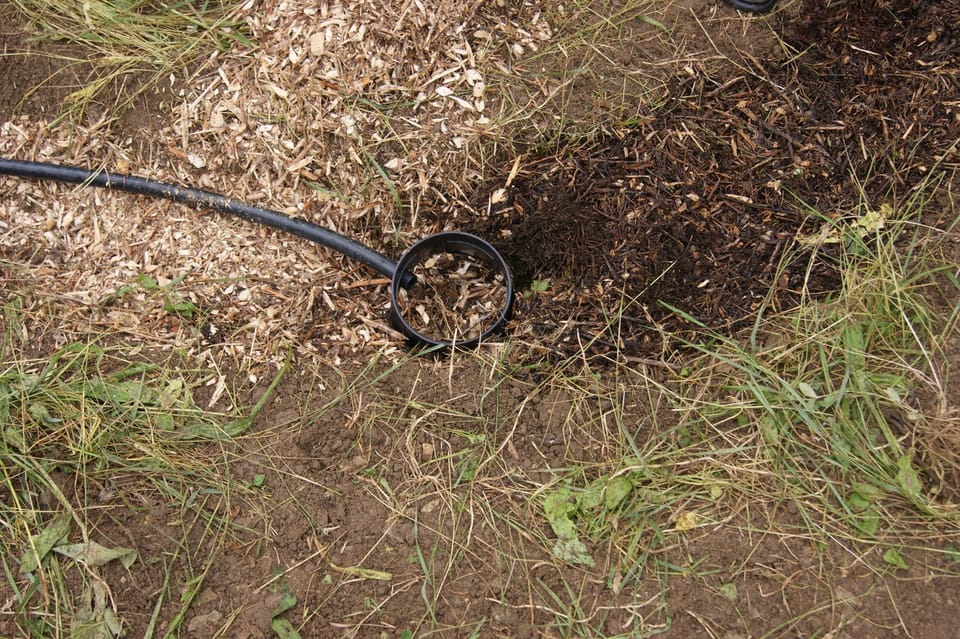
- Mulch basins. Dig a basin 6 to 12 inches deep around each plant's drip line, the ring under the outer edge of its branches, and fill it with wood chips. Each outlet sits in a small box at least 2 inches under the mulch.[4][7]
The washer's own pump does all the pushing, and it is not built to push water far or uphill.[4]
- Go downhill or level, never uphill. On a steep slope, zigzag the tubing so water does not rush to the bottom.[4]
- Stay within about 50 feet across flat ground, or you can strain the pump.[4]
- Never cap the end of the main line. If the outlets clog, a capped line can damage the pump.[4]
- Test it with a garden hose before you hook up the washer. Turn the tees up or down until water comes out of every outlet.[4]
The rules every system follows
These come from Permit Sonoma's requirements for a clothes washer system.[7] They match the state code.[8]
- One washer, in a one or two family home.
- All the water stays on your property. Keep the system the county's required distance from property lines and waterways. Ask Permit Sonoma for the distances when you call.[7]
- Below the surface only. At least 2 inches of soil, rock or mulch over the outlet. No spraying.[3]
- Divert to the sewer for diapers and other soiled or infectious laundry, and when the soil is saturated.
- No harsh chemicals, like water from cleaning car parts or oily rags.
- No added pump. The washer's own pump does the pushing. No connection to drinking water pipes.
- Keep an operation and maintenance manual, a written guide to your system, with the house. Pass it to the next owner.
What to water, and what to wash with
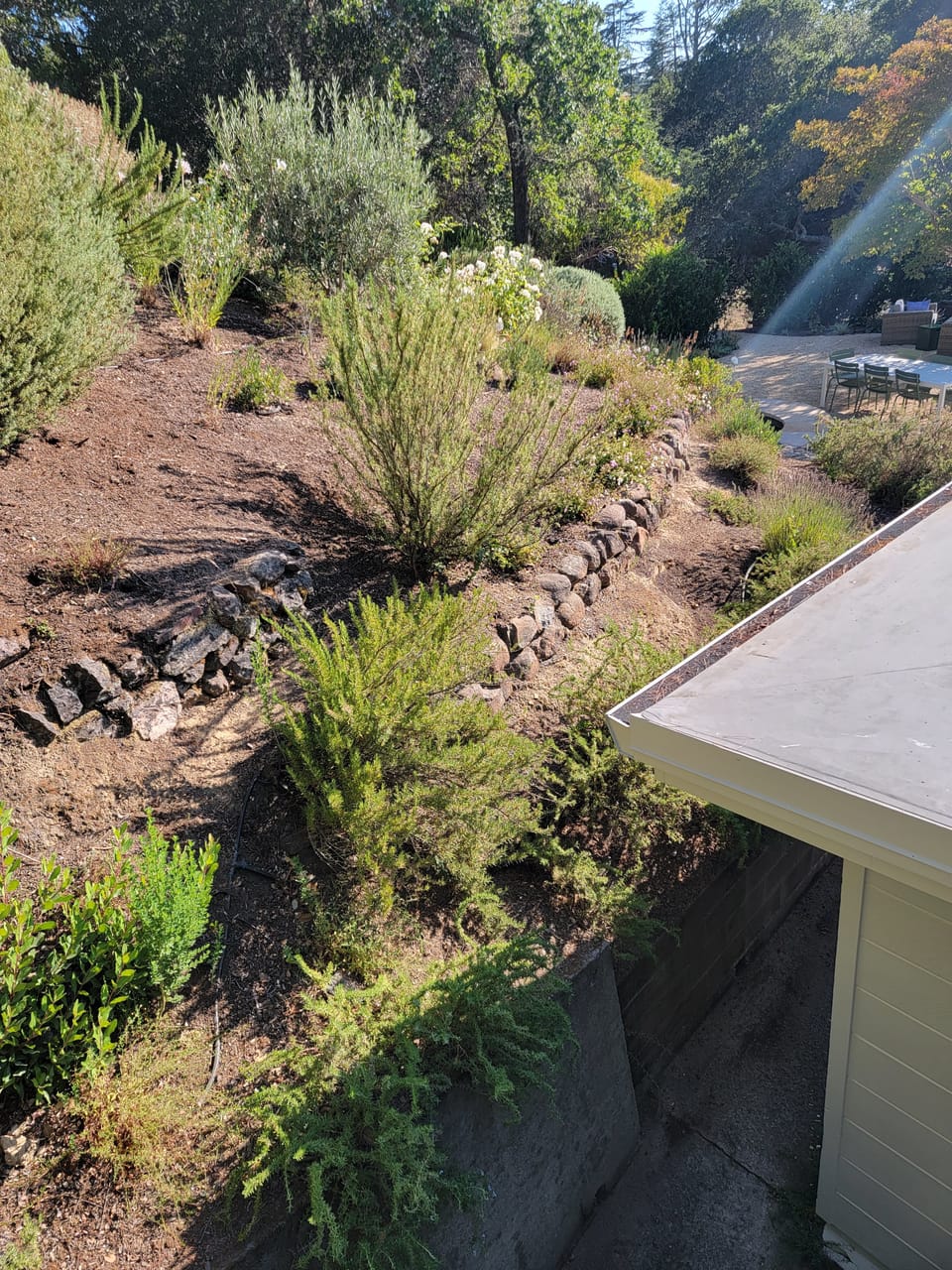
- Water trees and shrubs. Fruit trees, ornamental trees, shrubs and ground covers all take graywater.[3] A laundry to landscape system feeds mulch basins, not a lawn. See our guide to lawns.
- Skip root crops. No carrots, potatoes or other root crops, and nothing whose edible part touches the soil.[7][10] Staked tomatoes and peppers are fine.[10] See growing vegetables with less water.
- Choose a plant-friendly detergent. Look for one low in sodium (salt) and with no boron (borax). Boron is harmless to people but hard on plants. Sodium and boron both make soil less healthy for plants.[11][10]
- Turn the valve for bleach. Chlorine bleach harms plants, so send that load to the sewer.[11]
- Go easy on acid-loving plants: blueberries, rhododendrons and ferns.[11] Give plants fresh water now and then to flush salts.[10]
Will my city help pay?
- Petaluma: up to $125 for a laundry to landscape system.[12]
- Healdsburg: $60 for a laundry to landscape system.[13]
Other cities change their offers often. Check your utility on our rebates page, and read the rebate rules before you buy parts.
What should I do now?
- Look behind your washer. Outside wall or crawlspace, flat or downhill yard: you are a good fit.
- Make one call to Permit Sonoma or your city before you buy parts.
- Pick your plants: trees and shrubs downhill or within about 50 feet across flat ground.
- Switch the valve to the sewer when the winter rains soak the ground, and back in spring.
Showers make even more graywater than the washer. Our guide to using shower water on your garden covers the permitted way.
On a septic system? Sending washer water outside also means less water through the tank. Our septic guide explains why that helps. Curious where the sewer side goes? See where wastewater goes after you flush.
Want someone to build it? Our directory lists graywater and landscape businesses. They are listings, not recommendations.
Photos by Devan Hemmings unless noted.
Sources
- 1. ENERGY STAR, Clothes washers (about 300 loads a year; 14 and 20 gallons a load)
- 2. NOAA NCEI, U.S. Climate Normals 1991 to 2020, monthly precipitation, Santa Rosa
- 3. Sonoma Water, Graywater (definition and frequently asked questions)
- 4. San Francisco Graywater Design Manual, How to build a laundry-to-landscape system (San Francisco Public Utilities Commission, posted by the City of Menlo Park)
- 5. Greywater Action, Laundry-to-landscape system with an exterior wall
- 6. Sonoma Water, Water Supply
- 7. Permit Sonoma, Clothes Washer System Requirements
- 8. Greywater Action, California regulations: requirements for no-permit systems (California Plumbing Code, Chapter 15)
- 9. Permit Sonoma, Graywater Systems
- 10. UC Master Gardener Program of Contra Costa County, Graywater (2023)
- 11. Greywater Action, What soaps and products can I use with my greywater system?
- 12. City of Petaluma, Water conservation programs and rebates
- 13. City of Healdsburg, Water rebates
Checked 2026-10-23. Rules and programs change. If something here is out of date, the source above wins. Spot an error? See our corrections policy.
Related reads
 Can you use shower water for plants? How to send it to your gardenYes, on trees, shrubs and vines, through a graywater system that pipes it to wood chip basins around the plants. In California, a shower system needs a permit, so call your city or county building department before you buy parts.Graywater and reuse · Updated Nov 28, 2026
 What is recycled water? And can you drink it?Recycled water is wastewater from homes and businesses, cleaned at a treatment plant for a new job. Much of it waters farms, parks and golf courses through purple pipes, and that kind is not for drinking. A few places purify it further and do drink it, under strict rules.Graywater and reuse · Posted Nov 12, 2026
 Russian River minimum flows now follow Lake Mendocino's level, and it was under the Dry mark Nov. 19The state approved a Russian River flow order on November 18, 2026. It lets Sonoma Water, the local water agency, label the river Normal, Dry or Critical by how full Lake Mendocino is. The lake held 45,447 acre-feet on November 19, under the 51,000 Dry level for November 1. Lower Normal-year minimums start May 1, 2027 but this order ends about two weeks later.News · Posted Nov 27, 2026