NewsNews
Van Arsdale Dam drilling: state says PG&E's test holes need no full environmental review
On November 2, 2026, the state said PG&E's planned test drilling at a dam on the Eel River needs no full environmental review. The state lists it as Van Arsdale Dam, and we read it as Cape Horn Dam. It sends water to the Russian River. PG&E's request to remove the dam is not decided.
Listen to this article
Read aloud by an AI voice.
Where it is and what it does
Cape Horn Dam is on the Eel River. The Eel is a different river from the Russian River. The Potter Valley Project it belongs to sits about 15 miles northeast of Ukiah. The dam is 63 feet high and made of earth and concrete. Behind it is Van Arsdale Reservoir, which holds 390 acre-feet of usable water. One acre-foot is about 326,000 gallons. See it on a map: Cape Horn Dam, Eel River.
The project is a hydroelectric (water-powered electricity) project run by PG&E. The State Water Resources Control Board, the state water regulator, says the project sits in Mendocino and Lake counties.
Here is the water's path. Some Eel River water is diverted at Van Arsdale Reservoir. It runs south through tunnels and pipes to a power plant. From there it flows into the East Branch of the Russian River, and on into Lake Mendocino. The rest of the Eel keeps flowing past the dam toward the Pacific Ocean.
The project has two dams. The other one is Scott Dam, further upstream. The state board says Cape Horn Dam has structures that let salmon, steelhead and lamprey get past it. Scott Dam does not.
What happened
On November 2, 2026, the state posted a notice saying PG&E's planned drilling does not need a full environmental review. The notice came from the Division of Safety of Dams, part of the state Department of Water Resources. PG&E is listed as the party doing the work.
The state lists the dam as Van Arsdale Dam. We read that as Cape Horn Dam. Van Arsdale Reservoir sits behind Cape Horn Dam, and Scott Dam is the project's only other dam. The notice does not say Cape Horn.
The state calls the work geotechnical exploration. That means drilling test holes to learn what the dam and the ground under it are made of. The notice says the drilling stays within the footprint of the dam, the area the dam already covers.
The state calls it a minor repair or alteration to an existing dam. California's environmental law, called CEQA, has a standard exemption for that kind of work. The state's listing does not say when drilling starts. It does not include the drilling plan. It does not say why the drilling is being done.
The separate request to remove the dams
PG&E needs a federal license to run these dams. The Federal Energy Regulatory Commission (FERC) issues it. PG&E's license ran out on April 14, 2022, and it operates under an annual license. In July 2025, PG&E asked FERC to let it give up the license and take the dams out. This is a request. FERC has not decided.
Under the request, PG&E would:
- Take down Scott Dam.
- Take down Cape Horn Dam, except the parts needed for a new Eel River diversion facility.
- Let the Eel-Russian Project Authority build that facility. FERC calls it the New Eel-Russian Facility. It is meant to keep sending Eel River water to the Russian River after PG&E gives up the license.
PG&E's own packet says the authority is a joint group formed by the County of Sonoma, Sonoma Water and a Mendocino County water and power commission, with a seat for the Round Valley Indian Tribes.
FERC is doing its own environmental review of the request. Comments on what that review should cover were due September 18, 2026. FERC says it plans to prepare a federal environmental document. The sources we read do not say whether this drilling is tied to this request. The state board's page also lists other PG&E drilling notices dated 2026, tied to the design of the new diversion facility.
What it means for you
- If you get water from the Russian River system, some of the water flowing into Lake Mendocino comes from the Eel River through this dam. Nothing in these documents changes that today. The drilling is exempt from the state's full environmental review, and the dam removal is not decided.
- If you care about the Eel River or its fish, the request would take out two dams, one with fish passage and one without. The pages we read do not say how removal would change the Eel or the Russian River.
- If you want to follow it, sign up for FERC emails at ferc.gov/esubscription. When it asks for a docket number, the ID FERC uses for this case, enter P-77-332.
More background: how the Russian River works and Lake Mendocino and the river flow order.
Where this came from
State CEQA database entry 2026110040, Notice of Exemption for Potter Valley Project Drilling, posted November 2, 2026. The entry calls the dam Van Arsdale Dam, State Dam No. 97-102.
State Water Resources Control Board page on the Potter Valley Hydroelectric Project, for the dam and project facts.
FERC page on the Potter Valley Hydroelectric Project, for PG&E's request and the comment dates.
PG&E's Potter Valley Project information packet, for the project's two dams and the Eel-Russian Project Authority.
Photos by Devan Hemmings unless noted.
Sources
- State CEQA database, Notice of Exemption 2026110040, Potter Valley Project Drilling (Van Arsdale Dam), posted November 2, 2026
- State Water Resources Control Board, Potter Valley Hydroelectric Project (FERC Project No. 77)
- Federal Energy Regulatory Commission, Potter Valley Hydroelectric Project (describes the July 24, 2026 comment extension to September 18, 2026)
- PG&E, Potter Valley Project Information Packet (2026)
Checked 2026-11-13. Rules and programs change. If something here is out of date, the source above wins. Spot an error? See our corrections policy.
Related reads
 NewsMidweek storm looks stronger than the last two: 2 to 5 inches forecast, with flooding concernsThe National Weather Service expects the storm arriving late Tuesday and lasting through Thursday to be more impactful than the two before it. Its forecast is 2 to 3 inches of rain across much of the Bay Area and 3 to 5 inches in the coastal ranges, with a rising flooding concern. Monday night and Tuesday are the dry window to get ready.Posted Nov 15, 2026
 NewsCloverdale's Esmeralda plan: a site health study comes before phase one, and groundwater testing is requiredOn November 11, 2026, the Cloverdale City Council adopted the environmental review update for Esmeralda, a plan for up to 605 homes and 160 hotel rooms on a former mill site. The city's documents require a site health risk study before the first development phase can be approved. They also require groundwater testing.Posted Nov 14, 2026
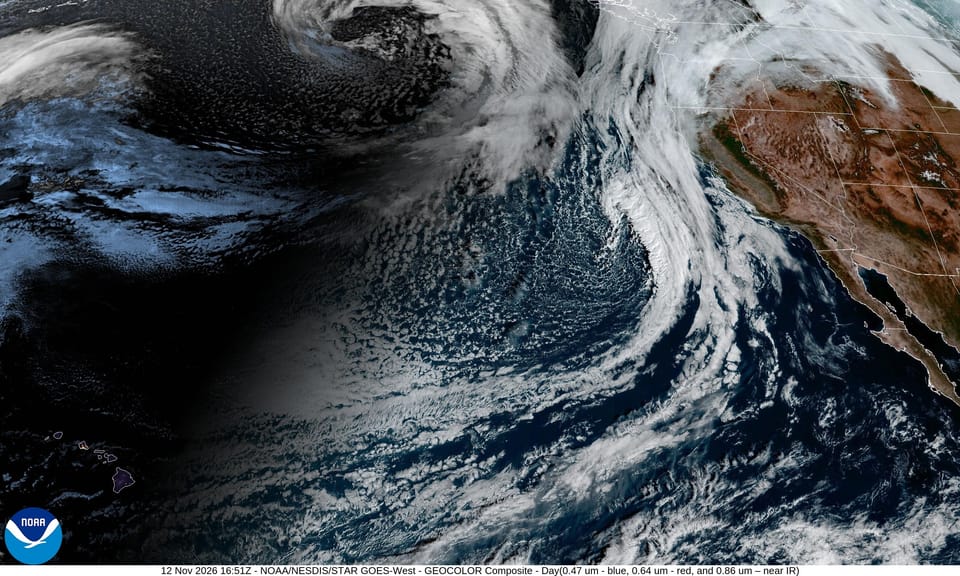 NewsNot a week of rain: three storms, starting overnightNot a week of rain. Three storms: Friday (the wettest, starting before dawn), Sunday into Monday, and about Wednesday, with mostly dry days between. Waves up to 30 feet hit the coast Saturday. Little flooding is expected this early in the season.Posted Nov 12, 2026