Saving waterGuide
When to turn off sprinklers for winter in Sonoma County
You know the sight: sprinklers running in a rainstorm. In most of Sonoma County you can turn off your sprinkler controller after the first soaking rain, usually in November, and leave it off until April or May. In Santa Rosa, from November through March, normal rain brings nearly three times the water a lawn uses. In a dry spell, check the soil and water new plants and pots by hand.
Forgetting can also raise your sewer bill for a whole year. Here is when to switch off, how to handle a dry spell, what to keep watering by hand, and when to turn it all back on.
Why can the sprinklers rest all winter?
Start with one patch of lawn. On a July day, sun, heat and wind pull water out of the grass and the soil around it. Scientists call that loss evapotranspiration. Here we just call it water loss.
In Santa Rosa, a lawn's water loss is about 6.4 inches of water in an average July. In December and January it is about 1 inch a month.[1] Short, cool, cloudy days just don't pull much water.
Meanwhile the rain shows up. From November through March, Santa Rosa averages about 25 inches of rain. A lawn uses about 8.6 inches in those months, so rain brings nearly three times what it needs.[1]
The chart shows the whole year. Blue bars: rain is more than a lawn uses. Gray bars: rain falls short, so plants need watering. November to March is all blue.
Our calculation from Santa Rosa weather station averages for 1990 to 2020, published by Sonoma Water.[1]
Local garden experts agree. The University of California (UC) Master Gardeners of Sonoma County give watering advice by month for March through October only.[2] For November, they say to turn off drip systems if you haven't already.[3] The City of Sonoma has advised the same: plants slow down for winter and need little to no water, so turn outdoor watering off until spring.[4]
When exactly do I switch it off?
After the first storm that soaks in. In most years that is November. You don't have to guess on a date.
Our take: once a storm has wet the soil a few inches down, set the controller to off and leave it there. Some controllers call this rain mode. Turn it back on only when the soil tells you to, not the calendar.
How to tell:
- Check the soil, not the sky. Dig down a few inches with a trowel. Soil can look dry on top and still be damp around the roots, especially under mulch.[3]
- Use a quarter inch of rain as a signal. After that much rain, a sprinkler system can be off for at least two days without harming most yards, the State Water Resources Control Board says.[5] The state board's page still lists pausing watering when it rains and for two days after as a helpful practice.[6] It used to be a statewide rule in the last drought, but that ended in 2023. Your city or water district may have its own rules, so check with it.[6]
- Or let a local tool tell you. The Sonoma-Marin Saving Water Partnership, a group of local water utilities, runs a free weekly watering schedule built from local weather stations. When it says "OFF," rain has fallen and plants don't need water.[7]
What if winter goes dry?
Averages hide the gaps. The winter of 2024-25 is a good example. November 2024 brought Santa Rosa 14.72 inches, about four and a half times the normal at a nearby gauge. Then January 2025 brought less than an inch.[8][9]
Look at the January bars. A wet start does not promise a wet middle.
Source: NOAA, the federal weather agency.[8][9]
Less than an inch of rain in January is still close to what a lawn loses that month, about 1 inch.[1] So one dry month is not an emergency for plants that are already settled in.
A long dry stretch is different. UC Master Gardeners say that if a few weeks go by with no rain, hand-water or turn your system back on for a while.[3] If the rains are late in December, they suggest the same thing.[3] They say to pay special attention to new plants and pots.[3]
See what El Niño could mean for Sonoma County this winter, and how much rain each town gets, month by month.
Is watering in the rain really a problem?
Beyond the waste, yes, in two ways.
- It can rot roots. Soil that stays wet for long stretches can give trees and shrubs a disease called Phytophthora root rot. Almost all fruit and nut trees and most garden trees and shrubs can get it. UC's pest experts say the most important way to prevent it is proper watering.[10] Winter rain already keeps the soil wet. Sprinklers on top of it just keep it soggy longer.
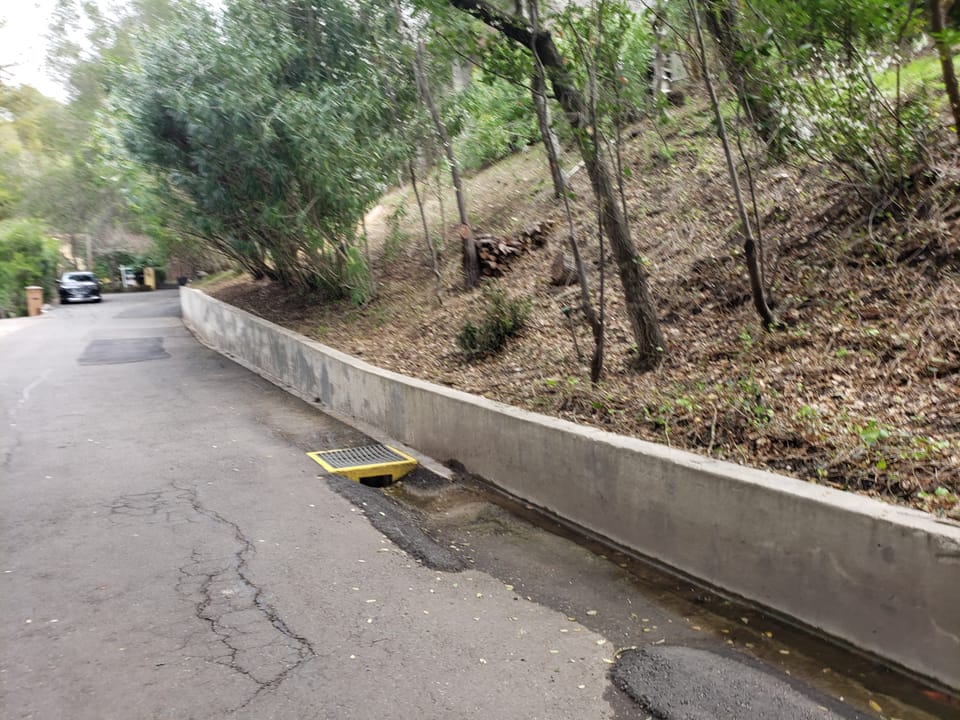
- It sends water to the creek. Water that runs off a soaked yard flows into street gutters and storm drains. Those carry it straight to the nearest creek with no treatment, picking up fertilizer, pesticides, pet waste and whatever else is on the ground.[11] Those creeks are fish and wildlife habitat, and some feed drinking water supplies.[11] More on that in only rain down the storm drain.
What does forgetting cost?
More than the water, in some Sonoma County cities. That is because of how sewer bills work.
Nobody meters what goes down your drain. So many cities and sewer districts here estimate it from the water you use in winter, when little goes on gardens. That number is your winter average. In Petaluma, it sets the sewer use charge, and the city updates it each July for the year ahead.[12] In Sonoma and much of Sonoma Valley, 30% of the sewer bill is based on household water use from December through February.[13]
Here is a worked example. Say a sprinkler clock is still on a summer lawn setting of 1 inch a week. That is the low end of the 1 to 1.5 inches a week UC lawn experts say most lawns need.[14] On 1,000 square feet of lawn, it puts down about 623 gallons a week. Left on from November through March, that is about 13,400 gallons the rain would have covered.
Petaluma bills sewer by the unit. One unit is 748 gallons. Spread over the winter months the city averages, that extra water adds about 3.6 units a month to your winter average. At $10.85 a unit, your sewer charge can go up by as much as about $39 a month for the next 12 months.[12] That is up to about $470 a year, on top of paying for the water itself. Petaluma charges your actual use instead when that is lower.[12]
Our calculation from Petaluma's rates as of July 1, 2026.
This works in your favor too. In Petaluma, using less water in winter keeps your sewer charge lower for a whole year. See how to read a Sonoma County water and sewer bill, including a 10-minute leak check.
What should I still water by hand?
A few things need you, even in winter.
- New plants. November is the recommended month to plant California natives in Sonoma County. They need good watering to grow roots, and winter rain is the best kind.[3] If it doesn't rain after you plant, water well and don't let the root ball dry out.[3]
- Pots and containers. UC Master Gardeners say to keep an eye on them in a dry fall.[3] Check them in dry weeks.
- Plants you moved or split this fall. They need water until the rain comes.[3]
Mulch helps here too. A good layer insulates roots and helps the soil hold moisture.[3] Winter is also the best time to start a low-water garden. See drought tolerant plants for Sonoma County.
Is a smart controller worth it?
If you forget, probably. A smart controller waters by the weather or by soil moisture instead of a fixed clock, so it skips rainy weeks on its own.[15] Swapping an old clock for one with the EPA's WaterSense label can save an average home up to 15,000 gallons a year.[15]
No smart controller? Many controllers have a seasonal adjust setting, shown as a percent. 100% is your July watering. Turn the percent down in cooler months.[2] The spring numbers are in the next section.
Some utilities help pay for one. See water rebates in Sonoma County.
When do I turn it back on?
Usually in April or May. UC Master Gardeners say rains generally taper off in April, and gardens may begin to need water in May.[3]
- Check the system first, in April. Look for cracks, leaks and clogs. Clean the filters, flush drip lines and replace the controller's batteries.[3]
- Wait for the soil to dry. Start when the soil around the roots dries, not on a set date.[3]
- Start low. Set the seasonal adjust to about two thirds in April and about 84% in May. In Santa Rosa, that matches what plants need compared with July.[2]
What it means for you
- This month: after the first soaking storm, set the controller to off.
- In dry spells: if a few weeks go by with no rain, dig a few inches down. If the soil is dry, water new plants and pots by hand.
- For your bill: in places like Petaluma and Sonoma Valley, water you skip in winter can lower your sewer charge.
- Our take: let winter rain do the watering, and plant this season so it can. Water that soaks into your yard instead of running down the street is good for your plants, the creeks and the fish that live in them.
Next: plan a garden that needs less water all year with drought tolerant plants for Sonoma County, or see how to keep more winter rain on your land.
Photos by Devan Hemmings unless noted.
Sources
- 1. Sonoma Water, 2020 Urban Water Management Plan (June 2021), Table 3-1: Climate, Santa Rosa CIMIS Station 83, 1990 to 2020
- 2. UC Master Gardener Program of Sonoma County, Determining How Much Water to Apply and How Often (seasonal adjustments for Santa Rosa, analysis by Sonoma Water)
- 3. UC Master Gardener Program of Sonoma County, Monthly Garden Tips
- 4. City of Sonoma, Fall is here: it's time to adjust your outdoor irrigation
- 5. State Water Resources Control Board, Statewide Water Restrictions FAQ (June 5, 2023)
- 6. State Water Resources Control Board, Water Conservation Emergency Regulations (status as of June 5, 2024)
- 7. Sonoma-Marin Saving Water Partnership, Irrigation Scheduling Tool
- 8. NOAA California-Nevada River Forecast Center, Monthly Precipitation Summary, Water Year 2025 (updated Oct 31, 2025)
- 9. NOAA NCEI, 1991 to 2020 monthly normals, Santa Rosa (USC00047965)
- 10. UC IPM, Phytophthora Root and Crown Rot (home and landscape)
- 11. Permit Sonoma, Pollution Prevention
- 12. City of Petaluma, Summary of Utility Rates (Water and Wastewater), effective July 1, 2026
- 13. Sonoma Water, Sonoma Valley County Sanitation District: how your sewer bill is calculated
- 14. UC IPM, UC Guide to Healthy Lawns: Irrigation scheduling
- 15. US EPA WaterSense, Irrigation Controllers
Checked 2026-11-01. Rules and programs change. If something here is out of date, the source above wins. Spot an error? See our corrections policy.
Related reads
 Saving waterWater rebates in Sonoma County: what they pay for, and how to get themYour water utility may pay you to pull out your lawn, about $1 a square foot in most of Sonoma County. Many also pay toward a new washer or toilet. Here is what your city offers and how to get approved before you start.Updated Oct 19, 2026
 Saving waterHow much water does a vegetable garden need? Growing food with less water in Sonoma CountyIn summer, a 4 by 8 foot bed of grown vegetables needs about 20 to 30 gallons of water a week here, and about half that in March and October. To use less, grow a smaller garden, grow greens in the cool seasons, mulch deeply and water with drip on a timer.Updated Oct 28, 2026
 Saving waterDrought tolerant plants for Sonoma County: what to plant, when, and how much water they needChoose plants that the Water Smart Plant Picker, the local water utilities' plant list, rates low or very low water. In Santa Rosa, a bed of them needs about a quarter of a lawn's summer water. Plant in fall, so winter rain gets the roots going.Updated Oct 26, 2026