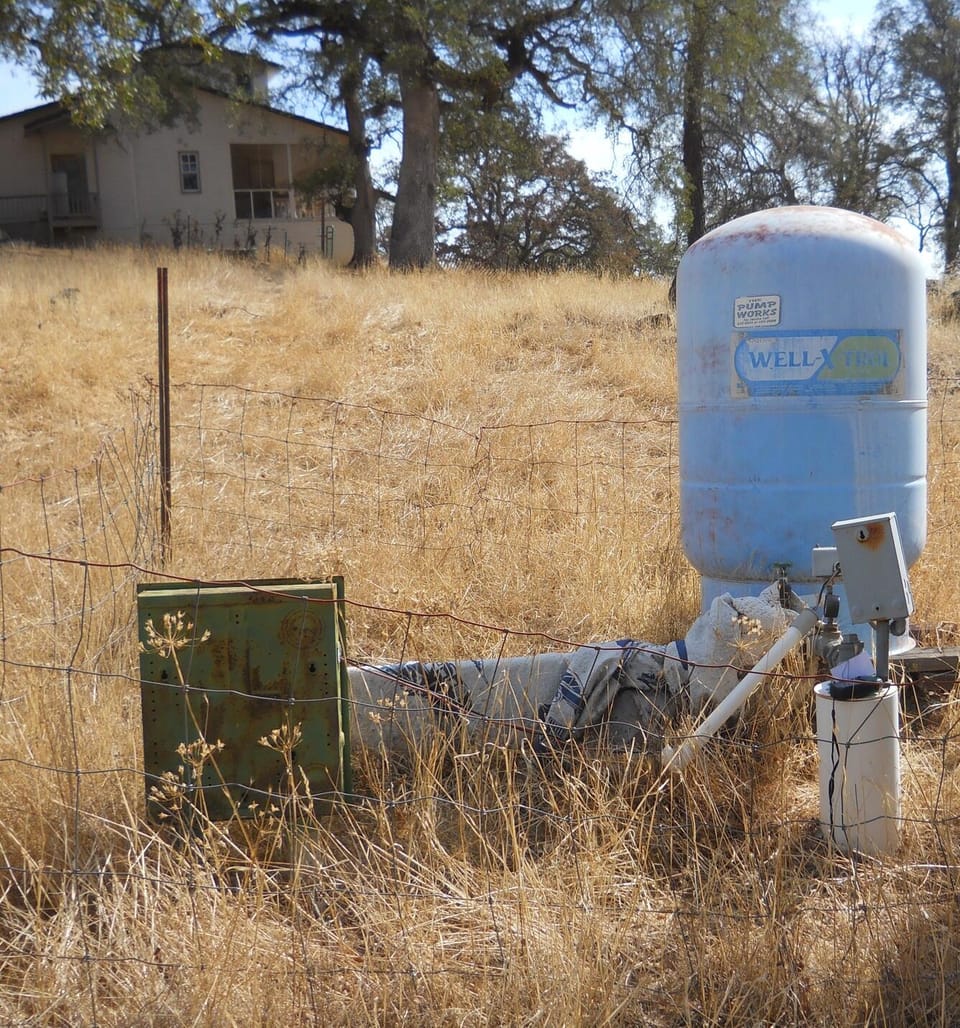
Flooded well or septic? Who to call after a Sonoma County storm
Don't drink the well water or pump the septic tank yet. Call county Environmental Health at (707) 565-6565, disinfect the well with plain bleach, then have the water tested for bacteria before you drink it. Use as little water as you can until the ground over your septic pipes dries out. The county lab's bacteria test is $39.
Listen to this article
Read aloud by an AI voice.
Floodwater can carry sewage, animal waste and chemicals.[1] If it reached the top of your well or covered your septic drainfield, here is what to do, in order.
Floodwater reached my well. What now?
- Drink bottled water for now. Don't drink the well water until it has been tested.[2][1]
- Stay away from wet wiring. A flooded well or pump can give you a shock.[3] Our take: have a licensed well contractor check the pump and wiring before you turn it on or disinfect.
- Disinfect with plain bleach. With the pump off, pour unscented household bleach into the well. Don't know its depth or pipe size? Use one gallon.[4] If you know them: a 100-foot well takes 9 ounces in a 4-inch pipe, or 2½ cups in a 6-inch pipe. The county says to adjust for depth, so use twice as much for 200 feet.[3] Then open every tap until you smell chlorine, close them, and let it stand at least 24 hours. After that, run it out through an outdoor hose, away from plants. Never down the drains: chlorine harms a septic system.[3]
- Then test for bacteria. Get a sample bottle from the lab first (below). Fill it a week or more after you disinfect.[4] If bacteria show up, disinfect again and retest.[3]
- Questions? Call county Environmental Health, (707) 565-6565, weekdays, 8 am to 4 pm.[5]
Where do I get the test done?
The county's Public Health Lab charges $39 for the basic bacteria test.[6] Through January 8, 2027, pick up its bottle at 3313 Chanate Road in Santa Rosa. Bring the sample back Monday to Thursday, 8 am to 4 pm. Results take about a day. No samples the day before a holiday. It's closed to walk-ins January 11 to 22, 2027. From January 25, 2027, it's at 2614 Paulin Drive.[7] You can also use a private certified lab; the county lists them on its well water testing page.[5] More in how to test your well water.
What about the septic system?
- Use as little water as you can. Hold off on normal use until the water in the drainfield (the buried pipes that soak wastewater into the ground) is lower than the water around the house. Until then, wastewater goes into the ground untreated.[2]
- Don't pump the tank yet. In soaked ground, an emptied tank can float up and damage its pipes. Pump it once the ground dries, to clear out silt the flood washed in.[2] See how often to pump a septic tank.
- Keep cars off the drainfield. Wet soil packs down and stops soaking water in.[2]
- See sewage? Outside city limits, call Permit Sonoma's code enforcement team (Permit Sonoma is the county's permit office). Business hours: (707) 565-1992. After hours: (707) 576-1365.[8] In a city, call your sewer utility.[1]
Is the river still rising?
Call Sonoma Water's flood hotline, (707) 526-4768. It starts giving updates once the Russian River at Hacienda Bridge, near Guerneville, passes 20 feet.[9] Our guide to Russian River flood stage shows what floods at each level.
Who handles a clogged ditch or an eroding yard?
- Clogged ditch or culvert outside city limits: the county looks after public drains, except Sonoma Water's channels.[10] You can send the county a service request with a photo on SoCo Connect, its online request site. It isn't watched around the clock.[11] If water threatens a home or a life, call 911.[10]
- Erosion: call Sonoma RCD, the Sonoma Resource Conservation District, for free advice by phone or on a site visit. It's not a regulator and doesn't report violations.[12] The county's Storm Water and Creeks team is also listed for erosion help at (707) 565-6186.[13] See how to stop erosion on a slope.
Sandbags, alerts and the 211 help line are in Home Ready Sonoma's free storm help guide.
What it means for you
- Our take: write down your well's casing size and depth now. The bleach dose depends on both.
- On a well? Test for bacteria twice a year, not just after floods.[5] Our well test planner sets the dates.
Sources
- 1. Sonoma County Environmental Health, Returning Home After a Flood (PDF, June 2024)
- 2. US EPA, Septic Systems: What to Do after the Flood (updated Aug 24, 2026)
- 3. Sonoma County Environmental Health, Well Disinfection After a Flood (PDF, June 2024)
- 4. Permit Sonoma, WLS-011 Disinfecting Wells
- 5. Sonoma County Environmental Health, Well Water Testing (lab list and test schedule)
- 6. Sonoma County Public Health Regional Laboratory, Laboratory Fee Schedule, FY 2026-2027
- 7. Sonoma County Public Health Regional Laboratory, Water Testing (drop-off hours and the January 2027 move)
- 8. Permit Sonoma, Spill Reporting and Non-Storm Water Runoff
- 9. Sonoma Water, Flood Forecast and Emergency Information
- 10. Permit Sonoma, Flood Control: how to report flooding problems
- 11. County of Sonoma, Submit a Service Request: SoCo Connect
- 12. Sonoma Resource Conservation District, FAQs (site visits and fees)
- 13. County of Sonoma, SoCo Emergency: Prepare burned properties for the rainy season (Storm Water and Creeks team contact)
Checked 2026-11-26. Rules and programs change. If something here is out of date, the source above wins. Spot an error? See our corrections policy.
Related reads
 Well water testing in Sonoma County: what to test and how oftenIf you are on a private well, nobody tests your water but you. Test for bacteria twice a year and after any flood, and for nitrate and minerals like arsenic and manganese every five years. About 1 in 3 Sonoma County domestic wells on record sits in an area the state rates high risk.Wells and groundwater · Updated Oct 18, 2026
 Well test planner: what is due on your wellTell us when you last tested. We show what is due now, using Sonoma County Environmental Health's schedule.Wells and groundwater · Updated Oct 11, 2026
 Can your yard recharge groundwater? How much soaks in, and a soil testYes, a little. Rain that soaks deep can reach the water table and refill the groundwater wells pump. Paving sends it away instead: on mostly paved ground, about a fifth as much soaks deep as on natural ground (our math from California figures). Start with the 24-hour soak test below.Wells and groundwater · Updated Oct 18, 2026