Rain and storageGuide
How to collect rainwater at home: from gutter to barrel, and what to use it for
Set a dark, lidded barrel under one downspout, screen every opening, and run an overflow hose to a planted bed. Use the water on plants you don't eat. A downspout that drains 250 square feet of roof sheds about 155 gallons in an inch of rain, almost three barrels, so plan where the extra goes. Most US states allow it, but rules differ by state and city; Colorado, for one, sets limits.
Listen to this article
Read aloud by an AI voice.
Your roof already collects rain. The gutters just send it away.
Keeping some of it takes a barrel, a screen and a plan for the extra. Here is how, from roof to garden.
Is it legal to collect rainwater?
In most of the US, yes. There is no federal rule; each state decides.[1] A 2015 federal survey found most states had no rule on it at all.[1]
Colorado is the strictest. A household there may use two barrels, 110 gallons in all, for outdoor watering.[2] A few other states cap how much you can store or ask you to register.[1]
To check yours, ask your state's environmental quality or health department.[3] Your city or county may have rules of its own.[1]
What do you need to collect rainwater?
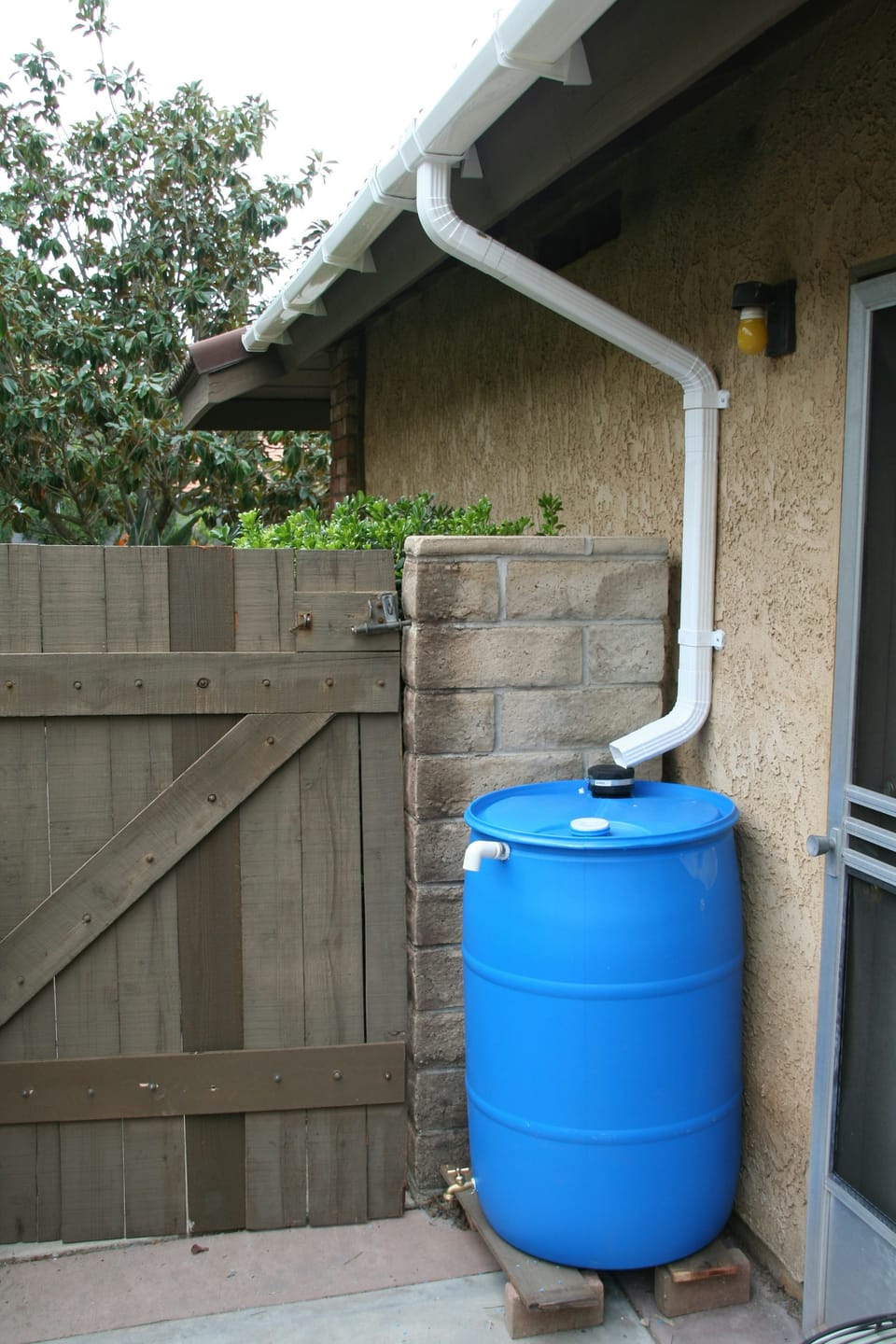
A basic setup has a handful of parts. The drawing shows how they fit together.
- Gutters and a downspout. The barrel sits under one downspout, so only part of the roof drains into it.[4]
- A barrel with a tight lid. Pick a dark or opaque one, since light through pale plastic grows algae.[5] Barrels sold for rain are made for this. If you reuse a drum, choose a food-grade one that never held oil, pesticide or harsh chemicals.[5]
- Fine screens, about 1/16 inch mesh, under the lid and over the overflow hole. They keep out leaves and mosquitoes.[6]
- A spigot near the bottom, so you can drain most of it into a watering can or hose.[5]
- An overflow outlet near the top, about as wide as the downspout, with a hose attached.[5]
Optional for garden water: a first flush diverter. It's a short pipe that catches the first, dirtiest water off the roof before it reaches the barrel.[3] Here is how a first flush diverter works.
How do you set up a rain barrel?
- Pick the downspout closest to the plants you'll water. A handy barrel gets used. One left sitting full goes stale.[4]
- Decide how high it sits. Raising it 12 to 36 inches on blocks or a sturdy stand makes room for a watering can and adds a little pressure.[4] It's still far less than a tap: a watering can or a low-pressure soaker hose works, a sprinkler won't.[5] Raising a barrel can change whether you need a permit where you live, so ask your building department before you build a stand.
- Give it a firm, level base, and strap it to the wall. A full 55-gallon barrel weighs over 450 pounds, enough to hurt someone if it tips.[5][4]
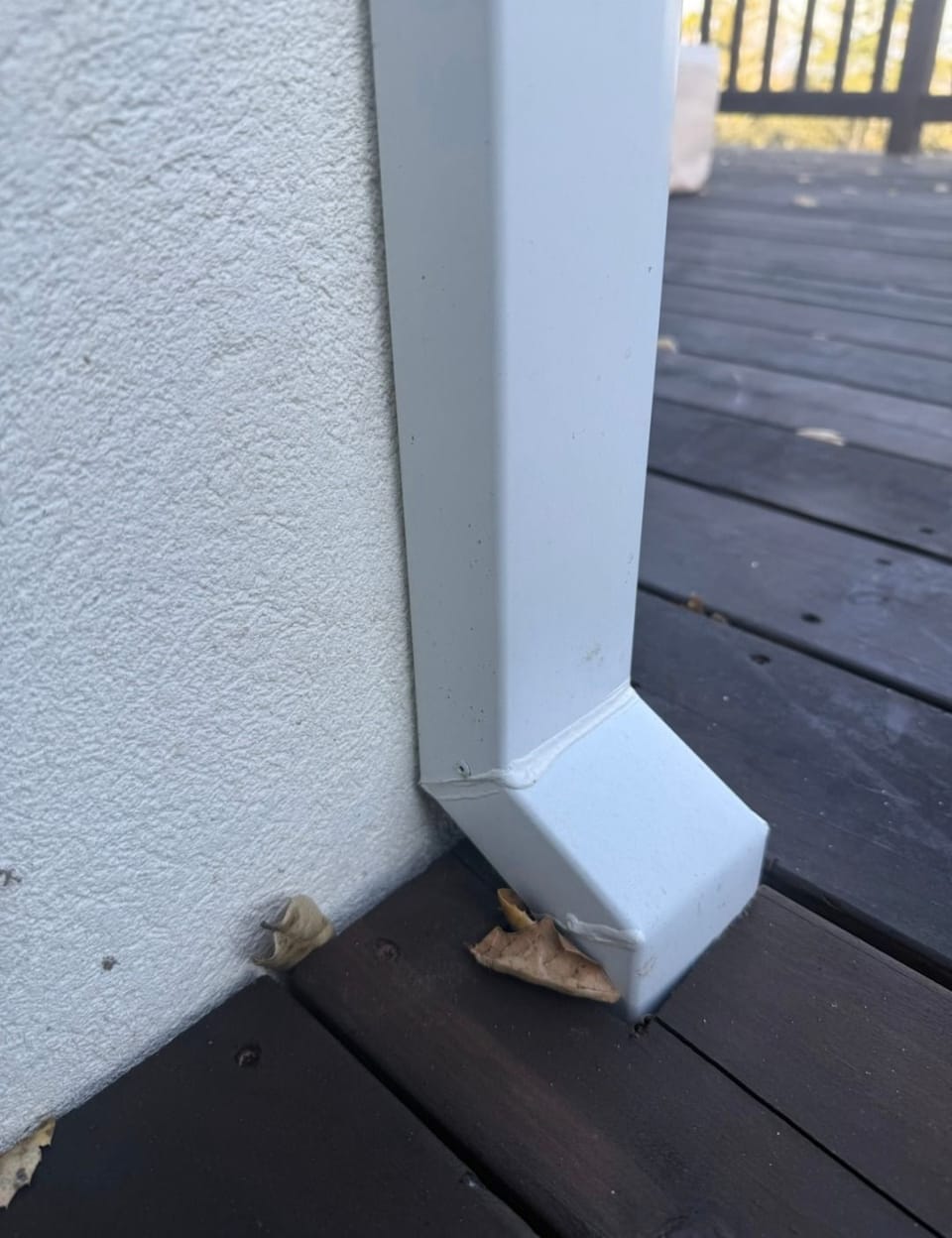
- Cut the downspout just above the barrel. Screw on an elbow or a flexible extension and aim it into the screened opening.[5]
- Run the overflow hose to a planted bed. Keep it away from your foundation, a septic system, the neighbor's yard and the driveway.[5]
Why the garden and not the driveway? Water on pavement carries dirt, fertilizer and oil to storm drains, which usually empty into creeks untreated.[5] Water in a bed soaks in and stays on your land. Our take: the soil is the biggest tank you own. See slow it, spread it, sink it.
How much rainwater can you collect?
More than a barrel holds. Measure the roof area that drains to your downspout, from the ground, then multiply: square feet, times inches of rain, times 0.623. That gives gallons, since an inch of rain on one square foot is 0.623 gallon.[5][4]
Here is what one inch of rain does to the barrel count.
| Roof that drains to your downspout | Water in a 1 inch rain | 55-gallon barrels it fills |
|---|---|---|
| 100 sq ft | about 60 gallons | 1 |
| 250 sq ft | about 155 gallons | almost 3 |
| 500 sq ft | about 310 gallons | almost 6 |
| 1,000 sq ft | about 625 gallons | 11 |
The simplest way to use the extra is to let the overflow soak into a bed. To store more, link a second barrel to the first, or step up to a tank; the last barrel in a chain still needs its own overflow.[5] To see what your roof catches in a year, try the rain catch calculator.
What if you don't have gutters?
Watch your roof in a moderate rain. Find where the water pours off in a stream, often at a corner or a dip in the eave, and set the barrel there. A rain chain, a hanging chain of cups or links, can guide the water down into it.[4]
What can you use rainwater for?
Plants, mostly. The CDC, the federal health agency, suggests rainwater for plants you don't eat and for washing things you don't cook or eat with.[3]
For drinking, cooking, brushing teeth, rinsing produce and watering plants you'll eat, it suggests tap or bottled water instead.[3] Roof water can carry germs from bird droppings, and chemicals from asphalt shingles, treated wood and galvanized metal.[3][5]
Never connect a barrel to your home's water pipes, and don't drink from it.[3] Thinking about drinking rainwater? Ask your local health department first.[3] More in can you drink rainwater?
How do you keep it clean and free of mosquitoes?
- Keep every opening screened and the lid sealed.[6] If a screen tears, use or empty the barrel within a week until you fix it. Mosquitoes can go from egg to adult in 5 to 10 days.[6][5]
- Look for wigglers. Scoop some water into a white cup. Mosquito larvae wriggle up to the surface to breathe.[7] If you find them, add a mosquito dunk made for rain barrels. It contains Bti, a natural soil bacterium that kills the larvae.[7]
- Clean as you go. Clear the inlet screen after storms, the gutters at least once a year and the inside of the barrel once a year.[5]
What do you do with it in winter?
That depends on your winter. Where hard freezes last for days, drain the barrel, disconnect it, store it indoors or upside down, and put the downspout back.[5] Where winter is the rainy season, keep it catching. Here is what to do with a rain barrel in winter.
In Sonoma County
- It's legal. A 2012 California law says you need no water right to use rain from your roof.[8]
- A simple barrel needs no permit. The state plumbing code doesn't require one for outdoor watering that doesn't spray, such as drip or an open hose, up to 5,000 gallons, if the tank sits directly on the ground, is no taller than twice its width, and has no power or tap water hookup.[9] Ask your building department before you raise one on a stand. Details in are rain barrels legal in California?
- Most of the rain falls from November to March. Santa Rosa averages about half an inch from June through September.[10] Our take: in the stormy months, use or drain the barrel between storms so it has room. Near the end of the rainy season, let it fill and save it for spring.[5][11]
- Mosquito help. The Marin/Sonoma Mosquito and Vector Control District can help with mosquitoes at no added cost: (707) 285-2200.[6]
- Rebates. The countywide rainwater rebate closed in August 2024.[12] Check water rebates and programs for what is open now.
What it means for you
- Pick one downspout near your garden and measure the roof that drains to it.
- Get a dark barrel with a sealed, screened lid, and set it level.
- Before the next storm, decide where the overflow goes.
Photos by Devan Hemmings unless noted.
Sources
- 1. Loper, Rainwater Harvesting State Regulations and Technical Resources, PNNL-24347, Pacific Northwest National Laboratory for the US Department of Energy (June 2015)
- 2. Colorado General Assembly, HB16-1005, Residential Precipitation Collection (signed May 12, 2016)
- 3. US Centers for Disease Control and Prevention, Collecting Rainwater and Your Health: An Overview (reviewed Nov 10, 2026)
- 4. Morganello, Designing for Rain Barrel Success, Clemson Cooperative Extension HGIC 1900 (Feb 2023)
- 5. Feehan and others, Stormwater Management: Rainwater Harvesting with Rain Barrels, University of Nebraska-Lincoln Extension G2220 (2014)
- 6. Marin/Sonoma Mosquito and Vector Control District, Reduce, Reuse and Recycle Water Responsibly (rain harvesting brochure, 2021)
- 7. Rutgers Cooperative Extension, Rain Barrels and Mosquitoes, Fact Sheet FS1240 (Nov 2014)
- 8. AB 1750, Rainwater Capture Act of 2012, enrolled text (Water Code section 10574)
- 9. 2025 California Plumbing Code, section 1601.3, Permit, and its exceptions (text as posted by GoCodebook)
- 10. NOAA National Centers for Environmental Information, 1991 to 2020 monthly normals, Santa Rosa (USC00047965)
- 11. UC Master Gardeners of Alameda County, Managing Bay Area Rainwater in a Changing Climate (Aug 28, 2026)
- 12. City of Healdsburg, Water Rebates (countywide rainwater rebate closed August 31, 2024)
Checked 2026-11-21. Rules and programs change. If something here is out of date, the source above wins. Spot an error? See our corrections policy.
Related reads
 Rain catch calculator for your roofA 1,000 square foot roof catches about 15,700 gallons in an average Santa Rosa year. Enter your ZIP and roof size to see yours.Rain and storage · Updated Oct 18, 2026
 Are rain barrels legal in California? Yes. Here is when you need a permitYes. State law says you do not need a water right to use rainwater from your roof. Under the state plumbing code, a barrel or tank up to 5,000 gallons for drip or hose watering needs no permit if it sits on the ground, is no taller than twice its width, has no pump and is not hooked to tap water.Rain and storage · Updated Nov 4, 2026
 How much rain Sonoma County gets, town by town and month by monthSanta Rosa gets about 30 to 34 inches in an average year, depending on the gauge and the years counted. Petaluma gets about 26 and Healdsburg about 43. Most of it falls from November to March.Rain and storage · Updated Oct 18, 2026